Chapter 6 - Temporary CustodyThe first week of temporary custody taught Peter that survival was not the same as healing.
Survival was getting Drew and Lily out of the basement.
Healing was convincing Lily that spilled milk did not require terror.
Survival was a cast around Drew’s leg.
Healing was explaining, five times in one afternoon, that needing the bathroom was not misbehaving.
Survival was police reports and court orders.
Healing was leaving a bowl of apples on the counter until the children stopped staring at it like it might disappear.
Peter had expected the big moments to be hardest.
The nightmares. The doctor appointments. The legal calls.
But it was the small moments that undid him.
Lily whispering “sorry” after sneezing.
Drew asking whether laughter was allowed after dinner.
Lily saving half a sandwich in her pajama drawer “in case tomorrow is no food.”
Drew waking from sleep and silently checking the locks on every upstairs door, not to keep danger out, but to understand where it might come from.
Peter learned quickly that love was not enough.
Love made him furious.
Patience made him useful.
So he took every call from every specialist. He met with a trauma therapist named Dr. Helen Morris, who explained that children from unpredictable homes often tried to control small things because large things had controlled them.
“Drew became Lily’s parent,” Dr. Morris said during their first consultation. “You cannot simply take that role away. It will feel like danger to him.”
“He’s six,” Peter said.
“Yes. And part of him is much older. That part helped Lily survive. We respect it while helping him become a child again.”
“How?”
“Slowly.”
Peter hated that word.
Slowly had allowed Reena three years.
But Dr. Morris seemed to read his face.
“Slowly does not mean passively,” she said. “It means consistently.”
So Peter became consistent.
Breakfast at seven-thirty.
Medication after breakfast and dinner.
Cartoons before therapy days.
Stories at night.
The porch light always on.
The bedroom door always open unless they chose otherwise.
No surprises if he could help it.
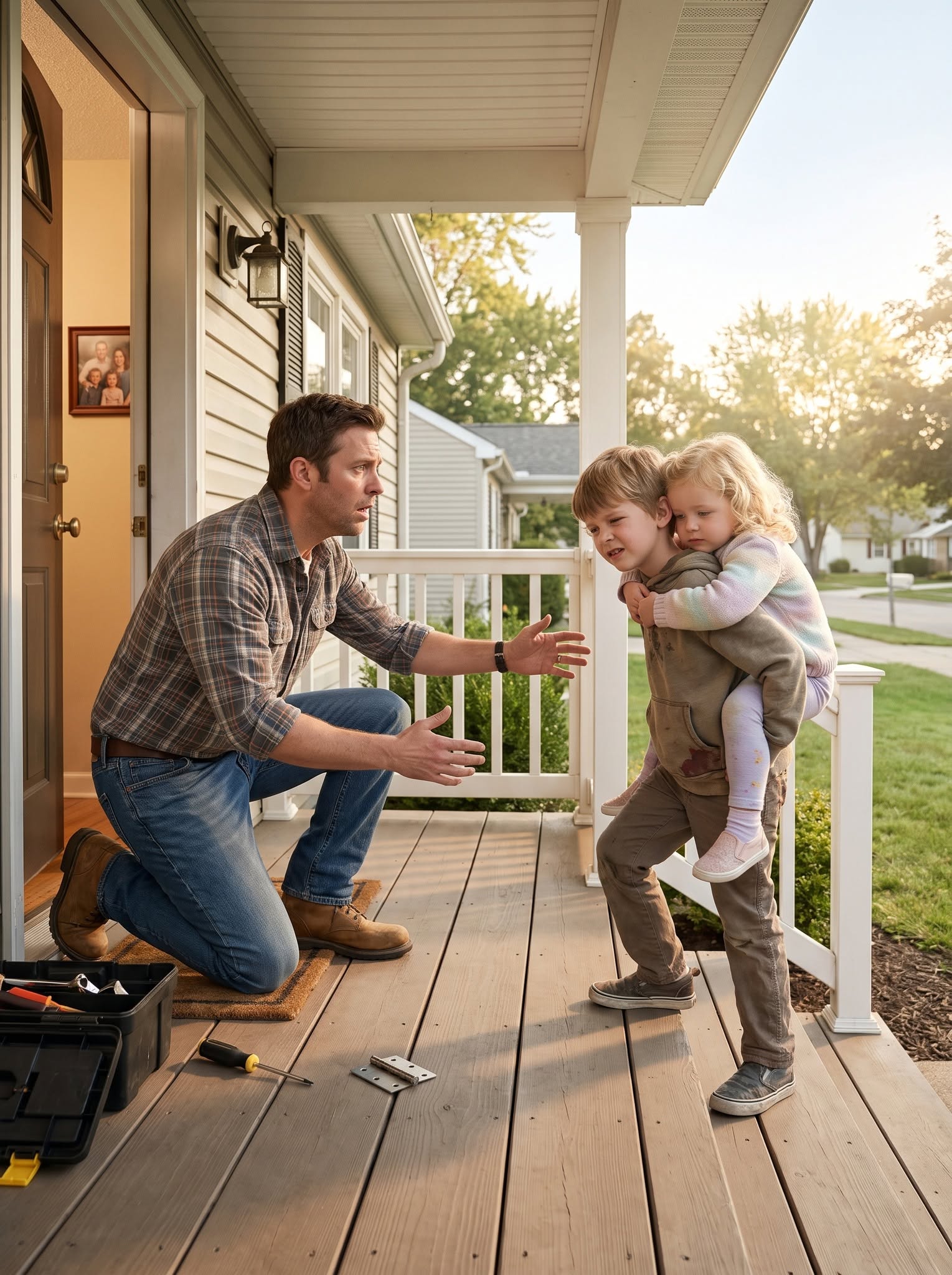
On Friday, his boss, Jim Walters, showed up with groceries, two casseroles, and a toolbox.
Peter met him on the porch.
“I told you I wasn’t coming in,” Jim said. “I know they don’t need strangers crowding them. I just brought food and that hinge finally annoyed me enough from across town.”
Peter looked at the toolbox.
“You drove fifteen minutes because my hinge annoyed you?”
“Your brother would haunt me if I let his kids live behind a squeaky door.”
Peter looked away.
Jim’s voice softened. “How are they?”
“Alive.”
“That bad?”
“That good.”
Jim nodded.
He fixed the hinge in six minutes.
Peter watched the door swing silently.
Something about it hurt.
For three years, the door had screamed every time it opened.
The day Drew came, it had screamed too.
Now it opened quietly.
Jim packed his tools.
“You need more time off?”
“Yes.”
“You got it.”
“I can’t afford—”
“You can. Shop has paid family leave bank. Guys voted yesterday.”
Peter stared at him.
“You told them?”
“I told them enough. They didn’t ask for details.”
Peter swallowed.
“Jim—”
“Don’t thank me. Come back when you can. Bring those kids by someday when they’re ready. I’ll teach them how to sand wood properly. Most adults don’t know.”
Peter laughed softly.
Inside, Drew watched from behind the curtain.
Jim saw him but did not wave too big.
Just lifted two fingers.
Drew disappeared.
“That’s progress,” Peter said.
“Looked like surveillance.”
“It is.”
“Smart kid.”
“The smartest.”
That afternoon, Mara arrived with more news.
Reena had been released on bond.
Peter’s hands went cold around his coffee mug.
“No.”
“She is under strict orders. No contact with the children. No contact with you. She cannot come within five hundred feet of your home, the hospital, their therapy center, or future school placement.”
Peter stared at the window.
“Orders are paper.”
“Yes,” Mara said. “But violating them sends her back to jail.”
“If she gets close enough to violate them, she gets close enough to scare them.”
Mara’s face softened. “I know.”
Peter looked toward the living room. Lily was building a tower from blocks. Drew sat nearby with his leg propped up, pretending not to supervise every block placement.
“Do I tell them?”
“Yes. In a careful way.”
“Why? Why not let them have one peaceful day?”
“Because if they see her or hear adults mention it, and you didn’t tell them, it may feel like another secret.”
Secrets.
Peter hated that word now too.
That evening, after dinner, he sat on the living room floor with both children.
“I need to tell you something,” he said.
Drew immediately went still.
Lily looked at Drew and copied him.
Peter kept his voice gentle.
“Reena is not in jail tonight.”
Drew’s face went white.
“She’s coming.”
“No. She is not allowed to come here. The judge said she cannot contact you.”
Drew’s breathing changed.
“Allowed doesn’t stop her.”
Peter nodded.
“You’re right. A rule by itself does not stop everyone. So there are more things. The police know. Mara knows. I know. The doors lock. Mrs. Finch next door knows to call me if she sees anything strange. And if Reena breaks the judge’s rule, she goes back to jail.”
Lily whispered, “Downstairs?”
Peter’s chest tightened.
“No. Jail. A place for grown-ups who break serious rules.”
Drew stared at the floor.
“What if she says sorry?”
Peter chose his words carefully.
“Sorry does not erase unsafe.”
Drew looked up.
That sentence seemed to land somewhere deep.
“Can grown-ups say sorry and still not come back?”
“Yes.”
Lily hugged her bear.
“Good.”
That night, Drew had his worst nightmare yet.
Peter woke to a thump and found him on the floor beside his bed, tangled in blankets, gasping.
“I dropped her,” Drew cried. “I dropped Lily.”
Lily woke and started crying too.
Peter sat on the floor, not touching him until Drew grabbed his shirt.
“She was behind me,” Drew sobbed. “I couldn’t go fast.”
“You got her out,” Peter said. “Drew, look at me. You got her out.”
“But I was slow.”
“You were hurt.”
“I should’ve gone sooner.”
Peter closed his eyes briefly.
A six-year-old carrying the guilt of rescue timing.
“No,” Peter said firmly. “The person who should have stopped it was Reena. Not you.”
Drew cried harder.
Peter held him until his breathing slowed.
Then Lily climbed awkwardly into Peter’s lap too, still half-asleep, bear crushed between them.
For nearly an hour, they sat on the floor in the dim moon night-light.
Nobody said much.
Nobody needed to.
The next morning, Peter found Drew at the kitchen table drawing again.
This time, he had drawn three people on a porch.
A tall man.
A boy with a cast.
A little girl holding a bear.
In the corner of the page, he had drawn a basement door.
But this time, the door was open.
Peter sat beside him.
“Can I ask about the picture?”
Drew did not look up.
“That’s the old house.”
“And this?”
“Your house.”
Peter pointed gently to the open basement door.
“Why is it open?”
Drew shrugged.
“So people can see.”
Peter nodded.
“That’s important.”
Drew pressed the crayon harder.
“She said Dad couldn’t see us anymore.”
Peter’s voice softened. “Your dad isn’t here the way we want him to be.”
Drew’s chin trembled.
“But if he could have seen, he would have come.”
Drew looked at him.
Peter held his gaze.
“He would have broken every door in that house.”
Drew’s eyes filled.
Then he whispered, “Like you?”
Peter shook his head.
“No, buddy. Like you.”
Drew stared at the picture for a long moment.
Then he drew one more thing.
A light over the porch.
Yellow.
May you like



Bright.
On.
Related Stories







