Chapter 12 - THE LIFE THEY COULDN'T TAKESeven years after I caught Kristina Bellamy hiding a rattlesnake in my bed, I stood on a stage in Atlanta and watched my daughter wave at me from the front row.
Claire was three.
She had Daniel's smile and my complete inability to sit still during long speeches.
Beside her sat Emily, Charles, and several Northstar employees who had been with me since the company occupied two rented rooms above a dentist's office.
Behind me was a screen displaying one sentence:
NORTHSTAR SHIELD — ACQUIRED FOR $1.2 BILLION
The number didn't feel real.
People assumed money would be the satisfying ending to my story.
It wasn't.
I already had money when Kristina tried to kill me.
Money was the reason she believed my life could be converted into an opportunity.
The billion-dollar acquisition mattered because it gave me something I had wanted long before I ever met Ryan.
Freedom to choose what came next.
I retained a board seat.
My employees received substantial payouts.
The employee equity pool I had insisted on years earlier turned dozens of ordinary engineers, administrators, and support staff into homeowners, debt-free parents, and first-generation millionaires.
That mattered to me more than the headline.
After the announcement, I stepped down from the microphone.
Claire escaped Daniel and ran onto the stage.
“Mommy!”
The audience laughed.
I crouched.
She crashed into me.
“You talked too long.”
More laughter.
“I know.”
“Can we have cake?”
“We can have cake.”
She grabbed my hand.
That photograph—not the courthouse photographs, not the rattlesnake headlines—became the one that followed me everywhere afterward.
Me in a navy dress, kneeling beside my daughter, laughing.
For once, I didn't mind.
Ryan was released from prison the following year.
He served a little over five years after credit for cooperation and good behavior.
He moved to Charlotte.
Close to Noah.
He contacted me once before his release through his attorney.
Would you be comfortable if I wrote to you after I leave?
I answered:
Only if there's something important to say.
Six months passed.
Then a letter arrived.
Ryan had taken a job with a nonprofit that helped families rebuild after financial fraud.
He earned less in a year than he once spent on vacations.
He wrote:
For the first time, I think I understand what work is supposed to feel like when you're not trying to impress anyone.
I smiled.
Then reached the final paragraph.
Noah asked me why I went away. He's old enough to know prison isn't a business trip. I told him I broke the law and hurt people because I was afraid to tell the truth. I didn't blame Mom. I didn't blame you. I thought you should know.
That was important.
I wrote back.
That was the right thing to tell him.
A month later, Ryan asked if I would be willing to meet.
I wasn't sure.
Daniel said, “Do you want to?”
“I don't know.”
“Then don't go until you do.”
Simple.
Three months later, I did.
We met in a public park in Charlotte.
Ryan looked older.
Less polished.
He wore jeans and a blue button-down.
No expensive watch.
No Bellamy-family armor.
“Thank you for coming.”
“I almost didn't.”
“I assumed.”
We walked.
For several minutes, we talked about ordinary things.
His work.
My company sale.
Emily.
Charles.
Then Ryan said, “I saw your acquisition announcement.”
“Everyone did.”
“You built exactly what you said you would.”
“Not exactly.”
He smiled.
“No. Better.”
I glanced at him.
“That almost sounded sincere.”
“It was.”
We reached a bench.
Ryan sat.
“I owe you something.”
“If it's another apology, I have enough.”
He laughed quietly.
“Fair.”
He looked toward children playing nearby.
“I wanted to tell you that you don't have to keep my letters.”
“What?”
“I know I sent a lot from prison.”
“Yes.”
“I think some part of me was asking you to witness my regret.”
“That sounds accurate.”
“It wasn't fair.”
I studied him.
“You're right.”
He nodded.
“I don't need you to carry it.”
I understood immediately.
For years, everyone had expected me to decide whether Ryan deserved forgiveness.
But that question centered him.
My job wasn't to manage his redemption.
It was to manage my own life.
“I threw some of them away,” I said.
“Good.”
“Kept a few.”
“Why?”
“They remind me people are complicated.”
Ryan smiled sadly.
“That is an extremely generous summary of my behavior.”
“It isn't generosity. It's accuracy.”
A little boy ran toward us.
Dark curls.
Brown eyes.
Noah.
Sabrina followed.
She stopped when she saw me.
“Hi.”
“Hi.”
Noah looked at me curiously.
Ryan stood.
“Noah, this is Amanda.”
I wondered what Ryan had told him.
Apparently enough.
Noah said, “Dad says you make computer stuff.”
I smiled.
“I used to.”
“He says you're really smart.”
Ryan looked embarrassed.
Noah continued.
“Mom says Dad used to be stupid.”
Sabrina covered her face.
“Oh my God.”
I laughed.
Ryan groaned.
“Buddy.”
“What?”
Sabrina mouthed sorry.
“It might be the most accurate family history he's heard,” I said.
The tension dissolved.
Noah ran back toward the playground.
I watched him.
For years, he had represented something painful.
Ryan's betrayal.
The child I had wanted with him.
Now he was simply a little boy.
Innocent.
Loved.
That felt like healing.
Before I left, Ryan said, “Amanda.”
I turned.
“I hope you're happy.”
I looked across the park.
Daniel had arrived to pick me up.
Claire sat on his shoulders, waving wildly.
I smiled.
“I am.”
Ryan followed my gaze.
His expression softened.
“Good.”
And that was our final meaningful conversation.
Not because either of us died.
Not because someone stormed away.
Because nothing else needed saying.
Years passed.
Charles eventually retired.
He spent more time fishing than working.
The restitution fund created through Northstar's partnership repaid nearly ninety percent of verified losses tied to Kristina's scheme.
Sabrina became CEO of the restructured company.
She was good at it.
Disciplined.
Transparent.
Almost obsessively ethical.
People sometimes joked about that.
I understood why she wasn't laughing.
Emily's sons grew up.
Connor became an engineer.
His younger brother, Luke, became a teacher like my father.
Daniel and I had another child when Claire was five.
A boy.
We named him Samuel.
After Dad.
On Samuel's first birthday, our house was full.
Children running.
Music.
Cake icing on furniture.
Emily yelling because someone spilled juice.
Daniel standing at the grill insisting he knew what he was doing.
It was chaos.
Ordinary, wonderful chaos.
At some point, Claire came running toward me carrying a plastic snake from a bag of toy animals.
“Mommy! Look!”
My body reacted before I could stop it.
A sharp inhale.
Half a heartbeat of fear.
Claire noticed.
“What?”
I looked at the green rubber snake in her hand.
Then at her concerned little face.
Years earlier, I might have asked her to put it away.
Instead, I took it.
“Nothing.”
“Are you scared of snakes?”
I smiled.
“A little.”
“Why?”
I thought about what to tell a six-year-old.
“Something scary happened with one a long time ago.”
“Did it bite you?”
“No.”
“So you beat it?”
Children simplify everything.
I smiled.
“Something like that.”
Claire took the toy back.
“I'll protect you.”
My throat tightened.
“Thank you.”
She ran away.
Daniel appeared beside me.
“You okay?”
I watched Claire chase her cousins through the yard.
“Yes.”
And I was.
That evening, after everyone left, I found the plastic snake beneath the dining table.
I picked it up.
For seven years, a rattlesnake had represented the moment my old life ended.
The marriage.
The trust.
The house.
The belief that people who loved you could never intentionally destroy you.
But looking at that ridiculous green toy, I realized the snake no longer owned the memory.
My daughter did.
I placed it inside her toy basket.
Then went upstairs.
Daniel was reading to Samuel.
Claire was already asleep.
I stood in the hallway watching them.
There was no chandelier.
No mansion.
No Bellamy portrait.
No secret phone.
No mother-in-law calculating the value of my death.
Just home.
Later, Daniel and I sat on the porch.
The night was warm.
He handed me tea.
“You ever think about how weird your life is?”
“Frequently.”
“Billion-dollar company. Murder plot. Federal trial.”
“You forgot your terrible architecture.”
“My architecture saved you.”
“My architecture would have been better.”
“Seven years and you're still wrong.”
I smiled.
He took my hand.
“What are you going to do now?”
That question had followed me since the acquisition.
I didn't need to run Northstar anymore.
I didn't need another company.
I had enough money for several lifetimes.
“I've been thinking about Dad.”
“The foundation?”
I nodded.
My father's foundation had primarily funded scholarships.
I wanted to expand it.
Legal assistance for people escaping financially abusive relationships.
Emergency relocation funds.
Security consultations.
Support for spouses discovering hidden financial crimes.
Daniel looked at me.
“You've already decided.”
“Probably.”
“You get that look.”
“What look?”
“The one that means somebody is about to receive a terrifyingly detailed spreadsheet.”
I laughed.
Within a year, the Pierce Foundation opened its first family financial-safety center.
By the third year, there were six.
We helped thousands of people.
Not all were facing dramatic murder conspiracies.
Most weren't.
Many simply needed access to money their spouses controlled.
Legal advice.
A secure place to stay.
Someone to believe their documentation.
Our motto came from my father:
Losing something doesn't mean losing yourself.
I never told the public where the sentence came from.
It belonged to us.
On the tenth anniversary of the rattlesnake incident, a journalist contacted me.
She wanted to write a retrospective.
I declined.
She asked one final question by email:
What do you think about when you remember that day?
I nearly deleted it.
Then I typed:
I think about how close I came to dying.
I stopped.
That wasn't the full truth.
I deleted the sentence.
I wrote again.
I think about everything that happened because I lived.
That was better.
I sent it.
Then I closed my laptop.
Outside, Claire and Samuel were arguing over a soccer ball.
Daniel was pretending not to take sides.
I walked toward them.
“Mom!” Samuel yelled. “Claire cheated!”
“I did not!”
“You moved the goal!”
“It was crooked!”
Daniel looked at me desperately.
“I need a neutral judge.”
“You married the wrong woman.”
Claire laughed.
Samuel demanded justice.
The evening sun fell across the yard.
I stood there surrounded by noise, love, irritation, unfinished homework, dirty dishes, and a dog we had somehow acquired despite Daniel insisting for years that he didn't want one.
This was what nobody tells you about revenge stories.
The best ending isn't watching the people who hurt you suffer.
Kristina lost everything.
Ryan went to prison.
Their crimes became public.
Justice mattered.
But none of that was the happiest part.
The happiest part was reaching a day when their names barely entered my mind.
A day when my children's laughter was louder than the memory of that rattle.
A day when I could walk into my bedroom without fear.
A day when twenty-five million dollars was simply a number on an old insurance document instead of the price someone had once placed on my life.
That night, after the children were asleep, I opened the safe in my study.
Inside were a handful of objects I had kept.
Dad's photograph.
The first Northstar incorporation document.
Claire and Samuel's hospital bracelets.
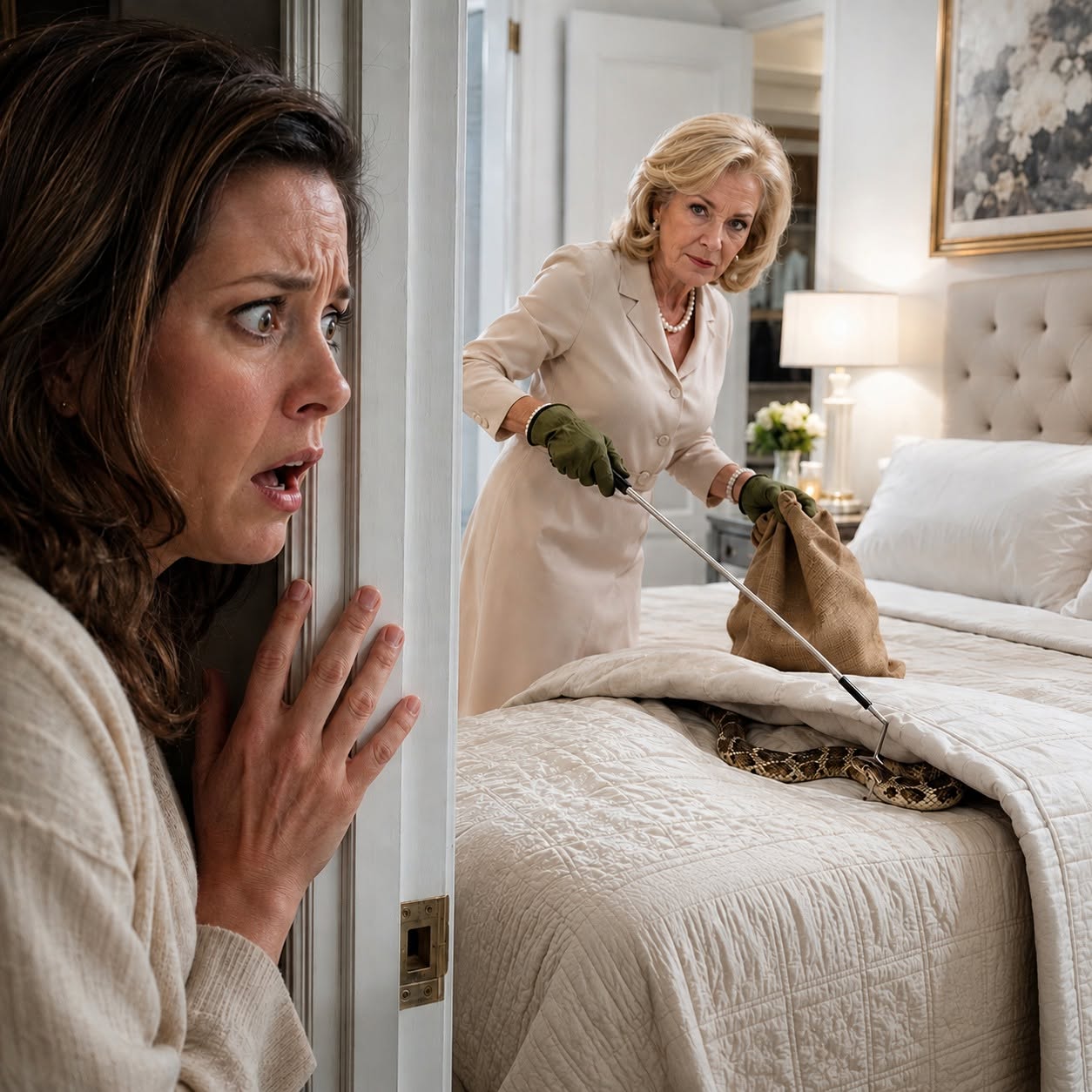
And one old evidence photograph from the police investigation.
My former bedroom.
Cream comforter.
One corner lifted.
A rattlesnake coiled beneath it.
I had kept the picture because for years I thought forgetting would make me vulnerable.
Now I understood something different.
Remembering did not require keeping every wound.
I removed the photograph.
Daniel found me by the fireplace.
“What are you doing?”
“Getting rid of something.”
He glanced at the photograph.
He knew immediately.
“You sure?”
“Yes.”
I fed one corner into the flame.
The paper curled.
The bed disappeared first.
Then the snake.
Then the image turned black.
Daniel stood beside me without speaking.
When the last piece became ash, I felt lighter.
Not transformed.
Not suddenly healed.
Just finished.
I looked at him.
“You know what's funny?”
“What?”
“I used to think surviving was the ending.”
“And now?”
I smiled.
“It was Chapter One.”
He kissed my forehead.
We turned off the lights.
Before going upstairs, I glanced once toward the fireplace.
Nothing remained except ash.
Ten years earlier, I had hidden behind a doorway while a woman placed death beneath my blanket.
I had been frightened.
Confused.
Completely unaware of how much betrayal waited behind that moment.
I lost a husband.
A family I thought I belonged to.
A home.
Years of trust.
But I did not lose myself.
I built again.
Loved again.
Became a mother.
Created work that mattered.
Learned that forgiveness could be optional while peace was not.
And eventually I stopped thinking of Kristina Bellamy as the woman who almost ended my life.
She became something smaller.
A chapter.
A terrible one.
But only a chapter.
Upstairs, Claire called:
“Mommy! Samuel stole my pillow!”
“I did not!”
Daniel sighed.
“Your children.”
“Our children.”
“Convenient.”
I laughed and started up the stairs.
The house was loud.
Messy.
Alive.
And as I reached the landing, it occurred to me that this was the one thing Kristina had never understood.
She believed wealth was power.
She believed fear was power.
She believed controlling people was power.
She believed survival belonged to whoever was ruthless enough to take what they needed.
But real power looked nothing like that.
It looked like walking away when revenge would keep you trapped.
It looked like telling the truth even when the truth destroyed the life you knew.
It looked like building something after someone tried to reduce your future to an insurance payout.
It looked like children arguing upstairs.
A husband waiting beside you.
A life nobody could purchase, inherit, steal, or collect after your death.
I once had a twenty-five-million-dollar insurance policy.
Kristina thought that was what my life was worth.
She was wrong.
My life had never been worth twenty-five million dollars.
It had never been worth one billion.
It wasn't worth any number.
Because some things aren't assets.
They don't have prices.
And by the time I finally understood that, I had something far better than revenge.
I had peace.
I had love.
I had my family.
May you like
And most importantly—
I was still here.