Chapter 13 - Sunday PancakesSix months later, Rosie’s Diner reopened with a line around the block.
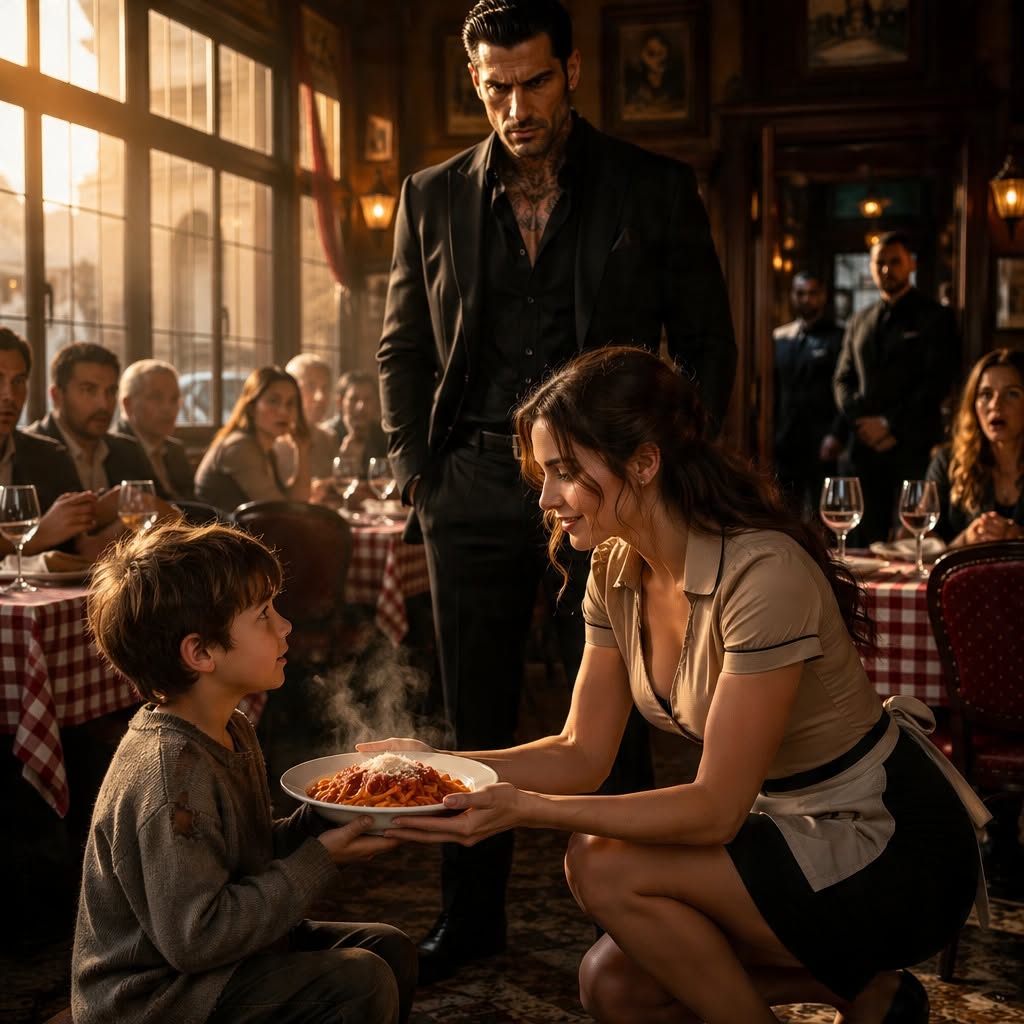
The new windows gleamed.
The booths were still red.
The floor still creaked near the coffee station because Rosie insisted some things had character and contractors needed to stop insulting history.
The neon sign had been repaired, but not replaced.
ROSIE’S DINER glowed pink and blue over Maple and 8th like a stubborn little sunrise.
People came because of the news at first.
They wanted to see the diner from the story.
They wanted to whisper about the waitress and the billionaire and the boy with the watch.
Rosie charged them full price and told anyone too nosy that gossip cost extra.
But after a few weeks, the crowd changed.
Regulars came back.
Truck drivers. Nurses. Office workers. Single moms. Old men who argued about baseball. Teenagers sharing fries. People who needed coffee, warmth, and a place where nobody looked surprised if you were tired.
That was the magic of Rosie’s.
Gabriel had kept his promises.
Repairs paid.
Payroll covered.
No marble.
He also created the Margot Vale Children’s Trust, not with a dramatic press conference but with actual work: emergency shelters, independent child advocates, legal support for kids caught between powerful adults, grants for diners and small businesses that fed children without asking questions first.
Rosie joined the board and terrified everyone into efficiency.
Nessa started community college.
Marco became Mikey’s official security director and unofficial pancake critic.
Helena’s trial was still pending, but her world had shrunk to lawyers, evidence, and the slow humiliation of truth.
Brennan took a deal.
Redding did not.
No one cared what he wanted anymore.
As for Gabriel, he changed slower than headlines did.
But he changed.
He came to Rosie’s every Sunday morning with Mikey.
At first, he arrived with two SUVs and too many men.
Rosie told him he was scaring the muffins.
Now he came with Marco and one car parked down the street.
Progress.
Mikey always ordered chocolate chip pancakes, bacon, and strawberries.
Gabriel ordered black coffee and whatever Mikey told him he was allowed to try.
I still worked the counter.
Not because I had to.
Gabriel had offered help in a dozen careful ways.
A better apartment.
School money.
A position at the foundation.
I accepted exactly one thing: enough money to replace what I lost in the fire and cover the medical bill from the cut on my cheek.
Everything else waited.
Not because I was proud.
Because I wanted to choose my life without feeling purchased by someone else’s guilt.
Gabriel understood.
Eventually.
One Sunday in spring, Mikey came in carrying a small paper bag.
He was taller now. Healthier. Still careful sometimes, still watchful when doors slammed, but no longer trying to vanish.
“Emily,” he said, climbing onto his favorite stool. “I brought you something.”
“Is it a pancake from your house? Because we discussed this betrayal.”
“No.” He rolled his eyes like a normal kid.
That alone made my day.
He handed me the bag.
Inside was a framed photograph.
The old one.
Mikey on Gabriel’s shoulders, both of them laughing, Margot’s handwriting on the back.
But now there was another photo behind it.
A new one.
Mikey at Rosie’s reopening, standing between me, Rosie, Gabriel, Nessa, and Marco. Everyone looked slightly chaotic. Rosie was pointing at the camera. Marco looked annoyed. Gabriel looked like he was trying not to smile and failing.
Mikey had written on the back in careful letters:
For the days we remember how to smile.
I had to turn away for a moment.
Rosie saw and immediately shouted, “Emily Carter, don’t cry into my clean mugs.”
“I’m not crying.”
“You’re leaking from the face.”
Mikey giggled.
Gabriel sat at the counter, watching us.
There was something softer in him now.
Not less powerful.
Better aimed.
“Miss Carter,” he said.
I pointed my coffee pot at him. “After six months, you can call me Emily.”
“I do call you Emily.”
“Only when you’re emotionally cornered.”
Mikey nodded. “He practices in the car.”
Gabriel looked betrayed.
Marco coughed into his fist.
I smiled.
“Fine. What is it?”
Gabriel placed an envelope on the counter.
I narrowed my eyes. “We talked about envelopes.”
“This one is not money.”
“That sounds exactly like something money would say.”
He slid it closer.
Inside was a set of documents.
Not a check.
Not a deed.
A proposal.
Rosie’s Diner would partner with the Margot Vale Children’s Trust as the first official Safe Table location—a place where any child could receive a meal, contact help, and be connected with an advocate without being turned away.
Rosie’s name was listed as founding advisor.
Mine was listed as program director.
Paid.
Fairly.
With hours that did not destroy a human body.
I stared at the paper.
Then at Gabriel.
“You named it Safe Table?”
“Mikey did.”
Mikey sat up straighter.
“Because you gave me a table before you asked me for answers.”
My throat tightened again.
I read through the first page.
Then the second.
No ownership tricks.
No control hiding under charity language.
Rosie leaned over my shoulder and squinted.
“I had my lawyer check it,” she said.
“You have a lawyer?”
“I have three ex-husbands. Of course I have a lawyer.”
Marco muttered, “That explains a lot.”
Rosie pointed at him. “You. More coffee, less commentary.”
He obeyed.
Because everyone obeyed Rosie eventually.
I looked back at the proposal.
A job helping kids like Mikey.
A way to keep Rosie’s what it had always been, but wider.
Warmer.
Stronger.
I looked at Gabriel.
“Why me?”
He did not answer quickly.
That was one of the things I liked about him now.
He had stopped treating silence like a weapon and started using it to be honest.
“Because when a hungry child looked like trouble, you saw a child first,” he said. “Systems are built by people who forget that. I don’t want this one built by them.”
Mikey watched me with hopeful eyes.
Rosie pretended not to.
Marco pretended to be a wall.
I signed.
The diner erupted like I had just won a championship.
Tasha rang the service bell six times. Rosie cried and threatened anyone who noticed. Mikey hugged me so hard I nearly dropped the pen.
Gabriel waited until the noise settled.
Then he said quietly, “There is one more thing.”
I groaned. “Gabriel.”
“No envelope.”
“Good.”
“A question.”
That made me nervous in a whole different way.
Rosie suddenly became extremely interested in wiping an already-clean counter.
Marco walked away for no reason.
Mikey smiled into his pancakes.
Gabriel looked almost uncertain.
I had seen this man face criminals, cameras, lawsuits, and grief.
But asking one honest question at a diner counter seemed to scare him most.
“Would you have dinner with me?” he asked.
The room went silent.
Then Rosie dropped a spoon on purpose.
“Subtle,” I told her.
“I’m old, not dead.”
I looked at Gabriel.
There were a thousand reasons to say no.
His world was complicated.
Mine had only recently stopped burning.
Mikey watched me, trying not to look like the answer mattered too much.
So I chose carefully.
Not for Gabriel.
Not for Mikey.
For myself.
“One dinner,” I said. “Somewhere normal. No private room. No security team staring at the bread basket. No food with foam.”
Gabriel’s smile came slowly.
Real.
Warm.
Rare.
“No foam.”
“And if you try to buy the restaurant, I’m leaving.”
“I’ll do my best.”
“Gabriel.”
“I won’t buy the restaurant.”
Mikey whispered, “Told you she’d say yes.”
I looked at him. “You were in on this?”
He took a huge bite of pancake and suddenly became very busy chewing.
Everyone laughed.
And that was the sound I remembered later.
Not the gunshots.
Not the threats.
Not Helena’s smile or the smoke rising from Rosie’s roof.
I remembered laughter.
A boy safe enough to tease his father.
A diner full of people who had survived the fire.
A powerful man learning how to sit at a counter and be human.
And me, Emily Carter, still holding a coffee pot, still wearing comfortable shoes, still wondering how one hungry child had walked into my life and changed every locked door I thought I knew.
I had only meant to feed him.
One plate.
One night.
One small act of kindness.
But kindness, I learned, is never small once it finds the right person.
Sometimes it opens a door.
Sometimes it saves a child.
May you like



And sometimes, by morning, the stranger at your door knows your name because destiny sent him to the one woman who would not look away.
THE END.







