Chapter 2: Shadows in the Treeline
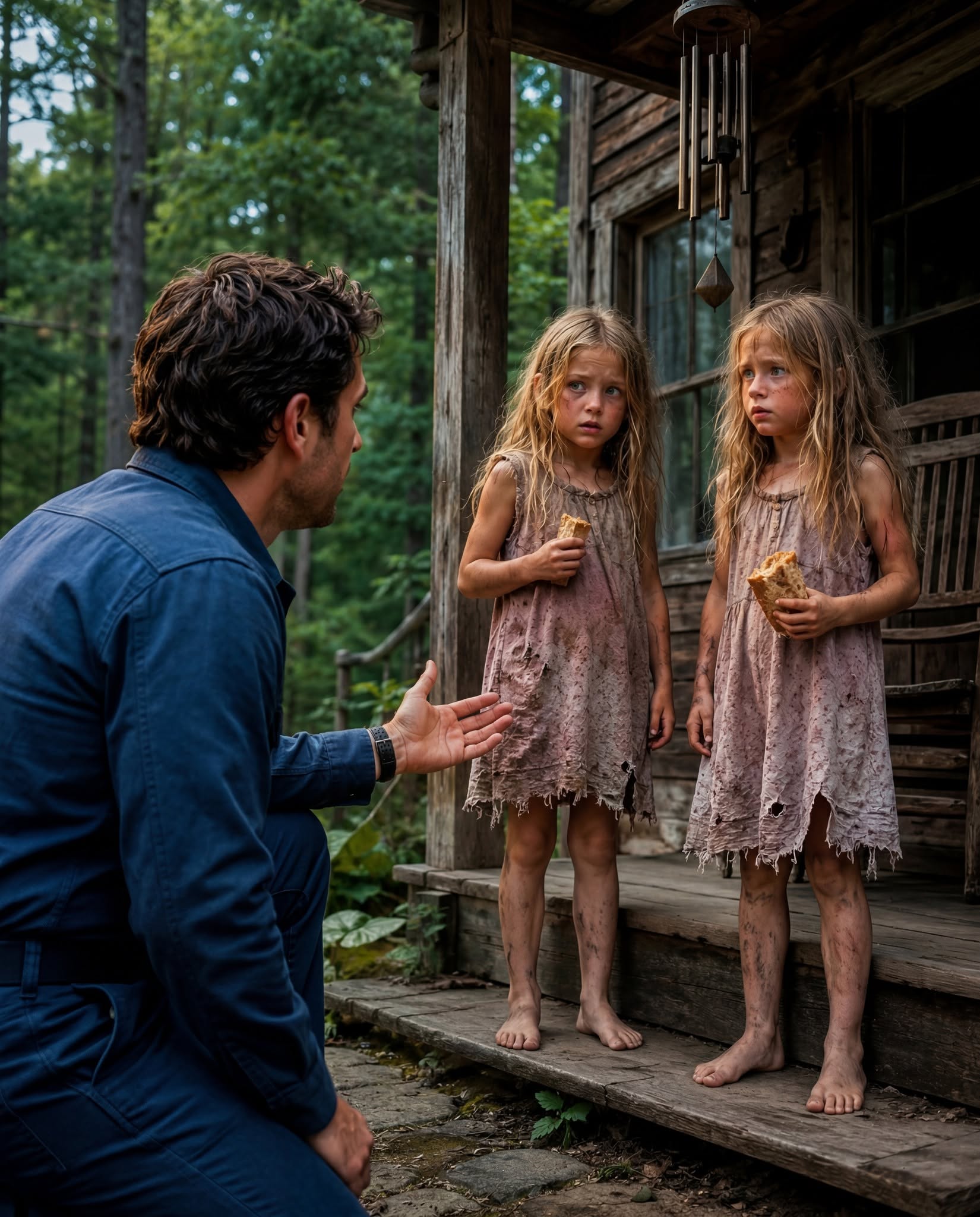
The wind picking up through the gorge seemed to carry a physical weight, rattling the old copper wind chime beside the door with a frantic, metallic urgency. I remained frozen on one knee, the damp gravel biting through my jeans, staring at Emma and Ella. My mind raced through a labyrinth of impossible calculations. Olivia had been gone for three years. She had passed away in a sterile hospital room in Charlotte after a grueling, sudden battle with an aggressive illness. How could these children, who couldn't be older than six or seven, possibly know her name? Why were they standing on the porch of a house that had sat padlocked and winterized since her funeral?
"What did you just say?" My voice was barely a whisper, flat and drained of air. "How do you know Olivia?"
Ella shrank back, her shoulder pressing against Emma’s. The synchronization between them was eerie; as Ella retreated, Emma took a half-step forward, her tiny, dirt-streaked knuckles tightening around the piece of stale, crusty bread until a few dry crumbs drifted down to the weather-worn porch planks. She didn't look at me. Her pale blue eyes were fixed entirely on the thick wall of pine and rhododendron bushes flanking the old deer trail.
A heavy, snapping sound echoed from the brush—the distinct crack of a thick branch breaking under substantial weight. It wasn't the erratic scattering of a startled deer or the light scurry of a mountain raccoon. It was deliberate. Rhythmic.
"Inside," I said, the corporate negotiator in me instantly giving way to pure protective instinct. I stood up quickly, my large frame casting a long shadow over the steps. "Come on. Both of you. Walk through the front door right now."
Neither girl moved. They seemed frozen by a terror that had nothing to do with me.
"Emma, Ella, listen to me," I kept my voice low but infused it with an absolute authority. I reached out, gently but firmly grasping their tiny, ice-cold wrists. Their skin was rough, covered in a fine layer of mountain dust and dried sap, with tiny bramble scratches crosshatched across their forearms. The moment my fingers closed around them, a tremor passed from Emma’s body into mine. They didn't resist. They moved like mechanical dolls, allowing me to guide them across the creaking porch boards.
I pulled open the heavy oak door. The lock, which usually required a firm twist of my key, was already turned. The door simply swung inward with a long, groaning sigh. The air inside was thick with the scent of cedar, old paper, and a faint, stale dampness that comes from years of abandonment. It was a time capsule of the happiest years of my life, but I didn't have a single second to process the grief.
I pushed the twins inside, stepped in behind them, and slammed the heavy door shut, throwing the deadbolt into place. The solid thud of the brass bolt sliding home offered a momentary illusion of safety.
Through the narrow pane of glass beside the door, I looked back out into the gathering twilight. The shadows between the trees were stretching, bleeding together into a solid wall of deep purple and black. For a split second, thirty yards down the hidden trail, I saw it. A figure. It was tall, dressed in a dark, shapeless canvas jacket, standing perfectly still behind a massive white pine. The silhouette was leaning slightly forward, as if trying to peer through the gloom toward the porch.
My hand instinctively drifted toward my pocket, checking for my phone. No signal. Of course. The Blue Ridge hollows were notorious dead zones, and the mountain ridge behind the cottage blocked the nearest tower ten miles out. I was entirely on my own, trapped in an isolated valley with two half-starved children and an unknown stalker lingering in the dark.
I turned away from the window, my heart hammering against my ribs. The interior of the cottage was cast in deep twilight. I reached for the light switch by the door and flipped it. Nothing happened. The power was out. I remembered then that I had called the utility company two weeks ago to reactivate the service, but in these rural counties, a downed line from the previous week's storm could take days to repair.
"Stay here," I murmured to the girls, though they hadn't moved an inch from the small braided rug just inside the entryway. They stood shoulder to shoulder, the stale bread still clutched in their hands like shields.
I walked quickly into the kitchen, navigating by memory. My boots echoed loudly against the pine floorboards. I found the emergency drawer beside the old porcelain sink. My fingers brushed past old menus, a box of matches, and finally closed around the heavy aluminum body of a Maglite flashlight. I clicked it on. The bright, high-intensity LED beam cut through the darkness, illuminating the layer of fine dust coating the countertops.
When I brought the beam back into the living room, the light washed over the twins' faces. Up close, the neglect was staggering. Their hair wasn't just messy; it had been crudely hacked off near the jawline, leaving jagged, uneven tufts that looked like they had been severed with a dull hunting knife. Their faded pink dresses were torn at the hem, caked with old mud, and smelled faintly of woodsmoke and damp earth.
"Let's get you cleaned up," I said, trying to force a gentle warmth into my tone that I didn't feel. Every muscle in my body was tight, waiting for the sound of footsteps on the porch. "And we need to find you something real to eat."
I set the flashlight on the mantle, aiming the beam at the ceiling to flood the room with a soft, reflected light. I knelt back down to their eye level. "Emma, who told you to wait for me? Who said Olivia's name?"
Emma looked down at the bread in her hand. Her lower lip trembled, but she spoke with a strange, old soul solemnity. "The lady in the picture. She told us in the shed. She said if the bad man came back, we had to run to the stone house. She said Ethan would have the keys."
A cold sweat broke out across my forehead. The lady in the picture.
I turned my head toward the mantle. Sitting right there, covered in a thin veil of dust, was a silver frame. Inside was a photograph I had taken five years ago—Olivia sitting on this very porch, laughing, her dark hair catching the autumn light, wearing my old red flannel shirt.
The twins had never met my wife. They couldn't have. But they recognized her face.
May you like



"Where is this shed, Emma?" I asked, my voice cracking.
Before she could answer, a heavy, thunderous blow struck the back of the cottage. It wasn't the front door. It was the kitchen window—the sound of shattering glass exploding across the linoleum floor.







