Chapter 1 - The Sunroom Ghost“Does she have nausea from the medication?”
The words left Clara before she could stop them.
Nurse Wendy Cline finally looked up from her phone.
Her eyes sharpened, not with concern, but with irritation. It was the look of someone catching a servant touching crystal with dirty hands.
“What did you say?”
Clara lowered her gaze immediately. Too late. She had already made her first mistake.
“I only meant,” Clara said carefully, “sometimes children do not eat when the medicine upsets their stomach.”
Nurse Cline stood.
She was younger than Clara had first guessed, maybe mid-thirties, with perfect blonde hair and a white uniform pressed so sharply it looked more decorative than useful. Around her neck hung a badge with the Moretti family crest printed beside her name.
Private Care Nurse.
Expensive.
Trusted.
Dangerous.
“Are you a doctor now?” Wendy asked.
“No, ma’am.”
“Then don’t diagnose my patient.”
Sophia did not move.
She sat facing the garden, small and silent, her dark curls spilling over the back of the wheelchair. Rain ran in silver threads down the glass. Outside, the flowers bent beneath the storm.
Inside, the little girl looked colder than the rain.
Clara picked up the untouched soup bowl from the tray.
“I apologize.”
Wendy gave a short laugh.
“You people always do.”
The words landed quietly, but Clara felt them. Not because they were new. Because they were familiar.
You people.
Poor women. Hired women. Women without names that mattered.
Women who came through service doors and learned to disappear.
Clara carried the tray toward the door.
Then Sophia spoke.
“Don’t take it.”
Clara stopped.
The child’s voice was barely more than breath, but it cut through the room more cleanly than Wendy’s contempt.
Wendy turned. “Sophia, you said you weren’t hungry.”
“I’m not.” Sophia still did not look away from the window. “But I don’t want her to take it.”
Clara stood still, one hand under the tray.
Wendy’s mouth tightened.
“You need to eat.”
“You said it didn’t matter.”
“I said don’t be dramatic.”
Sophia’s fingers curled around the wheelchair armrest.
Clara saw it.
Not the gesture itself. The effort behind it.
A faint tightening at the wrist. A tremor in the shoulder. The smallest shift of weight through the torso.
Most people would have missed it.
Most doctors might have missed it if they had already decided what the child could not do.
But Clara had built her career on watching children fight their way back from impossible injuries one tiny signal at a time. A blink. A swallow. A twitch. A breath held too long because pain had returned before hope did.
Sophia Moretti was not still because she felt nothing.
She was still because she had learned that movement had consequences.
Clara set the tray back down.
“Maybe,” Clara said softly, “she could try two spoonfuls later.”
Wendy’s eyes flashed.
“Maybe you could leave.”
Before Clara could answer, a shadow crossed the doorway.
Mrs. Rosie stood there with a bundle of folded linen in her arms. Her face revealed nothing, but her eyes moved from Wendy to Sophia, then to Clara.
“Mr. Moretti wants fresh towels in the east guest rooms,” Mrs. Rosie said.
It was not a request.
Clara nodded.
“Yes, Mrs. Rosie.”
She left the sunroom with the tray still untouched on the table and Sophia still staring at a garden made for running.
In the hallway, Mrs. Rosie walked beside her in silence until they were safely past the camera at the corner.
Then the housekeeper spoke without turning her head.
“You want to keep this job?”
“Yes.”
“Then learn the difference between seeing and saying.”
Clara’s throat tightened.
“I only asked about her medication.”
“And in this house, that is a confession.”
Clara glanced at the older woman.
Mrs. Rosie stopped near a linen closet and lowered her voice.
“That little girl has had neurologists from Boston, surgeons from Baltimore, some specialist from Switzerland with shoes that cost more than my car. Every one of them left here with Mr. Moretti angrier than when they arrived.”
“Why?”
“Because they all told him the same thing.”
“That she will never walk.”
Mrs. Rosie looked toward the sunroom.
“That hope is cruelty.”
Clara said nothing.
She knew that sentence. She had heard it in hospital conference rooms, whispered by men who mistook caution for wisdom. Hope could be cruel, yes. False hope could destroy a family.
But hopelessness could be a coffin.
Especially for a child.
Mrs. Rosie pushed the folded towels into Clara’s arms.
“You are here to clean dust, Miss Hayes. Not raise ghosts.”
Clara accepted the towels.
But as she turned away, Sophia’s small voice followed her through memory.
Don’t take it.
Not please.
Not help me.
Don’t take it.
As if the tray was not food, but proof that she still existed.
That evening, the Moretti mansion sank into its usual silence.
The men came and went through the front entrance in dark suits, speaking in low voices. A cook named Angela chopped vegetables in the kitchen with the tense precision of someone pretending not to hear things. Guards moved through hallways like furniture with weapons.
Clara worked until her back burned.
She cleaned rooms nobody used. She dusted framed photographs turned slightly away from the light. She changed sheets in guest bedrooms colder than hotel suites. She polished the banister of the grand staircase, though no one seemed to climb it except ghosts.
Everywhere, there were signs of the woman who had once made the mansion human.
A piano with sheet music still open.
A blue scarf folded inside a glass cabinet.
A family portrait above the staircase: Lorenzo Moretti, younger and less hard, standing beside a beautiful woman with soft brown eyes. Between them stood a little girl of perhaps four, wearing a white dress and red shoes, laughing at something beyond the camera.
Sophia.
Standing.
Clara stared at the photograph too long.
A voice behind her said, “That was before.”
She turned.
Lorenzo Moretti stood at the foot of the staircase.
He had removed his suit jacket, but the white shirt and dark vest made him look no less dangerous. A glass of something amber rested in one hand. His face was unreadable.
Clara stepped down quickly.
“I’m sorry, sir. I was dusting.”
“You were staring.”
“Yes, sir.”
“At what?”
Clara knew better than to lie badly to a man like him.
“Your daughter looked happy.”
Something moved in his jaw.
For a moment, the house seemed to hold its breath.
Then Lorenzo looked at the portrait.
“She was.”
The words were plain.
That made them worse.
Clara lowered her eyes.
“I’ll finish the rail.”
“No.”
She froze.
“Leave it.”
“Yes, sir.”
She gathered her cloth and polish, but before she could escape toward the service hall, Lorenzo spoke again.
“Did she eat?”
Clara turned back.
“Sophia?”
His eyes cut to hers.
“You have another paralyzed child in my house?”
“No, sir.”
His expression did not change, but the warning was clear.
Clara swallowed.
“She did not eat lunch.”
“And dinner?”
“I wasn’t in the room.”
“Nurse Cline said she ate.”
Clara felt the trap open beneath her feet.
The safe answer was simple.
Then Nurse Cline must be right.
But Clara saw Sophia’s pale face. The untouched bowl. The little wrist trembling against the armrest.
“She may have,” Clara said slowly. “I did not see it.”
Lorenzo walked closer.
“You choose words carefully.”
“I try to.”
“People who choose words carefully are usually hiding something.”
Clara met his eyes for half a second, then looked away.
“People who do not choose words carefully usually get punished for it.”
The silence after that was sharp enough to cut skin.
Clara realized what she had said.
Lorenzo’s gaze darkened.
Somewhere behind the walls, rain beat against stone.
“You have worked here three days,” he said. “And already you sound bitter.”
“I apologize.”
“Don’t.”
His voice dropped.
“I hate apologies.”
Clara stood with the polish bottle pressed against her palm.
Lorenzo studied her again in that cold, measuring way. He was not merely looking at her face. He was reading pulse, posture, fear, lie, weakness.
She wondered how many men had died because Lorenzo Moretti looked at them exactly this way and saw too much.
“You have children?” he asked.
The question struck harder than it should have.
Clara’s fingers tightened.
“No.”
“No husband?”
“No.”
“Family?”
The answer lived somewhere behind her ribs.
Buried under a hospital corridor.
Under a headline.
Under blood that had never left her memory no matter how many times she washed her hands.
“No one who claims me,” she said.
For the first time, Lorenzo’s expression changed.
Not sympathy.
Recognition.
A crueler thing.
“Then you understand this house better than most.”
He turned away.
“You may go.”
Clara did.
But she did not sleep.
Her room was on the third floor, narrow and neat, with one small window overlooking the back garden. The bed was firm. The sheets smelled faintly of lavender. Rain tapped the glass all night like fingers asking to be let in.
Clara lay on her back staring at the ceiling.
She told herself she would not interfere.
She told herself she had come here for a paycheck and a hiding place, nothing more.
She told herself Dr. Clara Halloway had died the day the medical board suspended her license, the day reporters shoved microphones toward her face and asked how it felt to kill a child.
But near midnight, a sound rose from below.
Not a scream.
A small crash.
Then silence.
Clara sat up.
For one minute, she did not move.
The smart thing was to stay in bed.
The safe thing was to stay in bed.
But Clara had lost everything once by trusting that other people would do the right thing.
She put on her robe and opened the door.
The mansion was dark except for security lights glowing along the baseboards. She moved quietly down the back stairs, avoiding the steps that creaked. The hallway outside the sunroom was empty.
Then she heard Sophia crying.
Not loudly.
Not like a spoiled child.
Like someone who had learned to cry without being heard.
Clara pushed open the sunroom door.
Sophia was on the floor.
Her wheelchair stood several feet away, one wheel angled against a small table. A book lay open beside her. A glass of water had shattered across the tile, spreading around her like broken ice.
The little girl was trying to drag herself backward with her elbows.
Her face was white with terror.
Clara crossed the room in seconds.
“Sophia.”
The child flinched.
“Don’t tell Wendy.”
“I won’t.”
“She’ll be mad.”
“I said I won’t tell her.”
Clara knelt carefully, checking the glass before touching the child.
“Are you cut?”
Sophia shook her head.
Clara looked at her legs.
Thin beneath the blanket. Still. Too still.
But her left foot was bare.
And the smallest piece of glass rested against the arch.
Sophia stared at Clara with huge dark eyes.
“Don’t touch it.”
“Does it hurt?”
The child’s mouth trembled.
That was the answer.
Clara’s pulse slammed.
“Sophia,” she whispered, keeping her voice steady, “can you feel that?”
Sophia began to cry harder.
“I’m not supposed to.”
Clara froze.
The room went silent except for rain and the child’s breath.
“What do you mean?”
Sophia looked toward the hallway as if the walls themselves could betray her.
“Wendy says Daddy gets sad when I lie.”
Clara’s blood turned cold.
“She told you feeling pain is lying?”
Sophia nodded.
“She said the doctors said I can’t feel anything. So if I say it hurts, I’m being bad.”
Clara closed her eyes for one second.
Not from weakness.
From rage.
When she opened them, her hands were steady.
“Listen to me very carefully,” Clara said. “Pain is not bad. Pain is your body talking.”
Sophia sniffled.
“But Daddy said no miracles.”
“This is not a miracle.”
Clara gently lifted the foot, avoiding the glass. Sophia gasped.
Not from fear.
From sensation.
Real. Clear. Present.
Clara felt the world tilt.
Every doctor who matters has told me that is permanent.
Maybe the doctors had been wrong.
Or maybe someone had made sure they never saw the truth.
Clara removed the glass from near Sophia’s foot and wrapped the child carefully in the fallen blanket.
“I’m going to put you back in your chair.”
“You can’t.”
“I can.”
“I’m heavy.”
“You are seven.”
Sophia blinked.
For a moment, almost impossibly, she looked like she might smile.
Clara lifted her with practiced ease, supporting her hips, protecting her spine, watching for spasm, pain, resistance. Sophia clung to her neck with both arms.
There it was again.
Strength through the trunk.
Not much.
But enough.
More than the chart would have said.
More than Nurse Cline wanted anyone to notice.
Clara settled her into the wheelchair and tucked the blanket around her.
“Did you try to reach the book?” Clara asked.
Sophia nodded.
“It fell.”
“Why didn’t you call someone?”
“Wendy locks the bell at night.”
Clara looked at the call button clipped uselessly to the side of the chair.
Locked.
Not broken.
Locked.
The kind of cruelty that wore a nurse’s badge and called itself care.
Sophia watched her face.
“Are you mad?”
Clara forced herself to breathe.
“No, sweetheart.”
“You look mad.”
“I am mad at the floor.”
Sophia stared at her.
Then, very softly, she laughed.
It was tiny. Rusty. Almost forgotten.
But it was a laugh.
Clara felt something inside her crack open.
For years, she had run from children’s hospital rooms, from tiny hands reaching for her, from the unbearable memory of a boy she had not saved in time. She had told herself she would never again be responsible for a child’s hope.
Yet here was Sophia Moretti, trapped inside a fortress, being taught to mistrust her own body.
Clara could walk away.
She should walk away.
Instead, she knelt in front of the chair.
“Sophia, may I ask you something?”
The girl nodded.
“When the glass touched your foot, did it feel sharp, dull, hot, or cold?”
Sophia thought.
“Sharp. And cold.”
Clara’s heart pounded.
“Can you feel both feet?”
Sophia hesitated.
“Sometimes.”
“Sometimes is important.”
“Wendy says sometimes doesn’t count.”
“Wendy is wrong.”
Sophia’s eyes widened.
Adults in this house did not say such things.
Clara knew she had crossed another line. Maybe the final one.
But some lines were fences.
Others were cages.
“Can you wiggle your toes?” Clara asked.
Sophia stared at her feet.
Nothing happened.
Her small face collapsed with shame.
“I told you. I can’t.”
“That’s all right.”
“I tried.”
“I know.”
“No, you don’t.”
“Yes,” Clara said quietly. “I do.”
Sophia looked at her.
Something in Clara’s voice had changed. Some old grief had slipped through the fake name and plain black dress.
For a moment, the child saw past the maid.
“What were you before?” Sophia whispered.
Clara went still.
Before she could answer, the sunroom lights snapped on.
Both of them turned.
Lorenzo Moretti stood in the doorway.
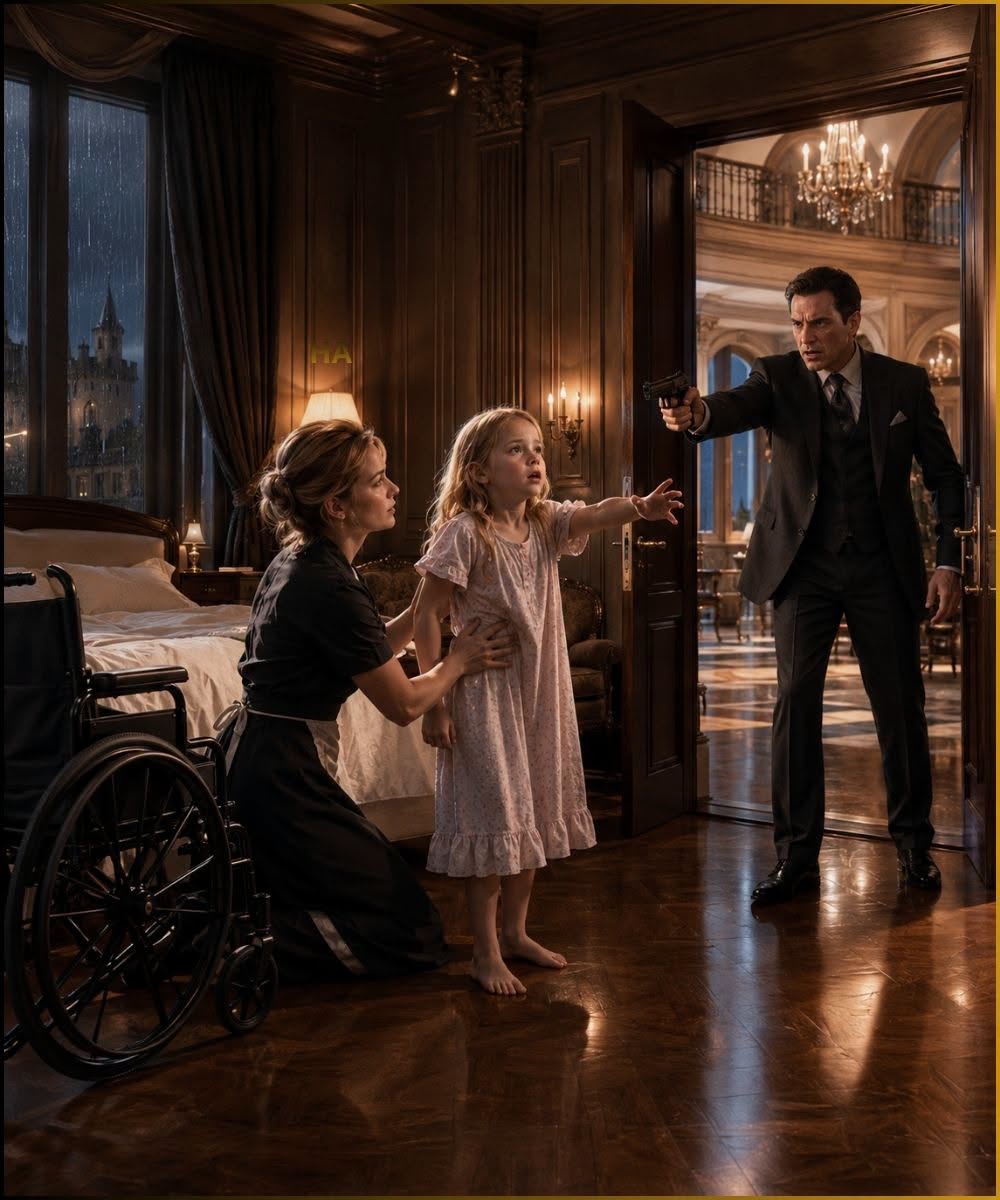
He wore black trousers and a white shirt open at the throat. In his right hand was a pistol.
Not raised.
Not yet.
But there.
His eyes moved from the broken glass to Sophia’s tear-streaked face, then to Clara kneeling before the wheelchair with the locked call button in her hand.
The room turned colder than the storm.
“What,” Lorenzo said, “are you doing with my daughter?”
Sophia made a frightened sound.
Clara rose slowly.
She did not run.
She did not explain too quickly.
Men with guns rarely trusted panic.
“She fell,” Clara said.
Lorenzo stepped into the room.
“And you just happened to be here.”
“I heard her.”
His gaze flicked to the locked bell in Clara’s hand.
“What is that?”
Clara held it up.
“The call button.”
“I know what it is.”
“It was locked.”
Lorenzo’s face changed.
Only slightly.
But enough.
He looked at Sophia.
“Who locked it?”
Sophia’s mouth opened.
No sound came.
Clara saw the battle inside the child. Fear of lying. Fear of telling the truth. Fear of making the adults angry. Fear, most of all, of disappointing the father who had mistaken protection for absence.
Lorenzo crouched in front of the wheelchair.
The gun lowered toward the floor.
“Sophia.”
His voice was different now.
Not soft.
But broken at the edges.
“Who locked your call button?”
Sophia stared at him with tears shining on her cheeks.
“Wendy said I bother people at night.”
For one terrible second, Lorenzo did not move.
Then he stood.
The man who turned back toward Clara was not a grieving father.
He was something far more dangerous.
“Did she hurt you?” he asked Sophia, though his eyes remained on Clara.
Sophia whispered, “No.”
Clara could not stay silent.
“She told Sophia that feeling pain means she is lying.”
Lorenzo looked at her.
“What did you say?”
Clara felt the gun in the room like a second heartbeat.
But she had come too far to kneel before fear now.
“She can feel her foot, Mr. Moretti.”
The words struck him harder than any bullet.
His face emptied.
“Don’t.”
“It was sharp and cold. She identified both sensations.”
“I said don’t.”
“She may have incomplete sensation below the injury level. She may have more function than you were told.”
Lorenzo raised the gun.
Not all the way.
But enough.
Sophia screamed, “Daddy!”
Clara did not step back.
Her heart hammered so violently she thought it might tear through her chest, but her voice stayed calm.
“I am not giving her fairy tales,” Clara said. “I am telling you what I saw.”
Lorenzo’s eyes were black with fury.
Or terror.
Sometimes fathers could not tell the difference.
“You’re a maid.”
“Yes.”
“You clean my floors.”
“Yes.”
“You know nothing.”
Clara looked at Sophia.
The child was crying silently now, both hands gripping the armrests.
Then Clara looked back at Lorenzo.
“I know your daughter felt glass against her foot.”
The gun trembled.
Just once.
But she saw it.
So did he.
The silence stretched until the rain seemed to stop outside the windows.
Finally, Lorenzo lowered the weapon.
“Get out.”
Clara did not move.
“Mr. Moretti—”
“Get out before I forget you are standing next to my child.”
Clara turned to Sophia.
“You did nothing wrong,” she said softly.
Sophia’s lips parted.
No one in the room breathed.
Then Clara walked out.
May you like

Behind her, Lorenzo Moretti stood in the sunroom with a gun in one hand, his daughter crying in front of him, and the first impossible seed of hope taking root in the dead house he had built to protect her.
By morning, nothing in the Moretti mansion would be the same.
Related Stories