Chapter 12 - The Promise We Finally KeptDetective Ortiz arrived forty minutes later.
The threatening message turned out not to be the beginning of another conspiracy.
It was the desperate end of the old one.
A former associate of Grant’s named Victor Hale had escaped the original investigation because he handled only technical work.
Fake accounts.
Remote servers.
Phone cloning.
Surveillance installation.
When federal investigators began tracing previously unknown payments, Victor panicked.
The message to Rachel was meant to frighten her into silence.
Instead, she handed it to police within minutes.
That single choice became a symbol of everything that had changed.
Investigators traced the account.
Victor was arrested two days later at an airport in Dallas carrying cash and a passport under another name.
He eventually pleaded guilty.
No dramatic chase.
No kidnapping.
No hidden trap.
Just consequences.
The first time I told Rachel, she sat at the kitchen table quietly.
“That’s it?”
“Looks like it.”
“No one else?”
“Ortiz says they’re confident the network is finished.”
Rachel exhaled.
Then she laughed.
“What?”
“I spent two years waiting for the next disaster.”
“So did I.”
“What do normal people do when there’s no disaster?”
“Complain about property taxes?”
She laughed harder.
Noah, now almost three, copied her without understanding why.
Tessa entered carrying a school backpack.
“What’s funny?”
“Your father.”
She looked at me.
“Really?”
“Occasionally.”
Life continued.
That was the miracle.
Not that everything became perfect.
It didn’t.
Rachel and I still argued.
Once about money.
Once because I agreed to work a Saturday without checking the family calendar.
Once because she made a decision about Noah’s preschool and told me afterward rather than before.
But our arguments ended differently.
Nobody disappeared.
Nobody created a secret account.
Nobody searched for a stranger online to confirm that the other person was evil.
Sometimes one of us said:
“I’m too angry to talk well right now.”
Then we came back an hour later.
Such an ordinary skill.
It might have saved us years earlier.
Tessa changed most visibly.
At eleven, she became fiercely independent again.
Soccer.
Art club.
Sleepovers.
She stopped asking permission for water.
That was how I knew healing had gone deeper than words.
One Saturday, we drove past the old neighborhood.
Tessa recognized it.
“Can we see the house?”
Rachel stiffened.
I asked, “Do you want to?”
“Yeah.”
We drove slowly past.
The new owners had painted the front door blue.
A bicycle lay in the driveway.
Someone had planted flowers beneath the kitchen window.
Tessa stared.
“That’s weird.”
“What?”
“It looks normal.”
I understood.
Trauma makes places feel sacred in the worst possible way.
You imagine the universe should mark them.
A burned tree.
Broken glass.
Something.
Instead, grass grows.
People cook dinner.
Children leave bicycles outside.
“Do you remember that day?” Rachel asked carefully.
Tessa nodded.
“Some of it.”
Rachel didn’t ask more.
After a moment, Tessa said:
“I remember Noah being really heavy.”
Rachel looked out the passenger window.
“I’m sorry.”
“I know.”
Tessa said it casually.
Not coldly.
Not emotionally.
Just truth.
“I know.”
Then:
“I don’t think about it much anymore.”
Rachel turned.
“Really?”
“Only when people tell me I’m mature.”
I looked at her through the mirror.
“What does that have to do with it?”
“I hate when adults say that.”
“Why?”
“Because sometimes they mean a kid is good at handling things adults should handle.”
I nearly pulled the car over.
She was eleven years old and had already learned something it took many adults decades to understand.
“You’re right.”
She smiled.
“I know.”
Rachel laughed.
“That’s definitely your father.”
“No,” I said. “That one is all her.”
We drove on.
The biggest decision came the following spring.
Our fourteenth wedding anniversary.
Technically.
Rachel left a card beside my coffee.
No expensive gift.
Inside she wrote:
I don't want to celebrate surviving the old marriage. I want to celebrate choosing the new one. Dinner tonight? No expectations.
I found her making lunches.
“Yes.”
She looked up.
“Yes what?”
“Dinner.”
“Okay.”
We went to a small restaurant in downtown Edmond.
Nothing fancy.
We talked about work.
The kids.
A trip we might take.
Then Rachel reached into her purse.
She placed her wedding ring on the table.
I stared.
She had stopped wearing it after moving into her apartment.
“What are you doing?”
“I’ve been thinking.”
“Dangerous.”
She smiled.
“This ring belonged to the marriage we broke.”
I waited.
“I don’t want to put it back on.”
My chest tightened slightly.
Then she continued.
“But I want to ask whether someday we could choose new ones.”
I looked at her.
“Are you proposing to your husband?”
“Technically separated husband.”
“That clears it up.”
She laughed.
Then became serious.
“I don’t need an answer tonight.”
I picked up the old ring.
Inside were the words engraved fourteen years earlier:
Always us.
Funny.
We had thought forever was something you promised once.
We were wrong.
Forever, when it worked, was made from ordinary Tuesdays.
“I have an answer.”
Rachel waited.
“Yes.”
She stared.
“Yes?”
“Yes.”
Tears immediately filled her eyes.
“But.”
She laughed through them.
“Of course there’s a but.”
“No giant wedding.”
“Agreed.”
“No pretending nothing happened.”
“Never.”
“Kids involved.”
“Yes.”
“Counselor involved.”
Rachel blinked.
“Our therapist?”
“She earned it.”
Rachel laughed so loudly another table looked over.
“And one more thing.”
“What?”
“New words inside the rings.”
“What words?”
I thought about Tessa.
The phone call.
Rachel handing over the threatening message.
The hundreds of small decisions that rebuilt what one huge mistake had nearly destroyed.
Then I knew.
SHOW UP.
Rachel’s face crumpled.
“Yes.”
Three months later, we renewed our vows under the oak tree.
Twenty people.
Family.
Friends.
Detective Ortiz came.
Eleanor came.
Thomas came with his children.
Caleb brought Ranger, now fully retired and more interested in hamburgers than police work.
Tessa stood between Rachel and me holding Noah’s hand.
We didn’t recite traditional promises.
Rachel spoke first.
“I cannot promise I’ll never be afraid.”
She looked at me.
“I promise I will not hide inside fear.”
Then she looked at Tessa and Noah.
“I cannot change the day I failed you.”
Tessa’s eyes filled.
“But every day I get afterward, I will show you that I learned from it.”
Then my turn.
“I can’t promise work will never demand me.”
I looked at Tessa.
“But I promise you will never have to wonder whether you can call.”
Her lower lip trembled.
“You can always call me.”
Rachel squeezed my hand.
“I cannot promise we will never hurt each other again.”
I looked at her.
“I promise we will not turn pain into secrecy.”
Then Tessa whispered:
“Can I say something?”
Everyone laughed softly.
I nodded.
She walked forward.
She was eleven now.
Taller.
Confident.
Nothing like the exhausted little girl on the kitchen floor.
“I had something written down.”
She pulled folded paper from her dress pocket.
“But I don’t want to read it.”
She looked at Rachel.
“I was really mad at Mom.”
Rachel nodded.
“I know.”
“I thought forgiving her meant saying what happened was okay.”
Silence settled over the yard.
“But my therapist said forgiveness can mean you don’t want to carry something every day anymore.”
Eleanor began crying.
Tessa continued.
“So I don’t.”
She shrugged.
“I still remember it.”
She looked at Rachel.
“But I don’t carry it.”
Rachel covered her mouth.
Tessa hugged her.
For a long time.
Then Tessa turned toward me.
“And Dad?”
“Yeah?”
“You work too much.”
Everyone laughed.
Including me.
“I’m working on it.”
“I know.”
Then Noah tugged her dress.
“Cake.”
Tessa rolled her eyes.
“See? This is what I deal with.”
The ceremony ended.
People ate.
Children ran through the yard.
Ranger stole half a hamburger from Caleb.
Eleanor sat beneath the oak talking with Rachel.
Thomas laughed with Melissa.
Nothing spectacular happened.
That was exactly what I wanted.
Late that evening, after everyone left, I found Tessa in the kitchen.
She was standing beside the counter making Noah a cup of water.
Rachel walked in.
“I can do that.”
“I got it.”
“You sure?”
“Mom.”
Tessa smiled.
“It’s water.”
Rachel laughed.
“Right.”
Noah ran in.
“Up!”
He reached for his sister.
Tessa lifted him.
He was getting heavy now.
She lasted about five seconds.
Then she said:
“Mom, take him.”
Rachel reached immediately.
No hesitation.
No expectation that Tessa should manage.
No child forced into the role of parent.
Rachel lifted Noah into her arms.
Tessa went upstairs.
I remained by the doorway.
For a moment, Rachel and I simply looked at each other.
She knew.
Of course she knew.
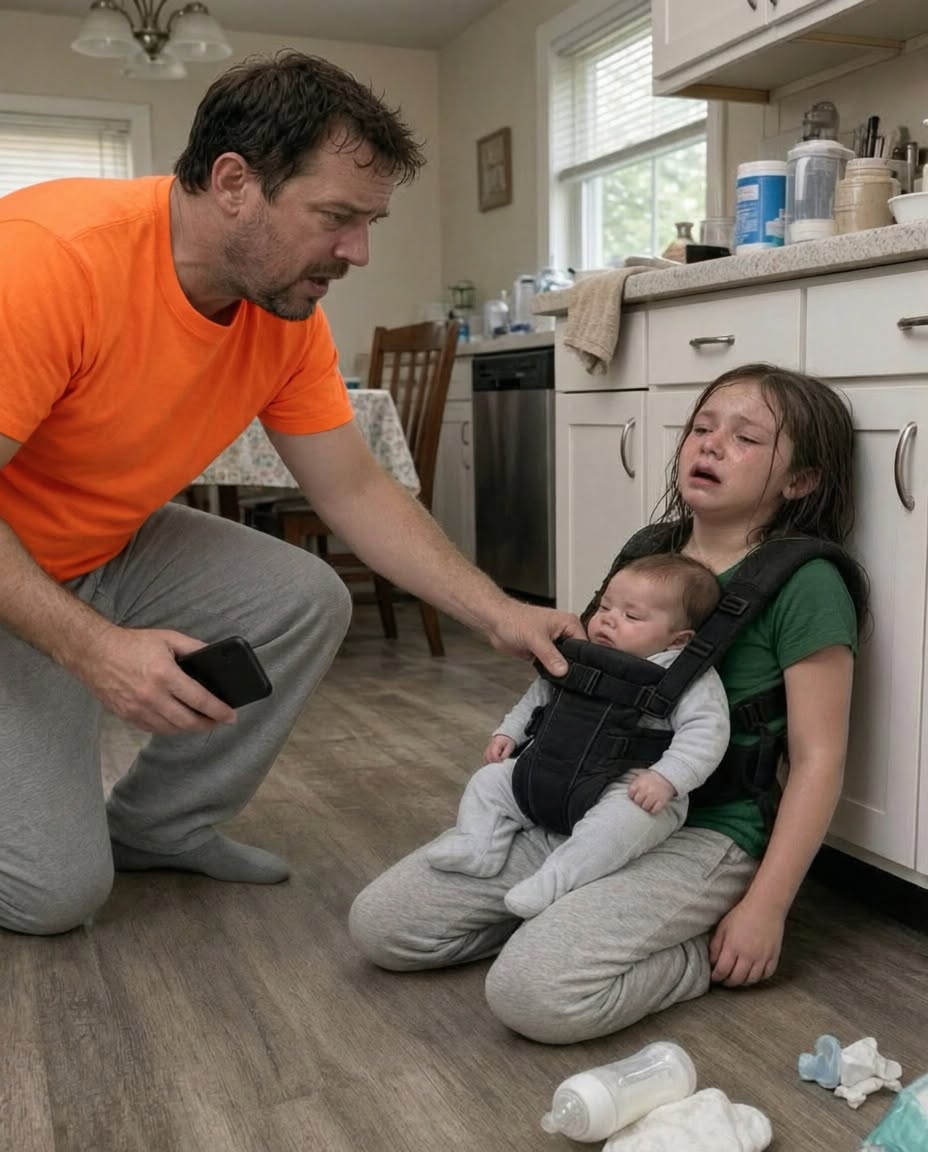
Almost three years earlier, our daughter had sat on another kitchen floor carrying a baby far longer than she should have.
She had whispered into a phone:
Dad, I can’t hold the baby anymore.
That sentence had felt like the beginning of the destruction of my family.
It wasn’t.
It was the moment the truth finally entered our house.
The secret phone I found upstairs revealed lies, betrayal, stolen money, manipulation, and a stranger who had spent months trying to tear us apart.
But the phone wasn’t the most important thing I found that day.
I found out my daughter was brave enough to ask for help.
I found out my wife was capable of terrible mistakes—and capable of facing what she had done instead of spending the rest of her life running from it.
I found out being a good husband did not mean pretending I had never failed.
And I learned something Grant Keller never understood.
Fear can control people for a while.
Shame can silence them.
Lies can separate them.
But none of those things are stronger than truth once people stop hiding from it.
Rachel shifted Noah on her hip.
“You okay?”
I smiled.
“Yeah.”
She reached out her free hand.
I took it.
Upstairs, Tessa shouted:
“Dad! Noah put my marker in the toilet again!”
I closed my eyes.
Rachel laughed.
“You handle it.”
“No chance.”
“You promised to show up.”
I looked at her.
“That’s emotional manipulation.”
“Therapist says I’m improving.”
I laughed and started upstairs.
Noah squealed in Rachel’s arms.
Tessa shouted again.
The house was loud.
Messy.
Ordinary.
Safe.
And for the first time in years, nobody inside it was waiting for someone to disappear.
I reached the stairs and looked back.
Rachel stood beneath the kitchen light holding our son.
She smiled.
I smiled back.
Then I went upstairs to help my daughter.
Because when she called for me now—
May you like
I showed up.
THE END