Chapter 12 - THE NAME ON MY UNIFORMA year after Luke's trial, I stood on the quarterdeck of a naval facility overlooking Chesapeake Bay while sunlight turned the water silver.
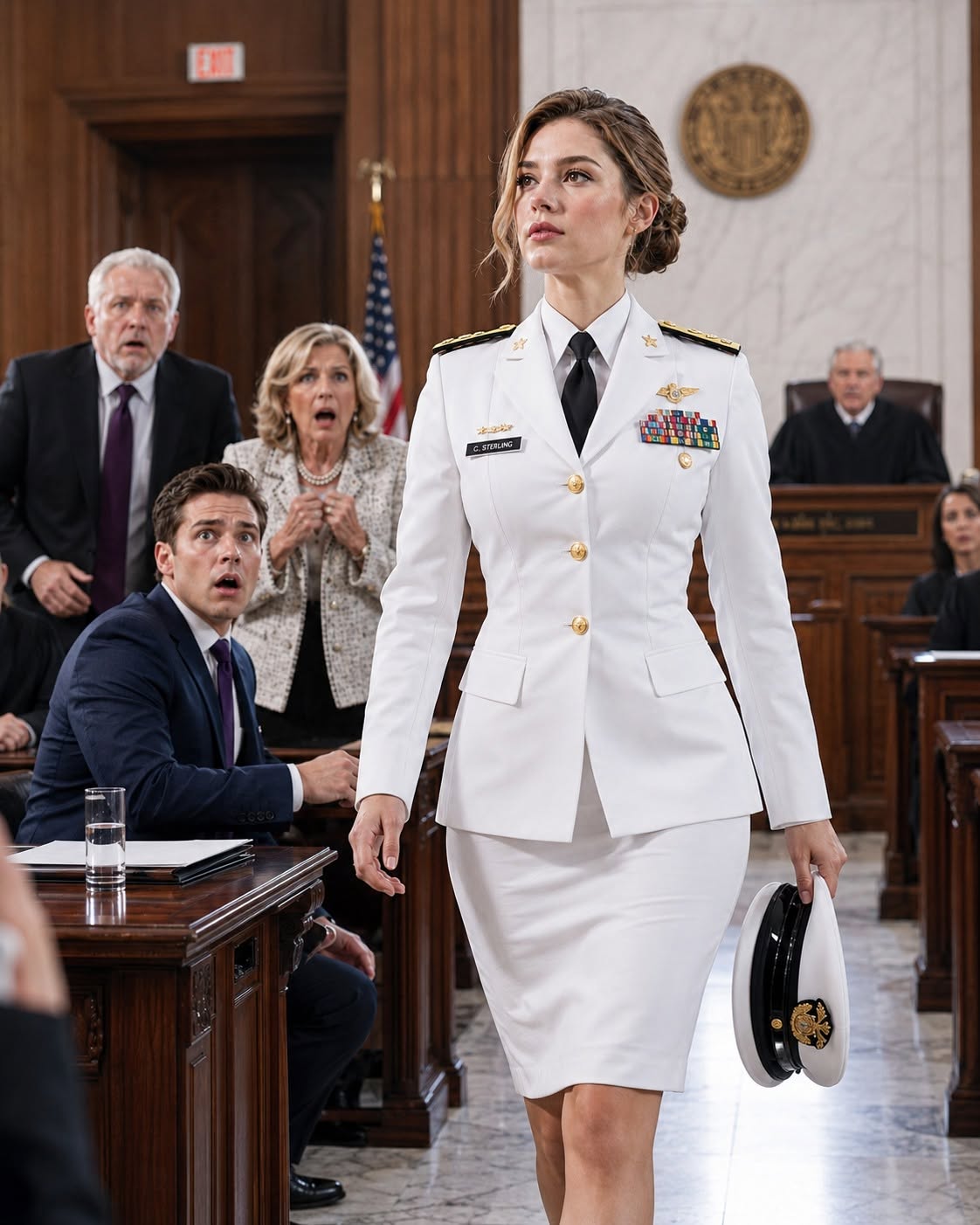
Wind tugged at the edge of my white cover.
Rows of chairs faced a small platform.
This time, when my name was announced, two people in the front row stood before everyone else.
My parents.
Mom clapped so enthusiastically that the woman beside her laughed.
Dad didn't care.
He was crying.
I had been selected for promotion.
Captain Grace Elizabeth Sterling.
When the new insignia was pinned into place, my commanding officer shook my hand.
“Congratulations, Captain.”
“Thank you, sir.”
Then came the part I had quietly dreaded.
Family photographs.
For years, I had learned not to expect anyone.
Coworkers became my witnesses.
Friends held cameras.
I smiled beside people who loved me while pretending I did not notice the empty space where my parents should have been.
That day there was no empty space.
Mom stepped beside me.
Dad joined her.
He straightened his tie twice.
“You look nervous,” I whispered.
“I'm standing next to a Navy captain.”
“You've known me since I couldn't tie my shoes.”
“Different chain of command.”
Mom rolled her eyes.
The photographer raised the camera.
“Everybody ready?”
Dad suddenly said, “Wait.”
He turned toward me.
“What?”
His voice became quiet.
“I want to say this before we take the picture.”
Mom looked at him.
Dad swallowed.
“I spent a long time thinking a parent's job was to protect the family's reputation.”
I waited.
“I was wrong.”
His eyes filled.
“A parent's job is to protect the truth inside the family, especially when the truth is uncomfortable.”
I looked down for a second.
“I can't give back those ten years.”
“No.”
“But I can spend whatever years I have left being better.”
Mom touched his arm.
Then looked at me.
“So can I.”
I nodded.
“I know.”
The photographer waited politely.
Finally I smiled.
“Can we take the picture before all three of us start crying?”
Dad laughed.
The camera clicked.
That photograph later sat on my office shelf.
Not because everything was repaired.
Some scars do not disappear when people apologize.
I still remembered birthdays alone.
Grandma Ruth's unanswered silence.
The lies.
The courtroom.
Luke's face when the doors opened.
But those memories no longer controlled the entire story.
My parents kept their promise about the money recovered from their legitimate assets.
After the government completed the forfeiture process, they established a modest charitable fund with what they could afford, supporting small emergency-response organizations and families harmed by contractor fraud.
Dad volunteered twice a week helping elderly veterans organize insurance paperwork.
Mom joined a community disaster-relief group.
Neither made public speeches about redemption.
That was important.
True accountability becomes suspicious when it turns into a performance.
They simply did the work.
Our Sunday dinners became regular.
Not perfect.
Regular.
Sometimes Mom asked too many questions.
Sometimes Dad became quiet whenever Luke's name came up.
Sometimes I disappeared into work for weeks and had to remind myself that people reaching out to me were no longer necessarily demanding explanations.
We learned each other again.
Luke remained in prison.
I visited several times during that first year.
Not every month.
Not on a schedule.
Only when I wanted to.
He eventually joined an educational program and began tutoring other inmates in basic accounting.
The irony was so obvious I mocked him for it.
He laughed.
A real laugh.
Then said, “Maybe I should've used accounting legally the first time.”
“Strong career advice.”
He grew quieter during each visit.
Less polished.
Prison had stripped away the audience Luke spent his life performing for.
Whether that would make him better, I didn't know.
I stopped trying to predict him.
One December afternoon, he slid a letter across the visitation table.
“What's this?”
“For you.”
“You could mail it.”
“I didn't know if you'd open it.”
Fair.
I unfolded it.
There were no excuses.
That surprised me.
Luke had written down the lies he remembered telling.
The fake investigation.
The discharge story.
The rehabilitation rumor.
The claims that I'd been jealous.
The emails.
Grandma.
At the bottom, one sentence:
I kept telling people you were a disgrace because admitting what you really were made me feel small.
I stared at it.
Luke said, “I spent years thinking you were trying to beat me.”
“I wasn't.”
“I know.”
“Do you?”
He nodded.
“I think I finally do.”
I folded the letter.
“I hated you for a while.”
“You should.”
“Don't tell me what I should feel.”
He almost smiled.
“Right.”
“I don't hate you anymore.”
His eyes lifted.
“That doesn't mean I trust you.”
“I know.”
“It doesn't mean we're going back to how we were.”
“I know.”
“And it definitely doesn't mean you get to borrow money.”
That earned the laugh I wanted.
When visitation ended, Luke stood.
“Grace.”
I looked back.
“Congratulations on captain.”
I frowned.
“How'd you know?”
“Mom sent me twelve pages about it.”
I laughed.
“Sounds like Mom.”
He nodded.
“I'm proud of you.”
For years, I thought hearing that from him would heal something.
It didn't.
I discovered I no longer required it to.
Still, I appreciated it.
“Thanks, Luke.”
I left.
Outside, cold Virginia air hit my face.
Dad waited in the parking lot beside his old sedan.
He had driven because I was heading to their house afterward.
“How'd it go?”
“Fine.”
“That means absolutely nothing.”
“Then why ask?”
He opened the passenger door.
“Habit.”
I got inside.
Mom had already called three times asking where we were because dinner was getting cold.
On the drive home, Dad asked about work.
I told him what I could.
He did not push for what I couldn't.
That small discipline touched me more than he knew.
At a stoplight, he looked at my uniform bag in the back seat.
“Can I ask something?”
“Sure.”
“Why did you wear the whites to court?”
I smiled.
I had wondered when someone would ask.
“It wasn't for Luke.”
Dad looked surprised.
“No?”
“No.”
“Then why?”
I watched the light turn green.
“Because I spent ten years hearing that uniform described like evidence of my failure.”
Dad's hands tightened slightly around the steering wheel.
“I wanted to walk into that courtroom exactly as I was.”
He nodded.
“Not hiding.”
“Not apologizing.”
We drove in silence.
Then Dad said, “You looked terrifying.”
I laughed.
“Good.”
“Your mother nearly fainted.”
“I noticed.”
“She thought she'd seen a ghost.”
In a way, she had.
The Grace Sterling my family remembered had disappeared years earlier.
She was twenty-eight.
Still desperate for approval.
Still believing that if she explained the truth clearly enough, people who loved her would automatically choose it.
I no longer believed that.
Love did not guarantee wisdom.
Family did not guarantee loyalty.
Uniforms did not automatically make people honorable.
Courts did not repair childhoods.
Apologies did not erase consequences.
And forgiveness was not the same thing as pretending harm never happened.
But I had learned something else.
A lie can own your reputation without owning your identity.
For ten years, Luke told my hometown I was a failed sailor.
I kept serving.
He told my parents I was unstable.
I kept leading.
He told relatives I was ashamed.
I kept advancing.
He told everyone I had disappeared because I couldn't face what I'd done.
In reality, I had simply stopped standing outside a locked door begging people to let me back inside.
Then one morning, those same people watched another door open.
And I walked through it.
Not as the disgraced daughter.
Not as the jealous sister.
Not as Luke Sterling's accuser.
As myself.
Months after my promotion ceremony, I returned to my childhood hometown for a Memorial Day event.
Dad had volunteered to help organize it.
Mom was handing out bottled water.
I attended in uniform.
Naturally, people stared.
Some remembered the rumors.
A woman who had once avoided me at a grocery store approached.
“Grace, I owe you an apology.”
“You don't owe me anything.”
“I believed things.”
“A lot of people did.”
She looked embarrassed.
“I should've asked.”
“Yes.”
I didn't rescue her from the discomfort.
That was another thing I had learned.
You can be kind without relieving everyone of accountability.
She nodded.
“Congratulations on everything.”
“Thank you.”
A little girl nearby pointed toward my ribbons.
“Are those medals?”
Her mother tried to quiet her.
I crouched slightly.
“Some represent awards.”
“Did you win them?”
“I earned them with a lot of other people.”
She stared at my cover.
“Are you the boss?”
I smiled.
“Not of everybody.”
She considered this.
Then asked, “Can girls be captains?”
Her mother looked mortified.
I laughed.
“Absolutely.”
The girl nodded as though she had just confirmed an important legal principle and ran away.
Across the lawn, Mom was watching.
She smiled.
Dad stood beside her.
They weren't ashamed.
They weren't confused.
They weren't waiting for Luke to explain who I was.
They knew.
Later that afternoon, the three of us walked toward the parking lot.
Mom slipped her arm through mine.
Dad carried the folding chairs.
“Dinner?” Mom asked.
“Sure.”
“Luke called this morning.”
I glanced at her.
“How is he?”
“Fine. He wants to call you next week.”
“I'll think about it.”
Mom nodded.
No pressure.
Another improvement.
We reached my car.
Dad started loading chairs into the trunk.
Mom looked at the name sewn on my uniform.
STERLING.
For years, I had considered changing it.
Not because I hated the name.
Because I hated what my family had made it represent.
Mom touched the edge of my sleeve.
“I'm glad you kept it.”
I looked at her.
“So am I.”
She smiled.
The name Sterling no longer belonged to Luke's company.
It didn't belong to the headlines.
It didn't belong to my father's mistakes.
It didn't belong to the rumors whispered at church, at school reunions, in grocery-store aisles or around Thanksgiving tables I wasn't invited to.
It belonged to me too.
And I had earned the right to decide what it meant.
I put my cover beneath my arm and looked across the field.
Flags moved in the late-May wind.
Families packed picnic baskets.
Veterans talked beneath white tents.
Children chased each other between folding chairs.
Nothing dramatic happened.
No courtroom doors opened.
No one gasped.
No guilty verdict was read.
There was only an ordinary afternoon with the parents I thought I had lost forever.
That might have been the happiest ending of all.
Not revenge.
Not Luke in prison.
Not headlines announcing I had been right.
Just peace.
Dad closed the trunk.
“Ready, Captain?”
I smiled.
May you like



“Ready.”
And this time, when my family walked away together, nobody was left behind.







