Chapter 9 - THE HOUSE LUKE BOUGHT WITH OTHER PEOPLE'S SUFFERINGFederal agents found Caleb Vance in Montreal.
He never made it farther.
Canadian authorities detained him at a private apartment connected to one of Rowe's former associates.
Then came the surprise.
Caleb wanted a deal.
Within twenty-four hours, his attorney contacted U.S. prosecutors.
Within forty-eight, Caleb was back under federal control.
He admitted ordering the intimidation campaign.
The photograph of Mom.
The calls.
The vehicle surveillance.
But he denied trying to kill Marcus Doyle.
“I wanted him scared,” Caleb reportedly said. “Not dead.”
Maybe he was telling the truth.
Maybe he wasn't.
Criminals become enthusiastic philosophers of moral distinction once the handcuffs arrive.
The bigger revelation was what Caleb possessed.
Records Luke believed had been destroyed.
For years, Caleb had maintained a private insurance file.
Not insurance in the legal sense.
Insurance against Luke.
Emails.
Audio recordings.
Copies of ledgers.
Photographs.
One video.
The video had been recorded at Luke's lake house eighteen months earlier.
The house my parents adored.
Six bedrooms.
Private dock.
Stone fireplace.
A kitchen large enough to host fifty people.
I had seen photographs online.
Mom once captioned one:
So proud of everything our son has built.
In the video, Luke sat beside Caleb and two executives discussing upcoming federal audits.
Caleb warned that Marcus Doyle was becoming nervous.
Luke replied, “Then remind Marcus who paid for his daughter's treatment.”
One executive asked what would happen if Marcus cooperated with authorities.
Luke lifted his drink.
“Everybody has a pressure point.”
Caleb said, “Grace doesn't.”
Luke smiled.
“Everybody does.”
My skin went cold.
“What was mine?” I asked Naomi.
She didn't answer immediately.
“Your parents.”
I stared at her.
“Explain.”
“We found references to a contingency plan.”
“What plan?”
“If you became an active threat, Luke intended to implicate Bernard.”
I thought of Harbor Ridge.
“He already did.”
“More than that.”
Luke possessed forged records suggesting Dad knowingly supervised payments.
Enough to trigger indictment.
“He was going to threaten me with Dad?”
“Yes.”
I laughed bitterly.
“He spent ten years making sure I hated Dad.”
“He may have overestimated that.”
Luke understood anger.
What he never understood was that anger and love can coexist.
My father had failed me terribly.
I still didn't want him sent to prison for crimes he hadn't committed.
In court, Caleb did not testify immediately.
His plea negotiations took time.
Instead, prosecutors introduced more documentary evidence.
One exhibit hit my parents especially hard.
A photograph of Luke's lake house beside an invoice for emergency modular housing.
The purchase dates were two days apart.
Money moved from a federal payment into a shell company.
Then into Vance Shield.
Then into an account used for the lake-house down payment.
Mom stared at the screen.
She had hosted charity fundraisers inside that house.
Veterans.
Storm victims.
Community groups.
All while standing on floors partly paid for with stolen emergency funds.
During recess, she walked into a bathroom and vomited.
I found her afterward sitting on a bench.
“Mom?”
She lifted one hand.
“I'm okay.”
“No, you're not.”
“No.”
I sat beside her.
“He bought me a kitchen,” she whispered.
“What?”
“Our kitchen remodel. Three years ago.”
I remembered the photographs.
Marble counters.
New cabinets.
An enormous stove.
“He said it was an anniversary present.”
I didn't know what to say.
She looked at me.
“I loved that kitchen.”
“You didn't know.”
“But I bragged about him.”
“You didn't know.”
“I used to tell women at church that Luke was proof we raised our children right.”
That sentence could have hurt me.
Oddly, it didn't.
Not anymore.
I had reached the point where truth no longer needed to compete with old insults.
“Mom.”
She looked at me.
“You can feel ashamed without making his crimes yours.”
Her eyes filled.
“How are you the one telling me that?”
“Years of expensive government leadership training.”
She laughed unexpectedly.
So did I.
It was small.
Awkward.
The first time we had laughed together in more than a decade.
For three seconds, I was someone's daughter again.
Then court resumed.
The defense strategy shifted.
Luke's attorneys began blaming Caleb and Rowe.
Luke, they argued, had been ambitious but manipulated.
He signed what others placed in front of him.
Trusted older mentors.
Failed to supervise employees.
Perhaps committed regulatory violations.
But masterminded a vast fraud?
No.
The problem was Luke's own voice.
Recording after recording contradicted the strategy.
Eventually, defense counsel did what they had to do.
They attacked me.
Martin Shaw stood before the jury.
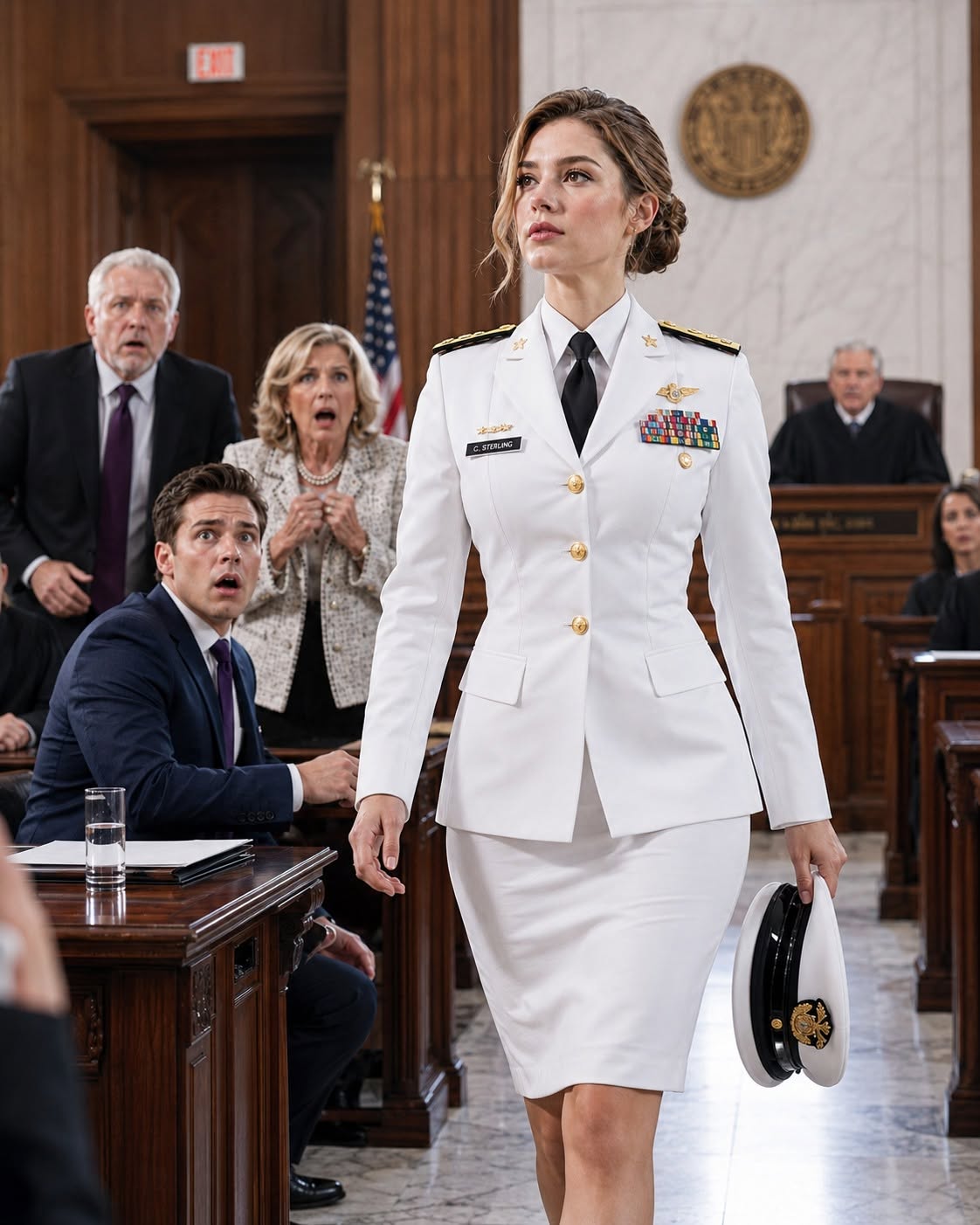
“Commander Sterling is impressive.”
That was never a good sign.
“Decorated career. Controlled demeanor. Government witness.”
He turned toward me.
“But impressive people can still be motivated by revenge.”
He displayed a message I had sent a friend eight years earlier.
One sentence:
Someday Luke's lies are going to collapse on top of him, and I hope I'm there to see it.
Shaw let the words sit.
“Did you write that?”
“Yes.”
“You wanted your brother destroyed.”
“I wanted the lies exposed.”
“You said you hoped to see them collapse on him.”
“Yes.”
“Sounds like revenge.”
“Sounds like I was angry.”
“You hate him.”
“I hate what he did.”
“Convenient distinction.”
“Important distinction.”
Shaw paced.
“You spent years collecting evidence against your own brother.”
“I spent years doing my job.”
“You recorded private conversations.”
“Under authorization.”
“You accepted his money.”
“Under authorization.”
“You lied to him.”
“Yes.”
Shaw stopped.
“So you admit you're capable of deception.”
Naomi objected.
The judge allowed limited questioning.
I leaned toward the microphone.
“Mr. Shaw, undercover cooperation generally fails if you begin the conversation by announcing you're recording it.”
A few jurors smiled.
Shaw's expression hardened.
“You think this is funny?”
“No.”
“Your brother could spend decades in prison.”
“Yes.”
“And that doesn't upset you?”
I looked at Luke.
For the first time throughout the entire trial, his eyes met mine without arrogance.
I remembered him teaching me to ride a bike.
Punching a boy who called me ugly in seventh grade.
Sneaking me extra birthday cake after Mom said I'd had enough.
People want monsters to be monsters in every memory.
They aren't.
That's what makes betrayal hurt.
“Yes,” I said quietly.
Shaw seemed surprised.
“It does upset you?”
“Yes.”
“Why?”
“Because he was my brother before he became the defendant.”
Luke looked down.
I continued.
“I didn't want this future for him.”
Shaw asked, “Then why are you helping send him to prison?”
“Because loving someone does not require helping them escape the consequences of what they chose.”
Silence.
Naomi's eyes met mine.
Shaw returned to his seat.
That night, my mother called.
For the first time in ten years, her number appeared on my phone and I answered without hesitation.
“Grace?”
“Yeah?”
“Your father and I are selling the lake house.”
I paused.
“Why?”
“We don't want it.”
“That may be complicated if it's subject to forfeiture.”
“I know.”
She took a breath.
“If anything remains after the government process, we want the money to go to the communities Luke cheated.”
I stared at the hotel window.
“That's a good idea.”
Mom continued.
“And the kitchen.”
“What about it?”
“I hate it.”
I laughed.
She did too.
Then her voice softened.
“I missed your laugh.”
My throat tightened.
“Goodnight, Mom.”
“Goodnight, sweetheart.”
She froze after saying it.
So did I.
Neither of us corrected it.
After the call, I stood alone for a long time.
The trial wasn't over.
Luke wasn't convicted.
My family wasn't magically repaired.
But for the first time in ten years, the future contained something other than absence.
Then Naomi texted me.
Caleb signed the agreement. He testifies tomorrow.
I knew what that meant.
The final wall around Luke was about to collapse.
May you like



And Luke knew it too.
Because less than an hour later, he made a decision that almost destroyed everything.
Related Stories







