Chapter 10 - THE PORCH THAT REMEMBEREDFor a moment, I could not move.
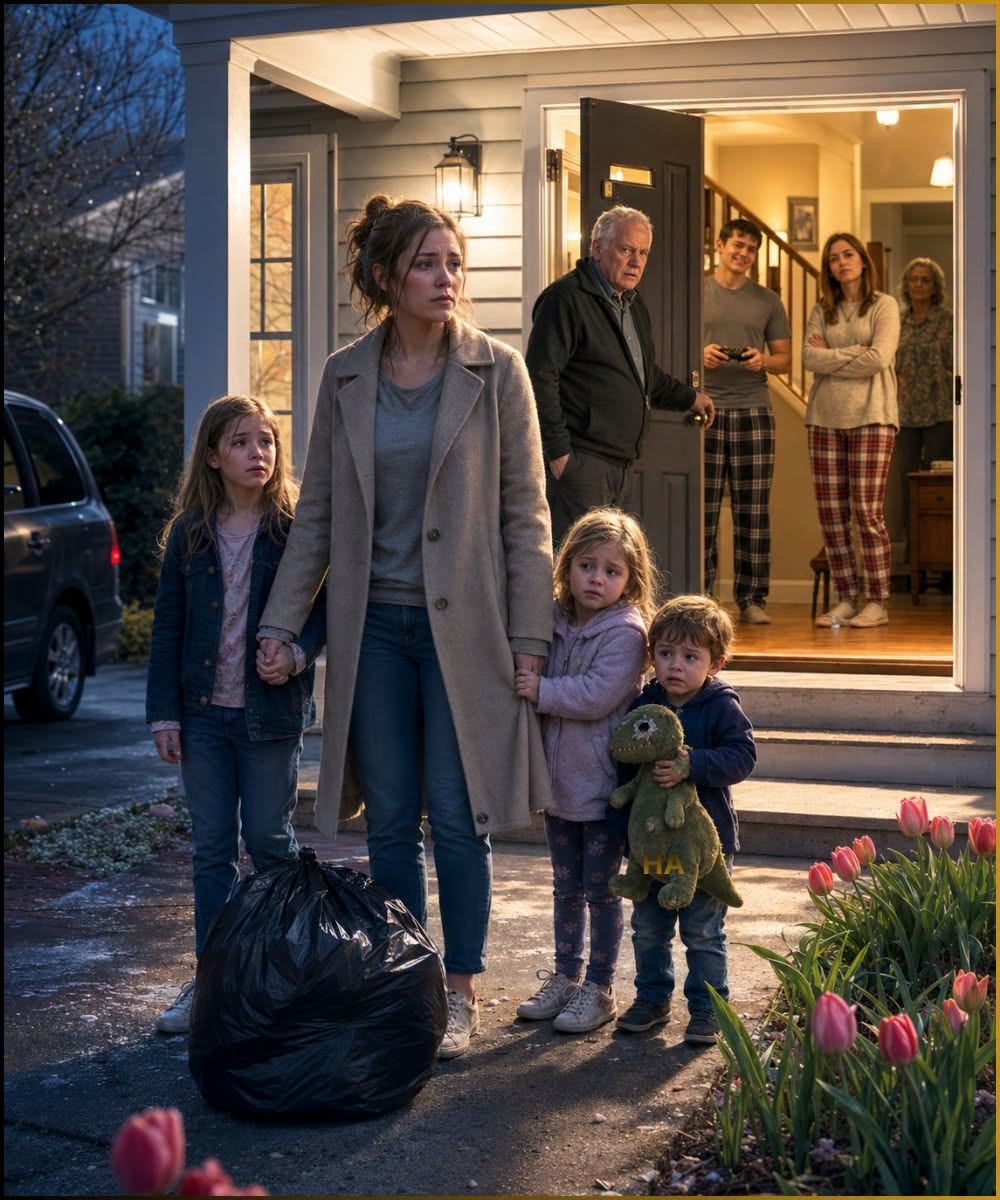
The image on my phone was too perfect.
Too cruel.
Too impossible.
My father stood stiffly in his winter coat, face gray with exhaustion. My mother clutched her purse with both hands, eyes darting toward the street like she was afraid the neighbors would see.
Tyler leaned against the porch railing, thinner than before, restless, angry, still managing to look offended by consequences.
At their feet sat two suitcases.
And the black garbage bag.
Not mine.
Theirs.
But my body did not know the difference.
Suddenly I was back there.
My parents’ porch.
My children behind me.
My whole life in plastic.
My father’s hand on the door.
My mother’s voice.
Close it.
The neighbors will see.
The doorbell rang again.
Katie looked up from the couch.
“Mom? Someone’s here.”
I locked my phone and forced my face into calm.
“Go upstairs with your brother.”
“Why?”
“Because I said so.”
She heard the tone and moved.
Sadie appeared in the hallway.
She had grown taller in eighteen months. Not enough to look like a teenager yet, but enough that childhood seemed to be loosening its grip. Her eyes went to my phone.
“Is it them?”
I did not ask how she knew.
“Yes.”
She swallowed.
“Are you going to let them in?”
That question held more than curiosity.
It held a porch.
A memory.
A lesson.
“No,” I said.
Something in her shoulders lowered.
Not relief exactly.
Safety.
I walked to the red door.
I did not open it.
I spoke through the video doorbell.
“What are you doing here?”
My mother flinched at the speaker.
“Cora,” she said. “Open the door.”
I almost laughed.
Not because it was funny.
Because the universe has a vicious sense of structure.
“What do you need?”
My father looked at the camera.
“We need to talk.”
“You can talk from there.”
Tyler scoffed. “Seriously?”
I ignored him.
My mother’s eyes filled with tears.
“We had nowhere else to go.”
The sentence moved through me like cold water.
I placed one hand against the inside of my red door.
Not to open it.
To steady myself.
“What happened?”
My father’s jaw worked.
“The house is being foreclosed on.”
My mother made a small sound, like the word itself was vulgar.
“Temporarily,” she said quickly. “It’s a temporary situation.”
Tyler rolled his eyes.
“It’s not temporary.”
“Be quiet,” my father snapped.
I watched them through the screen.
The family I once begged to shelter me now stood outside my home, asking the door to become kinder than they had been.
Brooke had warned me they were in trouble.
But trouble and arrival are different.
My mother stepped closer.
“Cora, please. It’s cold.”
I closed my eyes.
Behind me, the house was warm.
My children were safe upstairs.
Dinner simmered on the stove.
The life I built was breathing around me.
I thought about opening the door.
Not because they deserved it.
Because I knew cold.
I knew desperation.
I knew the humiliation of standing outside a lit house with nowhere to go.
That knowledge is dangerous.
It can make merciful people betray themselves.
So I asked the question nobody had asked me.
“Have you eaten?”
My father blinked.
My mother’s face crumpled slightly.
Tyler muttered, “Unbelievable.”
I looked at him through the camera.
“Tyler, if you speak again, I call the police.”
His mouth opened.
My father grabbed his arm.
Silence.
My mother cried harder.
“Cora, we made mistakes.”
I waited.
She looked toward the street.
“Can we please not do this outside?”
“The neighbors will see?” I asked.
Her face changed.
There it was.
Recognition.
Shame arrived late, but it arrived.
My father removed his glasses and rubbed his eyes.
“I’m sorry,” he said.
It was quiet.
Rough.
Not rehearsed.
My mother looked at him sharply, as if apologies were another debt they could not afford.
He continued.
“That night. I should have opened the door.”
My throat tightened.
“Yes,” I said. “You should have.”
He nodded.
“I was wrong.”
The sentence hung there.
Simple.
Massive.
My mother whispered, “We thought—”
“No,” I said. “Do not start with what you thought. Start with what you did.”
She stared at the camera.
I could see the battle in her face. Pride against need. Image against truth. Motherhood against performance.
Finally, she said, “I told him to close the door.”
“Yes.”
“I heard the children.”
“Yes.”
“I was ashamed.”
I laughed once, bitterly.
“Of me?”
She shook her head, crying now.
“Of what people would think.”
That was the first honest thing my mother had said to me in years.
Maybe ever.
I leaned my forehead against the door.
Sadie stood halfway down the stairs behind me. I did not turn, but I felt her there.
My father said, “We don’t expect you to take Tyler.”
Tyler jerked upright. “What?”
My mother looked panicked.
“Robert—”
“No,” my father said. His voice broke. “No more. We lost the house because we kept saving him from himself.”
Tyler’s face twisted.
“You’re blaming me?”
My father turned on him with a weariness that looked older than anger.
“Yes.”
The word cracked something open.
Tyler stepped back like he had been slapped.
My mother sobbed.
For a moment, I saw them not as villains, but as people drowning in a flood they had spent years calling rain.
That did not mean I had to drown with them.
I unlocked the door chain.
Sadie inhaled behind me.
I opened the door exactly six inches.
Cold air rushed in.
My parents looked smaller in person.
Tyler looked at the gap like he might force it wider.
He thought better of it when he saw my face.
“You cannot stay here,” I said.
My mother made a wounded sound.
I held up a hand.
“You cannot stay here,” I repeated. “My children’s home will not become a shelter for the same people who made them feel unwanted.”
My father closed his eyes.
My mother whispered, “They’re our grandchildren.”
“They were your grandchildren eighteen months ago.”
She flinched.
Good.
Some truths should leave marks.
I reached to the small table beside the door and picked up an envelope.
Brooke and I had prepared it after her warning.
Inside were printed resources.
A hotel voucher program.
A church emergency fund contact.
A legal aid number for foreclosure and debt counseling.
A list of shelters.
A number for a gambling addiction family support group.
And three hundred dollars in cash.
Not enough to fix them.
Enough to keep me from becoming them.
I handed it to my father through the gap.
His hand shook as he took it.
“This is what I can offer,” I said. “Information. One night of food and lodging if you use the cash carefully. Phone numbers for people trained to help.”
My mother looked at the envelope like it was an insult.
“You would send your own mother to a shelter?”
I looked at her.
“You sent your daughter to a parking lot.”
She had no answer.
Tyler laughed, but it came out weak.
“Wow. Guess success made you cold.”
I turned my gaze to him.
“No,” I said. “Survival made me clear.”
He looked away first.
My father’s eyes filled.
“Can I see the children?”
“Not tonight.”
“Cora—”
“Not tonight,” I said. “They are not here to soothe you. If they choose contact later, it will be slow, supervised, and based on changed behavior, not emergency guilt.”
My mother’s mouth trembled.
“You talk like a therapist.”
“I paid one instead of pretending pain disappears if nobody mentions it.”
Another silence.
Then my father nodded.
It was small, but real.
“Thank you,” he said.
My mother did not.
Tyler grabbed the garbage bag and stalked down the steps.
My father picked up the suitcases.
My mother remained for one second longer.
Her eyes lifted to the red door.
“You painted it,” she said.
“Katie chose the color.”
“She always did like bright things.”
I said nothing.
My mother waited, maybe for warmth, maybe for permission to become grandmother again in a sentence.
I gave her neither.
Finally, she turned and followed my father.
I closed the door.
Locked it.
Chained it.
Then I stood there, shaking.
Sadie came down the stairs.
“Mom?”
I turned.
Her eyes were wet.
“You didn’t let them in.”
“No.”
“But you helped them.”
“A little.”
“Why?”
I thought about that.
“Because I don’t want to be cruel,” I said. “But I also don’t want to be available for harm.”
Sadie nodded slowly.
Then she hugged me.
Not like a frightened child.
Like someone proud.
Katie yelled from upstairs, “Can we come down now or is this still dramatic?”
I laughed through tears.
“Come down.”
Owen appeared wearing dinosaur pajamas and holding a plastic sword.
“Did we win?”
I wiped my face.
I looked at the red door.
At the lock.
At the children.
May you like



At the life inside.
“Yes,” I said softly. “We did.”







