Chapter 7 - THE HEARINGThe day of the final custody hearing, I wore a navy dress from a thrift store and shoes Marla insisted made me look like “a woman who pays taxes and scares weak men.”
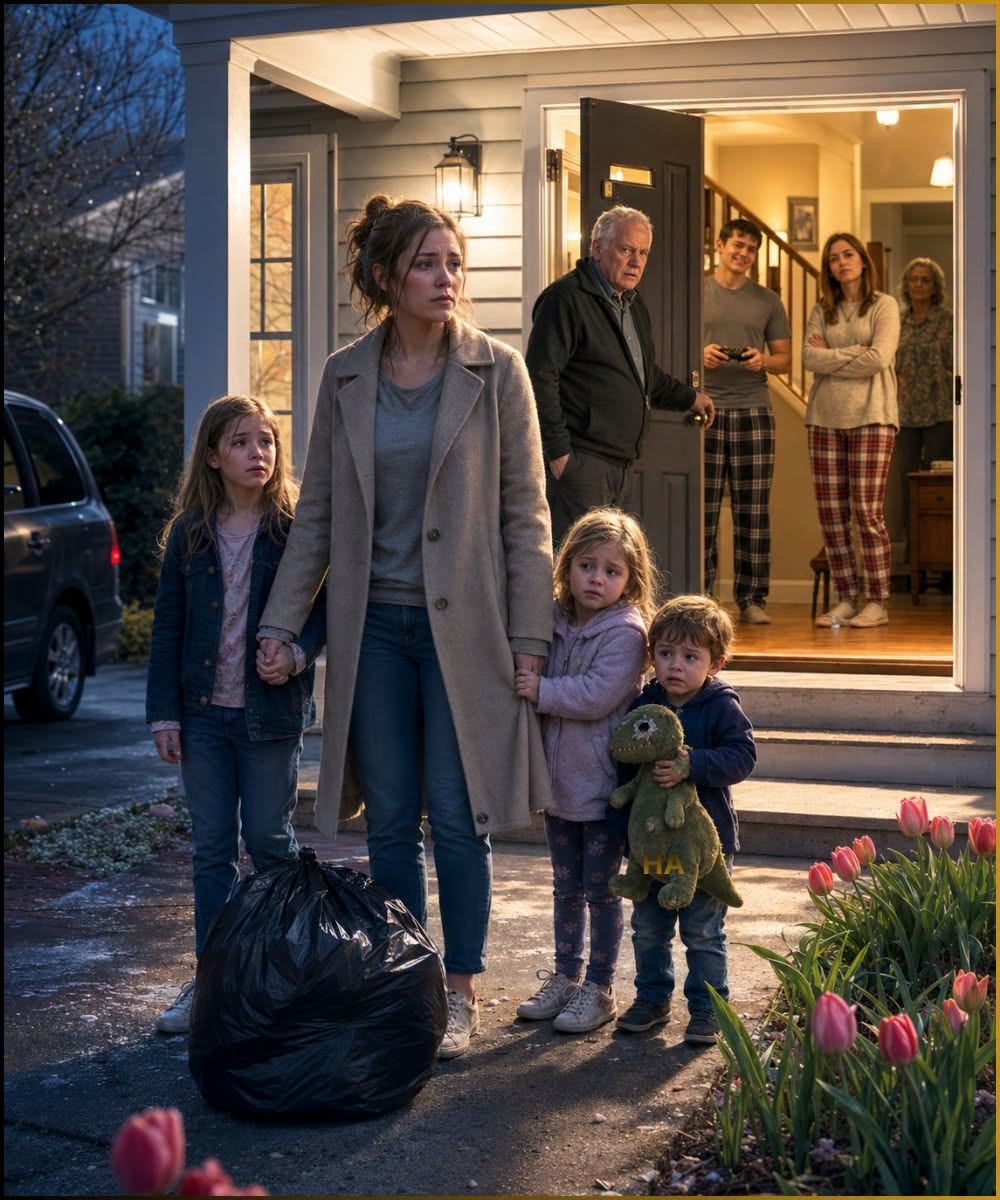
Sadie helped me zip the dress.
Katie gave me a sticker shaped like a star and told me to put it in my purse for courage.
Owen offered me his dinosaur.
“For biting,” he explained.
I kissed his head.
“I’ll try the legal system first.”
At the courthouse, Mark arrived with his attorney, his blue tie, and my parents.
Again.
This time Brooke came too, but Tyler did not.
I noticed because Tyler enjoyed my suffering too much to miss it voluntarily.
My mother looked thinner.
My father looked older.
Neither looked sorry.
Nina leaned close.
“Remember,” she said. “Answer only what is asked. Don’t argue. Don’t explain beyond the question. You are not on trial for being human.”
But it felt like I was.
Custody hearings are strange that way.
A woman can survive years of control, fear, manipulation, and exhaustion, only to sit in a courtroom while strangers examine whether she packed lunches consistently enough to deserve her children.
Mark testified first.
He was excellent.
I will give him that.
He spoke about family values. Stability. The marital home. The children’s routines. His concern for my mental health. His willingness to forgive.
Forgive.
As if freedom were something I had done to him.
His attorney asked, “Do you believe Mrs. Bennett has tried to alienate the children from you?”
Mark sighed.
“I don’t want to speak badly about their mother.”
Then he spoke badly about me for seventeen minutes.
Nina cross-examined him with the calm expression of a woman trimming a hedge.
“Mr. Bennett, did you move funds from the joint account the morning after your wife left?”
“I was protecting assets.”
“From groceries?”
He blinked.
Nina held up a printed message.
“Did you write, ‘You’re nothing without me’?”
“I was emotional.”
“Did you write it?”
“Yes.”
“Did you tell Mrs. Bennett no judge would give her the children?”
“I don’t recall the context.”
“Convenient,” Nina said.
Mark’s attorney objected.
Sustained.
But the judge had heard it.
Then came the visitation supervisor.
She testified that Mark repeatedly questioned the children about my home, finances, and whether I was dating.
I was not.
I barely had time to shave both legs in the same week.
Sadie’s school counselor testified gently about anxiety, hypervigilance, and improvement.
Marla testified with less gentleness.
When Mark’s attorney suggested she was biased because she employed me, Marla leaned into the microphone.
“Honey, I’m biased against men who send flowers to a woman they financially strangled. If that’s a legal problem, write it down.”
Nina closed her eyes.
The judge looked down, possibly hiding a smile.
Then my mother testified.
I had known she might.
I had prepared.
Still, watching her raise her right hand hurt in a way I cannot fully explain. She had taught me to make pancakes, tie bows, write thank-you notes, and never leave the house with wet hair. Now she sat fifteen feet away, ready to help my husband prove I was unstable.
Mark’s attorney asked, “Mrs. Hale, were you concerned when your daughter came to your home that night?”
My mother folded her hands.
“Very.”
“Why?”
“She was emotional. The children were tired. It was late. We didn’t know what had really happened.”
“Did you refuse to help her because you didn’t love her?”
My mother’s eyes shone.
“Of course not. We thought the best thing for the children was for Cora to calm down and go home.”
There it was.
Packaged.
Polished.
Cruelty dressed as concern.
Nina stood.
“Mrs. Hale, how many bedrooms are in your house?”
“Four.”
“And who lives there?”
“My husband and I. Our son Tyler.”
“Where does Tyler sleep?”
“The basement.”
“Is the basement finished?”
“Yes.”
“With a bathroom?”
“Yes.”
“With a separate living area?”
“Yes.”
“Did your daughter ask to stay permanently?”
“No.”
“What did she ask?”
My mother’s mouth tightened.
“She said she had nowhere to go.”
“And you told your husband to close the door because the neighbors would see, correct?”
My mother went pale.
Mark looked sharply at her.
Nina lifted a paper.
“Your daughter wrote that in her sworn statement. Are you saying it’s false?”
My mother looked at me.
For the first time in a year, I saw something like shame.
Then she looked away.
“No,” she whispered.
Nina’s voice softened, which somehow made it worse.
“Mrs. Hale, did you ask whether your grandchildren had eaten?”
Silence.
“Did you ask whether they were safe?”
My mother swallowed.
“No.”
“Did you offer to pay for a motel?”
“No.”
“Did you call the next morning to check on them?”
My mother’s eyes filled.
“No.”
Nina nodded.
“No further questions.”
When I testified, my hands shook only once.
I told the truth.
Not dramatically.
Not perfectly.
Just clearly.
I told the judge about the night I left. About Room 118. About work and school and therapy and the children’s progress. About documentation. About fear. About stability built without a safety net.
Mark’s attorney tried to paint me as bitter.
“Mrs. Bennett, isn’t it true that you want to punish your husband?”
“No.”
“You don’t resent him?”
“I resent what he did. That is different.”
“You want the court to believe you left for the children?”
I looked at Mark.
Then at my parents.
Then at the judge.
“I left because I did not want my daughters to think marriage meant disappearing,” I said. “And I did not want my son to think love meant control.”
The courtroom went still.
Three weeks later, the order arrived.
Primary physical custody to me.
Joint legal custody with limitations.
Mark’s visitation expanded only if he completed counseling, a parenting program, and complied with communication rules through a monitored app.
Child support ordered.
Spousal support temporary.
The marital home to be addressed in divorce proceedings.
It was not a fairy tale.
It was a court order.
Which, in my life at that moment, was better.
That night, I made spaghetti and garlic bread.
The children asked why we were celebrating.
I told them, “Because we get to keep building.”
Sadie looked at me carefully.
“Does that mean we won?”
I thought about it.
Winning sounded too simple.
Too clean.
“No,” I said. “It means we’re safe enough to grow.”
Katie raised her cup of milk.
“To growing!”
Owen lifted his dinosaur.
“To biting if needed!”
We clinked glasses.
For dessert, we ate grocery store cupcakes with too much frosting.
I saved the court order in a folder.
Not Evidence this time.
May you like
A new one.
Freedom.
Related Stories