Chapter 9 - THE HOUSE WITH THE RED DOORThe red door was Katie’s idea.
By month sixteen, The Clean Slate had enough steady contracts that my accountant, a soft-spoken man named Mr. Bell who wore sweater vests in every season, told me I could qualify for a small business loan.
I thought he was joking.
“I clean houses,” I said.
“You run a service business with recurring revenue, documented expenses, payroll records, and growth.”
I stared at him.
He smiled.
“Sometimes people need someone else to say the official words.”
The official words changed me.
I was not just surviving.
I was running a business.
A real one.
With insurance, invoices, supplies, branded shirts, and a waiting list.
Marla celebrated by making me a cake that said CONGRATS ON BEING ALARMINGLY COMPETENT.
I cried into the frosting.
The house came from Mrs. Hanley.
Not as a gift.
I would never have accepted that.
Her nephew owned a small two-story house on Maple Street that had been sitting empty since his divorce. It needed paint, new gutters, and someone who did not mind a kitchen from 1987.
To me, it looked like a castle.
Three bedrooms.
A small yard.
A front porch.
A front porch.
The first time I stood on it, my body remembered another porch.
Cold.
Yellow light.
A door half open.
A garbage bag at my feet.
Mrs. Hanley touched my arm.
“Bad memory?” she asked.
I nodded.
She pointed at the door.
“Then paint it something loud.”
So we did.
Red.
Bright red.
Katie chose it because “nobody sad can knock on a red door.”
Sadie chose her bedroom based on the morning light.
Owen chose his based on where his dinosaur would have the best “guarding angle.”
I signed the lease-purchase agreement with a hand that barely shook.
Move-in day became a community event.
Marla brought sandwiches.
Denise brought cleaning supplies and said it was ridiculous to bring cleaning supplies to the owner of a cleaning business, but she did it anyway.
Renee brought curtains.
Brooke brought a toolbox and admitted she had learned basic repairs from YouTube because “apparently waiting for emotionally unavailable men to fix things is not a life plan.”
That made Marla laugh for nearly a minute.
We moved in with secondhand furniture, donated lamps, mismatched dishes, and more gratitude than space.
That night, after everyone left, I stood in the living room surrounded by boxes.
Sadie came up beside me.
“It feels quiet,” she said.
“Good quiet or bad quiet?”
She thought about it.
“New quiet.”
I put my arm around her.
“We can fill it slowly.”
The children adjusted faster than I did.
They ran up and down the stairs. They argued about bathroom turns. Katie taped drawings to every available surface. Owen placed dinosaurs in windows for security. Sadie started inviting a friend from science club over on Fridays.
I, however, kept waiting for the house to vanish.
Trauma makes peace feel temporary.
Every bill paid felt like a trick.
Every good day felt like bait.
My therapist, Angela, told me that safety takes practice.
“You spent years scanning for danger,” she said. “Your nervous system thinks vigilance is love.”
I hated how accurate that was.
“So what do I do?”
“Notice peace without interrogating it.”
That sounded fake.
Then I tried.
Morning light on the kitchen floor.
Coffee in my own mug.
Katie singing off-key upstairs.
Owen roaring in the hallway.
Sadie laughing at something on her phone.
Peace.
Not perfect.
Not guaranteed.
But present.
I practiced noticing.
Two months after we moved in, I hosted Sadie’s tenth birthday party.
Ten.
Double digits.
She asked for a science theme, so Brooke helped create experiments involving baking soda, food coloring, and what I considered an irresponsible amount of glitter.
Mark arrived for pickup later that evening and saw the decorations through the window.
His face changed.
It was the first time he saw the life we had built without him not as a temporary rebellion, but as a structure.
A home.
A better one.
“You bought this place?” he asked.
“Not that it’s your business, but lease-purchase.”
“With what money?”
I smiled.
“My alarming competence.”
He did not understand the joke, which made it better.
The children came out with overnight bags for his scheduled weekend.
Sadie hugged me longer than usual.
“You have your phone?” I asked.
She nodded.
“Call if you need anything.”
Mark’s jaw tightened.
“I’m their father. They don’t need a panic button.”
I looked at him.
“Then don’t act like a reason for one.”
He stepped closer.
Then stopped.
The doorbell camera above my red door blinked blue.
He noticed.
I smiled again.
The weekend passed without incident, mostly because Mark now understood that I documented everything and the court believed paper more than performance.
By then, Tyler’s life was collapsing.
Brooke told me in careful pieces.
My parents had refinanced the house.
Tyler’s debts had multiplied.
My father delayed retirement.
My mother blamed stress, bad influences, the economy, Brooke’s lack of support, my abandonment, and “the culture.”
Anything but Tyler.
Anything but themselves.
Then, in February, eighteen months after the night on the porch, my father lost his job.
Not fired, exactly.
Restructured.
A polite word for being handed a cardboard box at sixty-three.
The house of cards shook.
Two weeks later, Tyler disappeared for three days with my mother’s car.
When he came back, the car had a dented bumper, an empty gas tank, and a notice from a payday lender in the glove compartment.
My father finally told him to leave.
Tyler laughed.
From the basement.
The same way he had laughed at me.
Only this time, he was laughing at the people who had built him a throne underground.
My mother called Brooke sobbing.
Brooke called me after, not to ask for help, just to tell me.
“How do you feel?” she asked.
I stood at my kitchen window, looking at the red door reflected faintly in the glass.
I expected satisfaction.
Victory.
A lightning strike of justice.
Instead, I felt tired.
“I feel like they spent years feeding a fire and now they’re shocked the house is burning.”
Brooke was quiet.
Then she said, “Mom asked for your address.”
My stomach tightened.
“Did you give it to her?”
“No.”
“Thank you.”
“She said they’re still your parents.”
I looked around my kitchen.
At the calendar full of children’s activities.
At invoices stacked beside permission slips.
At the life I had built from a garbage bag.
“No,” I said. “They’re the people who raised me. Parents open doors.”
Brooke inhaled.
“I’m sorry.”
“I know.”
And she did.
That mattered.
But it did not change what came next.
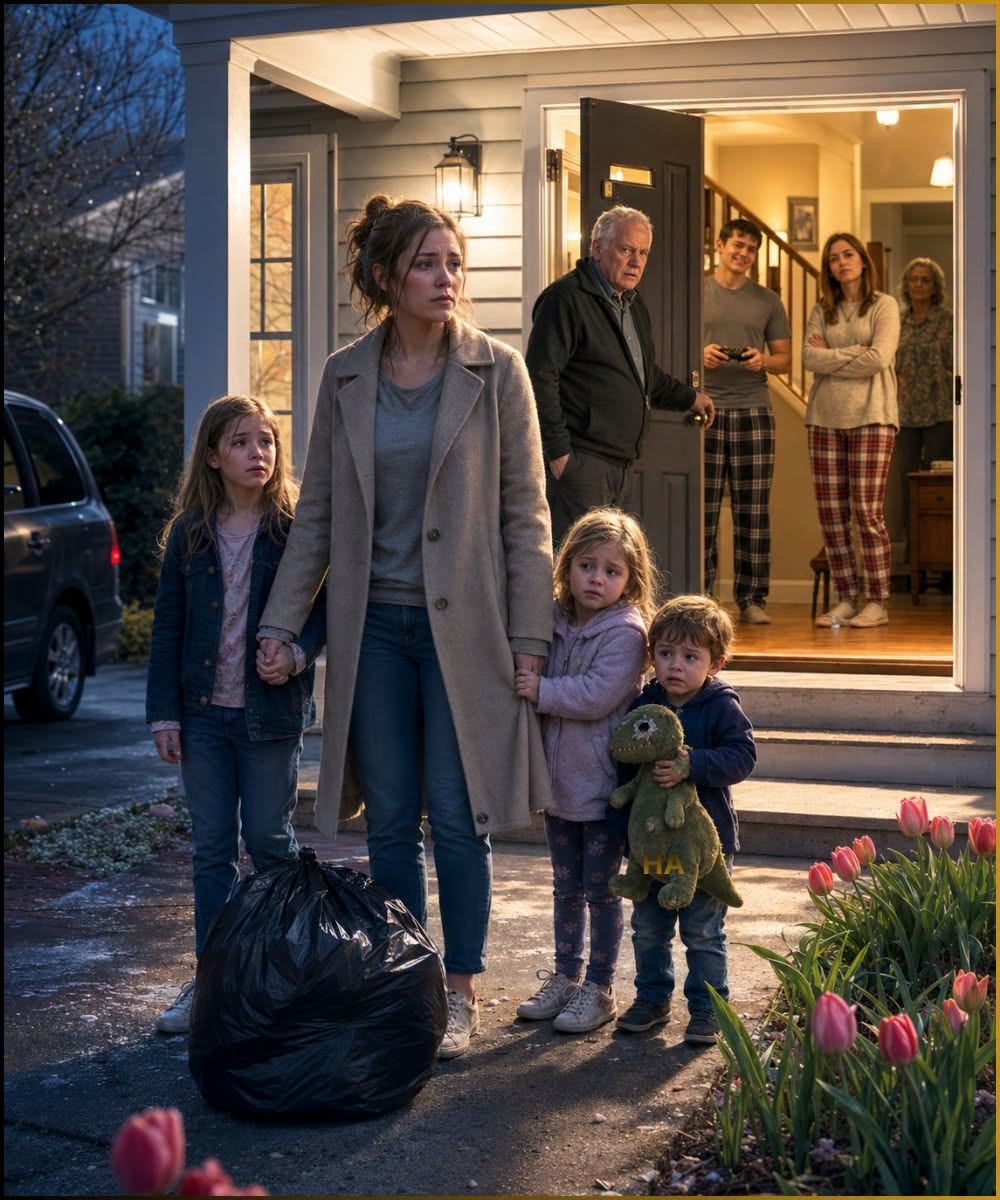
Because three days later, on a cold March evening, my doorbell camera lit up.
I opened the app.
My parents stood on my porch.
Behind them was Tyler.
May you like



At their feet sat two suitcases.
And one black garbage bag.
Related Stories







