Chapter 4 - THE BASEMENT PRINCEWord travels differently in small towns.
Facts walk.
Rumors sprint.
By the end of my first week at Ruthie’s, half of Millbrook knew I had left Mark. By the second week, the story had grown legs, teeth, and a tail.
Cora had a breakdown.
Cora ran off with the kids.
Cora was staying in a motel.
Cora was punishing Mark because he had one little affair.
Cora’s parents were heartbroken.
That last one made Marla snort so hard she nearly dropped a coffee pot.
“Heartbroken people open doors,” she said.
I worked every shift she gave me.
Six to two at the diner.
Then school pickup.
Then paperwork, calls, shelter appointments, legal meetings, laundry, homework, dinner made from whatever was cheapest, baths, bedtime, and finally the quiet hour when fear crawled back in through the cracks.
We moved from the motel into a transitional apartment on the edge of town.
Unit C.
Two bedrooms.
One bathroom.
A kitchen window that faced a brick wall.
To me, it looked like heaven with peeling paint.
Sadie and Katie shared a room. Owen slept in a toddler bed squeezed into mine. The first night, Katie taped a drawing to the refrigerator.
It showed four stick figures standing under a yellow sun.
At the top, in crooked purple letters, she wrote:
OUR SAFE HOUSE.
I cried in the pantry because there was nowhere else to do it.
Mark did not stop.
Men like Mark rarely stop when they lose control. They simply change costumes.
First came the flowers at Ruthie’s.
A huge arrangement of white roses delivered during the breakfast rush with a card that read:
Come home. Let’s stop hurting the kids.
Marla read it, rolled her eyes, and dumped the whole thing in the trash behind the diner.
“You want the vase?” she asked.
“No.”
“Good. Ugly vase.”
Then came the social media post.
A photo of Mark with the children from the previous Christmas.
Caption:
Missing my babies. Praying their mother chooses healing over bitterness.
People commented hearts.
Praying for you, brother.
Stay strong.
The kids need their dad.
I learned then that the internet loves a sad father if he is handsome and vague.
Nina told me not to respond.
“Courtrooms like silence better than screenshots of emotional arguments,” she said.
So I stayed silent.
But my family did not.
Brooke posted a quote about forgiveness.
Tyler posted a meme about “modern women destroying families.”
My mother posted nothing, which was somehow louder.
Then one afternoon, while I was wiping syrup off table seven, Tyler walked into Ruthie’s.
He wore sweatpants, expensive sneakers, and the same smirk he had worn in my parents’ hallway. Behind him were two friends I recognized from high school, men who had somehow aged without maturing.
“Well, well,” Tyler said, sliding into a booth. “Look at you. Back in food service.”
Marla looked up from the register.
Every waitress in the diner went still.
I walked over with a pot of coffee.
“What can I get you?”
Tyler grinned. “You can start by not acting like you’re better than everybody.”
“I asked what you wanted to order.”
His friends chuckled.
“You always were dramatic,” Tyler said. “Mom’s a mess because of you.”
I held the coffee pot steady.
“No,” I said. “Mom is uncomfortable because I stopped pretending.”
His smirk slipped.
“Dad says you won’t let them see the kids.”
“Dad had his chance to see them on the porch.”
Tyler leaned back.
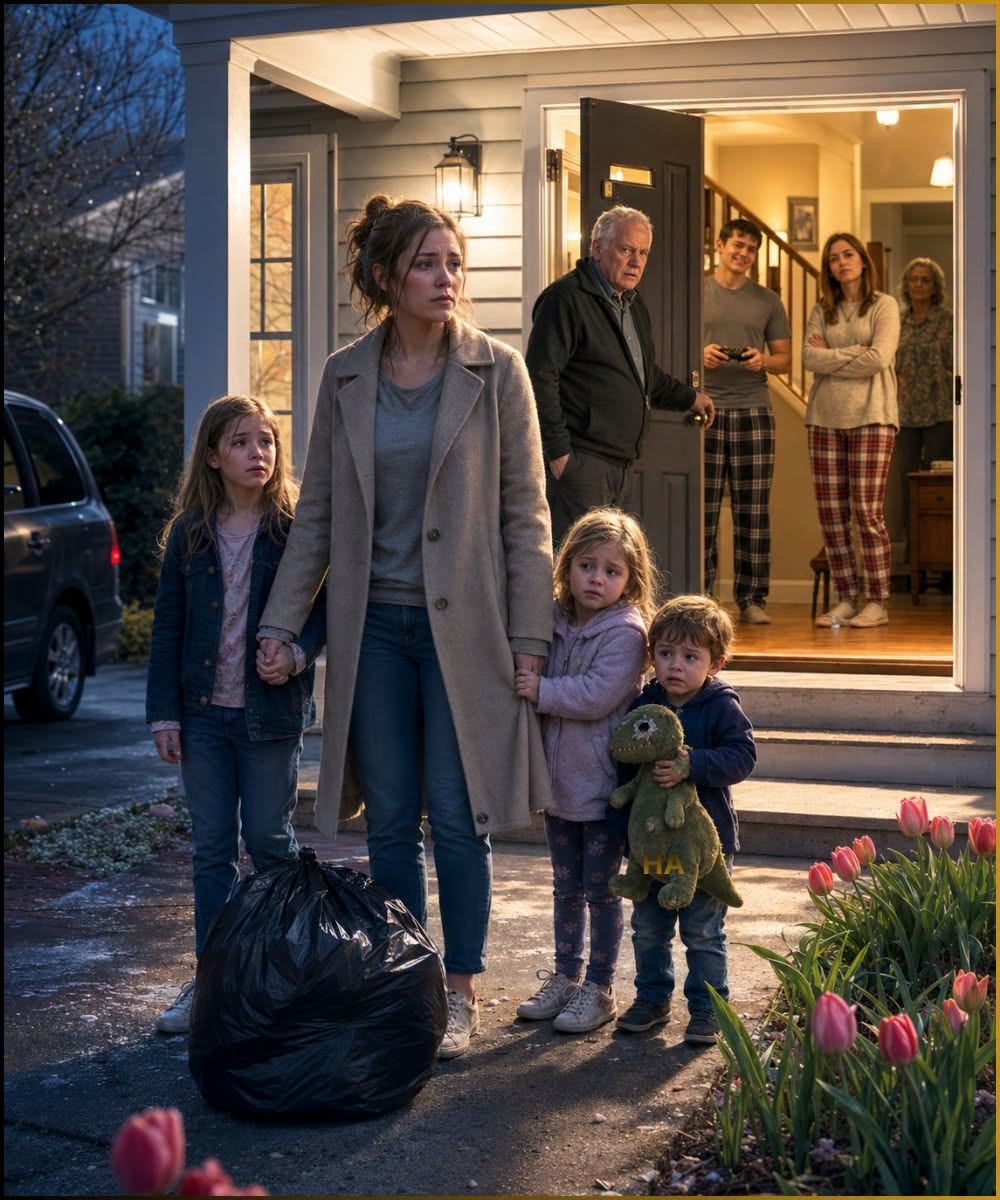
“You mean when you showed up in the middle of the night with a garbage bag like some kind of victim?”
There it was.
The word they could not stand.
Victim.
People who benefit from your silence hate when you name your wound.
I set the coffee pot down.
Marla appeared beside me.
“You ordering food,” she asked Tyler, “or auditioning to get thrown out before lunch?”
Tyler laughed. “This is a public restaurant.”
“And I’m the public who owns it.”
His friends stopped laughing.
Tyler looked around, realizing the entire diner was watching.
He stood slowly.
“You’re going to regret acting like this, Cora.”
I smiled.
It surprised both of us.
“I already know what regret feels like,” I said. “It sounds a lot like you laughing while my children stood outside in the cold.”
His face flushed.
He left without ordering.
That night, my father called from an unknown number.
I answered because I thought it might be legal aid.
“Cora,” he said.
I almost hung up.
Then I put the phone on speaker and set it on the kitchen counter, the way Nina had told me to do with any family call. Recordings required consent in some situations, but speakerphone allowed witnesses if needed. Sadie sat at the table pretending to do math. Her pencil stopped moving.
“What do you want?” I asked.
“Your brother said you humiliated him today.”
I looked at the sink full of dishes.
“Tyler came to my workplace to humiliate me. He failed.”
My father sighed. “Why are you doing this?”
There it was again.
The family translation machine.
Their cruelty became my behavior.
Their choices became my problem.
“I’m surviving,” I said.
“At what cost? Your mother cries every night.”
“Did she cry the night you closed the door?”
Silence.
Then, lower, “That was complicated.”
“It was a door, Dad. Doors are not complicated. They open or they don’t.”
His voice hardened. “You’ve changed.”
I looked around my tiny apartment.
At Katie’s drawing.
At Owen asleep with his dinosaur.
At Sadie watching me with careful eyes.
“Yes,” I said. “Finally.”
I hung up.
Sadie looked down at her worksheet.
After a moment, she said, “Grandpa sounded mad.”
“He is.”
“Because you told the truth?”
I pulled out the chair beside her.
“Sometimes people get mad when the truth stops serving them.”
She thought about that.
Then she erased an answer on her math page and corrected it.
“Mom?”
“Yeah?”
“I don’t want to go back to being quiet.”
I swallowed hard.
“You don’t have to.”
In the weeks that followed, I learned that survival is not one big heroic act.
It is forms.
It is bus passes.
It is learning which grocery store marks down chicken on Thursdays.
It is saying no while your voice shakes.
It is showing up to work with swollen eyes and still remembering who ordered decaf.
It is letting strangers help you more than your family did.
It is building a life so slowly that nobody notices until one day the thing stands.
And beneath my parents’ house, Tyler still lived in the basement for free.
No rent.
No bills.
No responsibility.
My mother washed his clothes.
My father paid his car insurance.
He played games all night and called me dramatic from a room he had never earned.
But something had shifted.
May you like
For the first time, I was not jealous of the room he had.
I was proud of the door I had survived without.
Related Stories