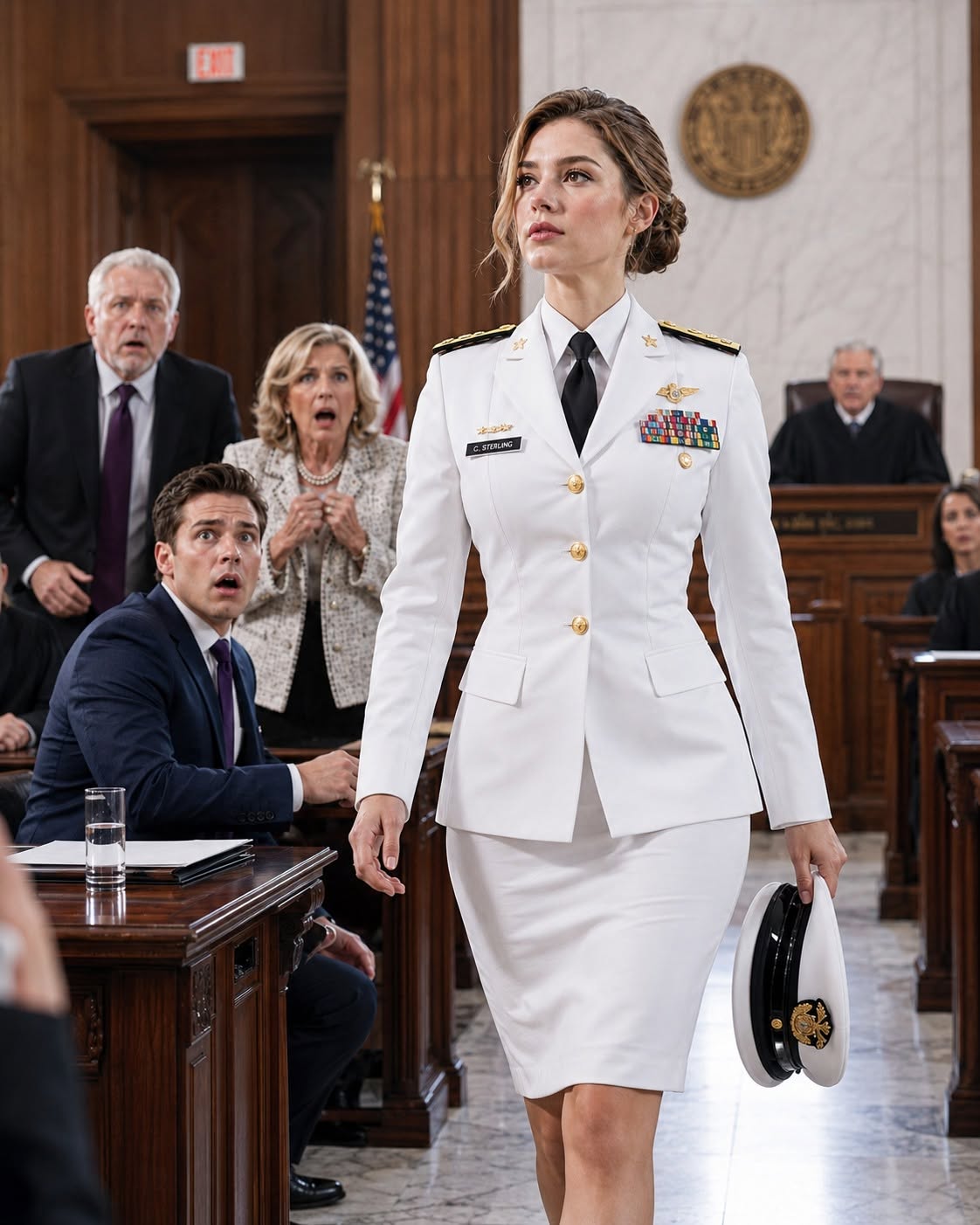
Chapter 2 - The Name Behind the MedalsFor several seconds, I forgot the Marines were standing there.

The noise of the terminal slowly returned around us—rolling luggage, boarding announcements, a child crying somewhere near the coffee stand—but General Holloway’s words stayed lodged in my mind.
He’s already trying to stop you.
I closed my fingers around the folder.
“Who knows?”
Holloway glanced toward Carter and the others.
“Not here.”
That told me enough.
This was no longer an embarrassing confrontation between an inexperienced corporal and an officer he had misjudged.
Something had changed.
Holloway looked at Carter.
“Identification.”
Carter immediately pulled out his military ID.
Holloway examined it.
“Twenty-two years old.”
“Yes, sir.”
“First enlistment?”
“Yes, sir.”
“Stationed at Camp Pendleton?”
“Yes, sir.”
Holloway handed it back.
“Then perhaps your leadership failed to teach you something basic.”
Carter stood rigidly.
“Sir?”
“Rank deserves professional courtesy. People deserve basic respect. Neither requires you to understand their entire life story first.”
Carter’s face reddened.
“Yes, sir.”
Holloway looked toward Carter’s companions.
“Names?”
“Lance Corporal Price, sir.”
“Lance Corporal Moreno, sir.”
Both looked miserable.
“Were either of you participating?”
Moreno answered immediately.
“No, sir.”
Price hesitated.
“I laughed at first, sir.”
Holloway studied him.
“At least you answered honestly.”
Then he looked at me.
“Colonel Shaw?”
He was giving me the choice.
Formal complaint.
Airport security.
Chain of command.
Public humiliation.
All of it was available.
Nine years earlier, I would have wanted Carter destroyed.
Nine years earlier, anger had been easier than grief.
Today, I simply felt tired.
“Corporal Carter.”
He faced me.
“Yes, ma’am.”
“You made an assumption.”
“Yes, ma’am.”
“You decided what an Army colonel was supposed to look like.”
His throat moved.
“Yes, ma’am.”
“And when reality didn’t match what you had imagined, you chose ridicule.”
“Yes, ma’am.”
His voice was barely audible now.
I watched him carefully.
“Do you understand why that concerns me more than your disrespect toward me personally?”
He looked uncertain.
“No, ma’am.”
“Because someday somebody may depend on your judgment.”
His eyes changed.
“A Marine under you might not look like the person you expect to be brave. A civilian might not look important enough to listen to. A young lieutenant might not look experienced enough for you to follow.”
I leaned slightly closer.
“Bad judgment under fluorescent airport lights embarrasses you.”
I paused.
“Bad judgment under fire kills people.”
Carter swallowed.
“Yes, ma’am.”
“Sit down.”
He did.
I turned toward Holloway.
“Where?”
“Private lounge.”
He started walking.
I followed.
As we passed the windows, I saw our reflections moving through the terminal.
His dark uniform.
My white one.
For a moment, I remembered another set of reflections.
Night-vision goggles.
Fire.
Eight soldiers crowded inside a transport helicopter flying low over black mountains.
Captain Evelyn Shaw had been thirty-two years old then.
Not Colonel.
Not decorated.
Not famous inside classified military circles.
Just an aviation officer assigned to a joint special operations support mission whose official paperwork would later describe it as a “routine extraction complicated by mechanical failure.”
That sentence had haunted me for nine years.
There had been nothing routine about it.
We reached an airline lounge near the end of the concourse.
Holloway showed credentials to an employee.
Minutes later, we were inside a small conference room behind frosted glass.
He locked the door.
Then he placed his briefcase on the table.
“You look like your mother,” he said.
I blinked.
Of everything I expected him to say, that wasn’t it.
“You met her twice.”
“Three times.”
“She never told me about the third.”
“Fort Bragg. Your promotion ceremony.”
I smiled faintly.
“She probably didn’t count that. She hated military ceremonies.”
“She threatened to hit me with her purse because I kept you standing at attention too long.”
“That sounds like her.”
The smile disappeared.
My mother had died eighteen months earlier.
She had spent her final years believing the official version of what happened in Syria because I was legally forbidden to tell her otherwise.
She knew I had been injured.
She knew men had died.
She never knew why I still woke up hearing Daniel Ruiz begging me not to leave him.
Holloway opened his briefcase.
He removed a sealed envelope.
“Someone sent this to my office yesterday.”
I opened it.
Inside was a photocopy of a classified after-action report.
Across the first page, someone had written three words in red ink.
LET IT STAY BURIED.
I felt cold.
“Where did this come from?”
“No return address.”
“Fingerprints?”
“Being processed.”
I studied the document.
At the bottom of the page was the signature I had spent nine years trying to prove was attached to a lie.
BRIGADIER GENERAL RICHARD VALE.
Now retired.
Now CEO of Vale Strategic Systems.
A defense contractor worth nearly four billion dollars.
And tomorrow, unless something went wrong, I was going to testify that Richard Vale had knowingly sent our aircraft into hostile territory using intelligence he had been warned was compromised.
Worse, he had altered the operational record afterward.
Three dead soldiers.
Two permanently disabled.
One career built on silence.
“Why now?” I asked.
“Because Colonel Mercer found something.”
I looked up.
“What?”
Holloway pulled out another sheet.
“A transmission log.”
My pulse quickened.
I had heard rumors about the missing communication file for years.
Officially, it had never existed.
The log could prove that Vale had been warned twelve minutes before our helicopter entered the valley.
“Where is Mercer?”
Holloway’s expression answered before his words did.
“Missing.”
I stared at him.
“Since when?”
“Thirty-six hours.”
“Does anyone outside the review board know he found the log?”
“Yes.”
“Vale?”
“We don’t know.”
I pushed my chair back.
“Then tomorrow’s ceremony should be canceled.”
“It isn’t really a ceremony anymore.”
I frowned.
Holloway sat across from me.
“The recognition is still happening publicly. The closed session afterward is the real reason you were ordered to Washington.”
“I know.”
“No.”
He held my gaze.
“You know part of it.”
Silence.
“The Department of Defense Inspector General reopened the investigation.”
I felt my heartbeat in my throat.
“Based on what?”
“Mercer’s discovery.”
“Without the transmission log, you have nothing.”
“We have you.”
I laughed once without humor.
“They’ve had me for nine years.”
“This time they’re willing to listen.”
That sentence should have felt like victory.
Instead, it made me angry.
“I submitted three reports.”
“I know.”
“I challenged Vale’s after-action statement.”
“I know.”
“I requested congressional review.”
“I know.”
“I was told I had trauma-related memory contamination.”
Holloway’s jaw tightened.
“I know.”
“I was ordered to stop discussing it.”
“I know, Evelyn.”
He rarely used my first name.
That silenced me.
He looked older suddenly.
Not like a four-star general.
Like the father of a dead son.
“My son called me six hours before that mission.”
I had never heard this.
“He told me he was worried about the intel.”
My breath caught.
“What did he say?”
“That Captain Shaw had concerns too.”
I looked away.
Daniel had trusted me.
Right up until the end.
Holloway continued.
“He told me if something went wrong, I shouldn’t let anyone blame you.”
My eyes burned.
I hated that.
I hated crying.
Especially in uniform.
“Why didn’t you tell me?”
“Because after he died, I wanted someone to blame.”
He looked at his hands.
“For a while, I blamed everyone who survived.”
The confession surprised me.
“Including you.”
I said nothing.
“I’m ashamed of that.”
“Sir—”
“No. You deserve to hear it.”
His voice roughened.
“You carried Daniel for almost half a mile.”
“Seven hundred yards.”
He looked up.
I had no idea why I corrected him.
Maybe because distance mattered when every yard had contained gunfire.
Holloway nodded.
“Seven hundred yards.”
Neither of us spoke for a moment.
Then my phone vibrated.
Unknown number.
I opened the message.
There was a photograph.
My stomach dropped.
It showed the front porch of my house in Virginia.
Taken that morning.
Then another photograph arrived.
My fourteen-year-old niece, Lily, stepping onto a school bus.
I stood so quickly my chair tipped backward.
Holloway moved around the table.
“What?”
I showed him.
A third message appeared.
WASHINGTON ISN’T WORTH LOSING ANOTHER SOLDIER.
Holloway’s expression turned hard.
“Call your sister.”
I already was.
Rachel answered on the third ring.
“Evie?”
“Where’s Lily?”
“At school. Why?”
“Go get her.”
“What happened?”
“Rachel, listen to me. Pick Lily up and go to Dad’s house.”
“Evie—”
“Now.”
My sister knew my voice.
She stopped arguing.
“Okay.”
“And don’t tell anyone where you’re going.”
I ended the call.
Holloway was already dialing military security.
Then someone knocked on the conference-room door.
Three slow knocks.
Holloway froze.
We exchanged a look.
Nobody should have known we were inside.
Another knock.
“General Holloway?”
A male voice.
Holloway reached inside his jacket.
“Who is it?”
“Airport police.”
He opened the door only a few inches.
Two uniformed officers stood outside.
Between them was Corporal Carter.
The same young Marine who had mocked me twenty minutes earlier.
Except he wasn’t laughing now.
He was holding a black smartphone.
“Ma’am,” Carter said, breathing hard, “I think the guy sitting behind you left this under your chair.”
My blood chilled.
“What guy?”
Carter swallowed.
“He left right after the general said your name.”
He extended the phone.
On its screen was a photograph.
Not of me.
Not of my family.
Colonel Mercer.
Bound to a chair.
Alive.
Underneath the image was a countdown clock.
May you like



11:47:32.
And it was running.
Related Stories