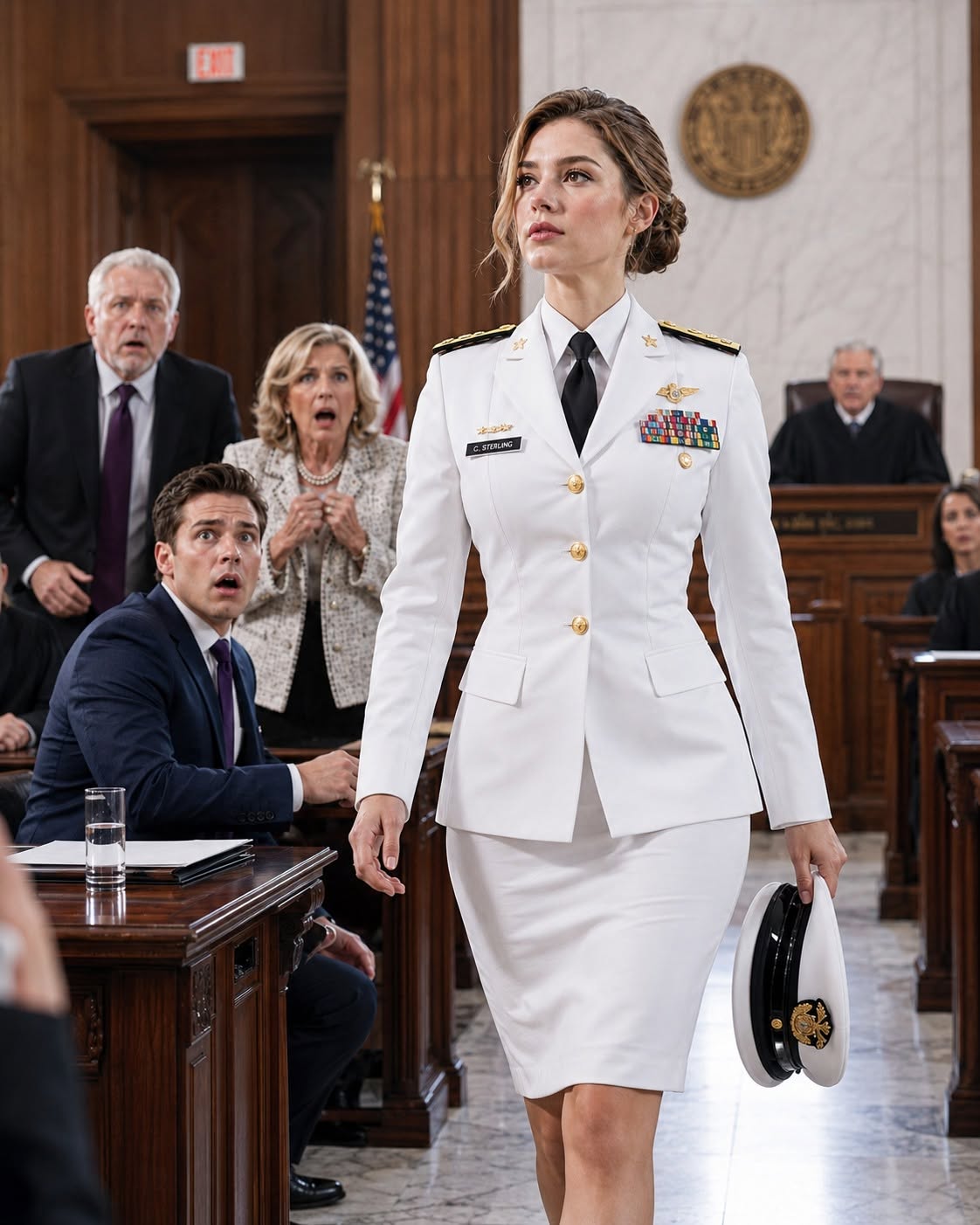
Chapter 11 - The Hearing America Never SawSix months later, Richard Vale entered federal court.

The airport confrontation had long since disappeared from most news feeds.
That was fine with me.
Important things rarely remain viral as long as meaningless ones.
The investigation did.
Twenty-three unauthorized field deployments.
Eight confirmed casualties connected directly to defective prototype intelligence.
Four deaths.
Three falsified after-action reports.
More than $180 million routed through shell contracts.
Wentworth was indicted.
Two retired officers accepted plea agreements.
Three corporate executives resigned.
Vale fought everything.
He hired six attorneys.
They attacked Briggs’ credibility.
They challenged digital evidence.
They suggested Mercer had manipulated the archive.
And eventually, inevitably, they attacked me.
I sat in federal court in service uniform while Vale’s attorney approached.
“Colonel Shaw, you have publicly described the Syria incident as traumatic.”
“Yes.”
“You suffered a concussion?”
“Yes.”
“Blood loss?”
“Yes.”
“Post-incident memory gaps?”
“During the first several hours after evacuation.”
“So your memory is imperfect.”
“Everyone’s is.”
The attorney smiled.
“But yours occurred during the very event you’re testifying about.”
“Yes.”
“Yet you’re certain General Vale spoke on the radio.”
“Yes.”
“Despite your injury.”
“Yes.”
He walked toward the jury.
“Colonel, isn’t it possible you convinced yourself you heard his voice because you needed someone to blame?”
“No.”
“How can you be certain?”
“Because we have the recording.”
A few jurors smiled.
The attorney did not.
“Let’s discuss the recording.”
He spent forty minutes challenging authentication.
The government’s experts dismantled him later.
Then he tried another strategy.
“Colonel Shaw, you received significant military recognition after this case became public.”
“Yes.”
“National attention.”
“Unfortunately.”
A few more jurors smiled.
“You were praised as a hero.”
“By journalists.”
“Promoted?”
“I was already a colonel.”
“Commended?”
“Yes.”
“So you benefited from this story.”
I looked toward Vale.
He was watching me.
For nine years, I had imagined what I would feel seeing him powerless.
Satisfaction.
Rage.
Victory.
Instead, I felt something close to pity.
Not sympathy.
Pity.
He had destroyed lives to protect his reputation.
Now reputation was all he had.
“I would trade every medal on this uniform to bring those men home.”
The courtroom went silent.
The attorney hesitated.
I continued.
“I would trade every headline. Every promotion. Every commendation.”
My voice tightened.
“For one more morning where Daniel Holloway could call his mother.”
The attorney returned to his table.
“No further questions.”
Holloway testified after me.
That was harder.
He described authorizing the rescue.
Receiving Vale’s suspension order.
Learning later that the delay had been unnecessary.
Then the prosecutor played Daniel’s final emergency transmission.
Holloway had objected initially.
Not legally.
Personally.
He had avoided hearing it again for nine years.
But Daniel’s mother, Anne, insisted.
“If his last words help tell the truth,” she said, “then let them.”
The recording began.
Static.
Gunfire far away.
My own younger voice.
Then Daniel.
Weak.
“Raven Two actual…”
I closed my eyes.
“Tell Dad…”
Static swallowed part of it.
Then:
“…not command’s fault.”
Holloway bowed his head.
Daniel coughed.
Then said something none of us had ever heard clearly because the original copy had been damaged.
Digital restoration recovered it.
“Tell him Evie stayed.”
My breath stopped.
Across the courtroom, Holloway looked at me.
Daniel continued.
“She stayed.”
Then static.
Nothing.
I had spent nine years remembering everything I failed to do.
Daniel’s final message remembered what I had done.
I covered my mouth.
Holloway cried openly.
Even some jurors wiped their eyes.
Vale stared at the table.
The trial lasted seven weeks.
The jury deliberated for two days.
Guilty.
Conspiracy.
Obstruction.
Fraud.
False statements.
Several additional counts connected to the concealment.
Other charges remained pending.
Wentworth was convicted separately months later.
Briggs received a reduced sentence because of his cooperation, but he still went to prison.
He accepted it.
Before sentencing, he wrote letters to every family affected by the Syria mission.
Daniel’s mother never opened hers.
“That apology belongs to him,” she told me.
“Not me.”
Mercer recovered.
Mostly.
His knee became worse.
He complained about it constantly.
Which I took as proof he was fine.
Carter stayed in the Marines.
He wrote once every few months.
Not sentimental letters.
Mostly updates.
Promotion to sergeant.
New duty station.
A photo of Price asleep on airport luggage with the caption:
I checked. His uniform is real.
I laughed harder than I should have.
Then one afternoon, a year after Gate C27, I received another message.
Ma’am, one of my junior Marines messed up today. I almost embarrassed him in front of everyone. Then I remembered Denver. Took him aside instead. Thought you should know.
I read it twice.
That was worth more to me than an apology.
People imagine accountability means punishment.
Sometimes it does.
But accountability without growth is just pain changing hands.
I replied:
That’s leadership. Keep learning.
Three dots appeared.
Then:
Roger, ma’am.
That evening, I drove to Arlington.
The sun was setting.
Daniel’s repaired watch ticked on my wrist.
I sat beside his grave.
“You’d hate all this attention.”
Wind moved through the grass.
“You always said I talked too much.”
I smiled.
“You were wrong about that.”
I placed a small unit coin beneath the headstone.
Then I told him about his father.
About Anne.
About Mercer.
About Carter.
About Lily starting high school and suddenly deciding she wanted to become an attorney, which terrified everyone.
Finally, I told him about me.
“I’m retiring.”
Saying it aloud made it real.
Twenty-eight years.
Enough.
I had spent most of adulthood believing service meant continuing until someone ordered you to stop.
Maybe service also meant knowing when your part was complete.
The Army would continue.
Young officers would step forward.
New soldiers would make mistakes.
Some would become extraordinary.
Some wouldn’t.
I had done what I could.
I touched the watch.
“It runs again.”
The second hand moved.
Tick.
Tick.
Tick.
For years, Daniel had been frozen at 2:17.
So had I.
Not anymore.
I stood.
“Goodbye, Danny.”
I walked toward my car.
Halfway there, someone called my name.
“Colonel Shaw!”
I turned.
Carter stood several yards away.
Now Sergeant Carter.
He was with two Marines I didn’t recognize.
He approached.
“Ma’am.”
“What are you doing here?”
“Visiting one of our guys.”
He glanced toward Daniel’s grave.
“I didn’t know you’d be here.”
“Neither did I.”
Carter smiled.
Then noticed the watch.
“Is that the one?”
I nodded.
“It works.”
“That seems right.”
I looked at him.
“When did you get wise?”
“Still working on it.”
“Good answer.”
He hesitated.
“Ma’am?”
“Yes?”
“When you retire…”
He seemed strangely nervous.
“What?”
“What do people call you?”
I smiled.
“Evelyn.”
He looked horrified.
“I don’t think I can do that.”
“You’ll survive.”
He laughed.
Then his expression became serious.
“Thank you.”
“For what?”
“Not destroying me when you could have.”
I studied the young man who had once pointed at me in an airport and announced to strangers that I didn’t belong in my own uniform.
“You did something stupid.”
“Yes, ma’am.”
“You weren’t beyond repair.”
He looked at Daniel’s headstone.
“Neither was the watch.”
I smiled.
“No.”
We stood in silence.
Then I heard the second hand moving against my wrist.
Time wasn’t forgiving.
May you like



But it moved.
And sometimes that was enough.