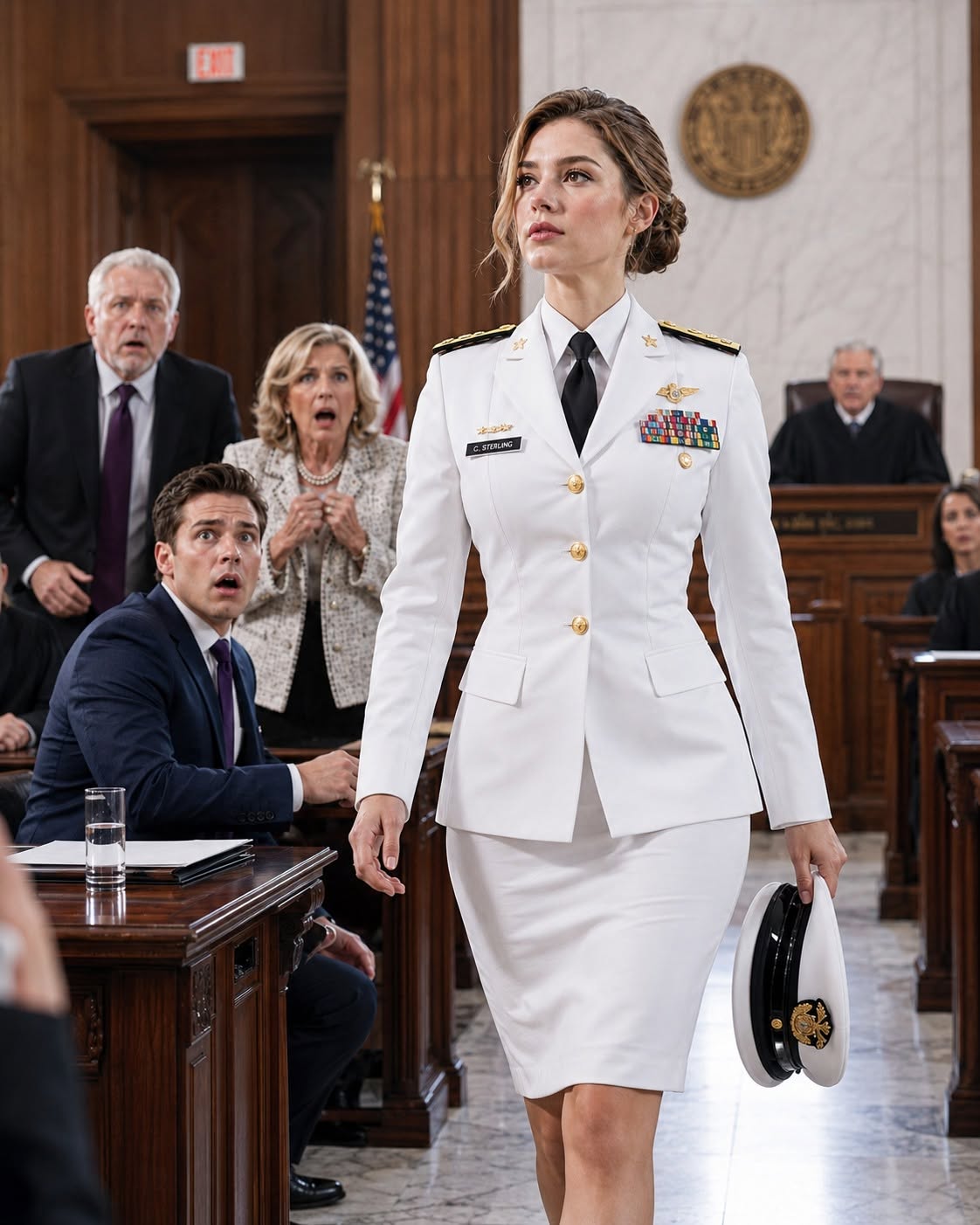
Chapter 12 - When the Uniform Came OffMy final morning in the Army arrived quietly.

No gunfire.
No courtroom.
No reporters.
No angry Marine pointing at my medals.
Just sunrise through my bedroom window and a white garment bag hanging from the closet door.
Inside was the same ceremonial uniform I had worn at Gate C27.
I stood looking at it for a long time.
Rachel knocked without waiting for permission.
“You’re going to be late for your own retirement.”
“That would be impressive.”
“You’ve had twenty-eight years to practice punctuality.”
Lily appeared behind her.
“Grandpa says you’re stalling.”
“I am not.”
“You’ve been staring at that jacket for ten minutes.”
I looked at my niece.
“You’ve become irritatingly observant.”
“Runs in the family.”
Rachel smiled.
A year earlier, Lily had been pulled from a van outside Arlington.
Today, she was sixteen, taller, louder, and wearing a blue dress she had spent three days pretending not to care about.
Life could return in ordinary ways.
That might have been the greatest miracle of all.
I put on the uniform.
Rachel straightened the collar.
Her fingers paused near my ribbons.
“When we were kids, you used to hate dresses.”
“This isn’t a dress.”
“You know what I mean.”
“I still hate dresses.”
She smiled.
Then became serious.
“Mom would’ve been unbearable today.”
“She would’ve told everyone embarrassing stories.”
“She would’ve brought baby pictures.”
“She would’ve corrected the general.”
“She did that while alive.”
We laughed.
Then Rachel hugged me.
“I wish she could see you.”
I looked down.
“She saw enough.”
For years, I had regretted that Mom never learned the full truth about Syria.
Eventually, I understood she had known the truth that mattered.
That I had come home.
That I loved her.
That something inside me hurt.
She didn’t need classified documents to recognize her daughter.
The retirement ceremony was held at Fort Myer.
I asked for small.
General Holloway ignored me.
Three hundred people attended.
Former soldiers.
Current soldiers.
Families.
Federal investigators.
Friends.
People I hadn’t seen in twenty years.
Mercer arrived with a cane he dramatically claimed made him “distinguished.”
“You look eighty,” I told him.
“Jealousy is ugly on you.”
“You were ugly before the cane.”
“Retirement has made you cruel.”
“I’m not retired for another forty-two minutes.”
“Then I’ll file a complaint.”
Near the back stood Sergeant Carter.
Beside him were Price and Moreno.
Of course.
When Holloway stepped to the podium, he looked at the crowd.
“Colonel Evelyn Shaw asked me to keep this short.”
I relaxed.
“So I prepared forty-seven pages.”
People laughed.
I glared at him.
He smiled.
“Evelyn has spent much of her career disliking public praise.”
“Correct,” I muttered.
More laughter.
“She would prefer I discuss the soldiers she commanded, the missions they completed, and the people she believes deserve more credit than she does.”
He paused.
“That is exactly why today we’re going to talk about her.”
I looked at Rachel.
She was crying already.
Traitor.
Holloway spoke about my career.
Flight school.
First command.
Deployments.
Syria.
He did not turn the story into myth.
I appreciated that.
He mentioned mistakes.
Arguments.
My famous lack of patience for paperwork.
The time I accidentally addressed a two-star general as “Mark” during a video conference because I had forgotten his rank was displayed on screen.
Then Holloway became serious.
“There are officers who teach you how to win.”
He looked at me.
“There are others who teach you what winning is for.”
Silence settled.
“Colonel Shaw taught soldiers that rank is responsibility, not entitlement.”
My throat tightened.
“That leadership is not being the loudest person in the room.”
I glanced toward Carter.
He was smiling.
“That mistakes matter. Accountability matters. But so does what someone chooses to become after the mistake.”
Now Carter looked down.
Holloway continued.
“Nine years ago, my son died under her command.”
The crowd grew still.
“For many years, I believed that sentence defined our relationship.”
He paused.
“It does not.”
He looked directly at me.
“My son died beside someone who refused to abandon him.”
My eyes burned.
“He died beside his friend.”
Holloway’s voice broke slightly.
“And because of Colonel Shaw, the truth about his final mission did not die with him.”
No applause came immediately.
I was grateful.
Some moments shouldn’t be interrupted.
Then Holloway opened a folder.
“Orders.”
I stood.
The official retirement order was read.
Twenty-eight years of service reduced, as military tradition requires, to formal language.
Effective date.
Authority.
Grade.
Honorable service.
Then Holloway removed my insignia.
Ceremonially.
Carefully.
When it was finished, everyone stood.
Applause filled the room.
I hated it.
And loved it.
Rachel cried openly.
Lily shouted, “GO AUNT EVIE!”
Everyone laughed.
I covered my face.
Holloway leaned toward me.
“You wanted small.”
“I’m never speaking to you again.”
“You’re a civilian. I no longer have authority over you.”
“That is the best thing anyone has said all day.”
Afterward, people formed an informal receiving line.
Hands.
Hugs.
Stories.
One old sergeant reminded me about a field exercise in Germany when I drove a Humvee into mud and blamed satellite navigation.
“It was bad navigation.”
“It was a ditch, ma’am.”
“An unmarked ditch.”
“It was six feet wide.”
“Ancient history.”
Mercer presented me with a gift.
A framed copy of the corrected Syria report.
I stared at it.
“That’s depressing.”
“Turn it over.”
On the back were photographs.
Daniel.
Bennett.
Cole.
All smiling.
Alive.
Before the valley.
Underneath, Mercer had written:
THE REPORT WAS WRONG.
THESE MEN WERE REAL.
REMEMBER THEM THAT WAY.
I hugged him.
He pretended this was uncomfortable.
Then Carter approached.
He carried a small package.
“Sergeant.”
“Ma’am.”
“I’m civilian now.”
He swallowed.
“Evelyn.”
It came out like he had committed a felony.
I laughed.
“There you go.”
“I hate it.”
“You’ll adapt.”
He handed me the package.
“What’s this?”
“Open it later.”
“That sounds suspicious.”
“Price checked it.”
Price raised both hands.
“Safe, ma’am.”
Moreno added, “Probably.”
I opened it anyway.
Inside was a cheap plastic Halloween medal.
Gold-colored.
Bright red ribbon.
I stared at them.
Carter looked terrified.
Then I started laughing.
Hard.
Harder than I had laughed in years.
Attached was a note.
WE CHECKED. THIS ONE IS FAKE.
Holloway saw it and laughed too.
Even Rachel, after hearing the explanation, nearly collapsed into a chair.
I wiped my eyes.
“Carter.”
“Yes, ma’am?”
“This is wildly inappropriate.”
His face fell.
“I—”
“I love it.”
He exhaled.
“Thank God.”
I held up the fake medal.
“You realize this is going on my wall.”
Price grinned.
“Then technically we’ve decorated an Army colonel.”
“Former colonel.”
Carter straightened dramatically.
“Even better.”
Later that afternoon, after everyone left, I drove home alone.
For the first time since I was twenty-two, I had no Army assignment waiting.
No report.
No next duty station.
No briefing.
No uniform required tomorrow.
At a red light, I looked at Daniel’s watch.
Still ticking.
My phone rang through the car.
Holloway.
I answered.
“You miss me already?”
“Not remotely.”
“What do you want?”
“Lunch next week.”
“That sounds suspicious.”
“Anne wants you over.”
That softened me.
“I’ll come.”
“She says noon.”
“I’ll be there.”
“And Evelyn?”
“Yes?”
There was a pause.
“You did good.”
Three simple words.
They nearly broke me.
“So did Daniel.”
“I know.”
The light turned green.
“See you next week.”
I drove home.
That night, I hung my ceremonial uniform in the back of the closet.
Not hidden.
Not displayed.
Simply placed where it belonged.
Then I put the plastic fake medal Carter had given me into a shadow box beside one of my real decorations.
Rachel stared at it.
“You’re seriously displaying that?”
“Yes.”
“Why?”
I looked at the ridiculous gold plastic medal.
Because it reminded me of an airport.
Of humiliation.
Of anger.
Of a young Marine making a terrible judgment.
Of another man choosing to learn.
Of an investigation finally reopening.
Of Daniel’s watch.
Of truth refusing to stay buried.
“Because it has a story.”
Rachel smiled.
“Everything in this house has a story.”
“Occupational hazard.”
Lily came downstairs carrying college brochures.
“I have an announcement.”
“You’re sixteen,” Rachel said. “Nothing good starts with that sentence.”
“I know what I want to study.”
I looked at her.
“Law?”
“No.”
Surprised, I waited.
“Public policy.”
Rachel groaned.
“That’s somehow worse.”
Lily smiled at me.
“I want to work where people make the rules.”
“Why?”
“So people like Vale don’t get to hide behind them.”
That silenced us.
I didn’t tell Lily she could change the world.
Adults say things like that too easily.
The world is large.
Systems are stubborn.
Power protects itself.
One person rarely changes everything.
But one person can refuse a bad order.
One witness can keep a record.
One soldier can save a file.
One general can admit he was wrong.
One young Marine can learn from humiliation instead of becoming bitter.
One family can survive something meant to break it.
And sometimes that is how change actually happens.
One choice at a time.
“Then learn the rules first,” I said.
Lily nodded solemnly.
“Then break them?”
Rachel stared at me.
“Do not encourage her.”
I laughed.
“No. Then improve them.”
Later, I stepped onto the porch.
The summer evening was warm.
Neighborhood lights glowed quietly.
Nothing dramatic.
No helicopters.
No cameras.
No danger.
For years, peace had made me uncomfortable.
Silence gave memory room to speak.
That night, silence felt different.
I heard crickets.
A dog barking three houses away.
Rachel and Lily arguing inside about popcorn.
Daniel’s watch ticking.
I closed my eyes.
For a moment, I saw Gate C27 again.
Carter pointing at my uniform.
People staring.
The general behind him.
Do you have any idea who you’re talking to?
At the time, the question had sounded like a defense of rank.
Now I understood it differently.
Nobody at that gate truly knew who they were talking to.
Carter didn’t know me.
The crowd didn’t know me.
The internet didn’t know me.
And for a long time, maybe I hadn’t known myself either.
I had believed the medals explained me.
Then I believed the mission explained me.
Then the dead.
Then the truth.
But people are larger than the worst thing that happened to them.
Larger than their greatest accomplishment too.
The Army had been my life.
It was not all of my life.
I opened my eyes.
The watch showed 8:43.
Moving forward.
I smiled.
The next morning, I woke without an alarm.
For several seconds, I panicked.
Then I remembered.
No formation.
No briefing.
No uniform.
I made coffee.
Terrible coffee, because apparently decades of military service had taught me nothing useful about coffee.
I carried it onto the porch.
A delivery truck stopped outside.
The driver approached holding a package.
“Colonel Shaw?”
I smiled.
“Just Evelyn.”
He checked the label.
“Sorry. It says Colonel.”
“It’s okay.”
He handed me the package.
“Thank you for your service.”
I used to have complicated feelings about that sentence.
What are you supposed to say?
You’re welcome?
Thank you?
You don’t know what it cost?
You don’t know what I did?
You don’t know who didn’t come home?
That morning, I simply said:
“Thank you.”
He left.
I opened the package.
Inside was a framed photograph.
Gate C27.
I stared.
Someone had captured the moment immediately after General Holloway arrived.
Carter was turned toward him, horror spreading across his face.
Price and Moreno were standing.
I sat in the chair, looking up.
But the photograph wasn’t centered on Carter.
It wasn’t centered on Holloway.
It was centered on me.
On my lap was the unopened folder that had brought me to Washington.
The folder containing Daniel’s future.
Our past.
The truth.
A note was taped to the back.
From Carter.
Ma’am—sorry, Evelyn.
I used to think respect was something a uniform demanded.
Now I think it’s something we owe people before we know what they’ve survived.
Thanks for teaching me that before I learned it somewhere worse.
I stood on the porch holding the photograph.
My eyes filled.
Then I laughed because he had added one final line.
P.S. The uniform still looks fake. Too many medals.
I shook my head.
“Idiot.”
But I was smiling.
I carried the photograph inside.
I didn’t hang it beside my military decorations.
I hung it near the front door.
Not because it showed the moment a general defended me.
Not because it reminded me that I had been vindicated.
Because everyone in that picture was about to change.
Carter would learn humility.
Holloway would finally discover what happened to his son.
I would stop carrying guilt that never belonged entirely to me.
And the truth would finally begin moving toward daylight.
Sometimes the moment that humiliates you is not the end of your story.
Sometimes it is the door.
You just don’t know what’s waiting on the other side.
I looked once more at the photograph.
Then at Daniel’s watch.
Tick.
Tick.
Tick.
For nine years, I thought justice meant going backward and fixing what happened.
It didn’t.
Nothing could bring Daniel back.
Nothing could give Bennett his future.
Nothing could return Cole to his family.
Justice could not repair yesterday.
But truth could change tomorrow.
And maybe that was why Daniel had preserved those recordings.
Not so the dead could speak forever.
So the living would finally listen.
Outside, the morning sun rose above the houses.
I opened the front door.
May you like



And for the first time in a very long time, I walked into a day that belonged entirely to me.
THE END.