Chapter 11 – After the Stabilization

The word stabilized should have meant relief.
It didn’t.
It felt more like being pinned in place by something that had decided I was allowed to keep existing—but only in a very specific way.
The chamber was gone.
Or maybe it had never been a chamber.
Now I stood in a narrow transit corridor with harsh lighting and clean walls that looked freshly constructed but somehow… already used.
Like reality had been rebuilt around the aftermath of what just happened.
K-17 walked beside me.
No restraints.
No guards.
That was the first thing that made me uneasy.
If I was dangerous, why wasn’t I restrained?
If I wasn’t dangerous, why did everything still feel like containment?
The woman was gone.
No explanation.
No goodbye.
Just absence, as if she had been reassigned to a layer of the system I no longer had access to.
I broke the silence first.
“So that’s it?” I asked. “I chose something and now I’m… what, part of your infrastructure?”
K-17 didn’t answer immediately.
We turned a corner.
The corridor opened into a wider space—less clinical, more operational.
There were people here now.
Not many.
But enough to feel like a functioning system rather than an isolated experiment.
They didn’t look at me directly.
That was worse.
They looked slightly around me, like I was something they had been trained to acknowledge indirectly.
K-17 finally spoke.
“You’re not infrastructure,” he said quietly.
I laughed once.
“That’s comforting.”
“It’s accurate,” he replied.
We stopped at a junction where two paths split again.
Of course they did.
I was starting to hate intersections.
“Then what am I?” I asked.
K-17 hesitated.
That hesitation again.
But this time it felt different.
Less like withholding.
More like translating something that didn’t have clean language.
“You’re a stabilizing reference,” he said.
I crossed my arms.
“That sounds like infrastructure with better branding.”
He exhaled slightly.
“It means the system doesn’t resolve without you in it.”
I frowned.
“That doesn’t make me feel better.”
“It’s not meant to.”
We walked again.
This time, the environment felt more consistent.
Less distortion.
Fewer impossible shifts in perception.
But I noticed something else.
People moved differently around me.
Subtly.
Not avoidance.
Not fear.
Calibration.
Like they were unconsciously adjusting their paths to avoid interfering with something they couldn’t see properly.
I hated that more than outright fear.
We passed a glass partition.
I caught my reflection.
For a moment, I expected to see something altered.
But I looked… normal.
Tired.
Confused.
Still me.
That almost made it worse.
Because nothing about me looked like what I had become.
K-17 noticed me slowing.
“You’re checking yourself,” he said.
“Is that strange?”
“In your case,” he replied, “yes.”
I stopped walking.
“Stop talking like I’m already different from me.”
He turned slightly toward me.
“You are,” he said simply.
That should have hurt more than it did.
But instead, it just settled in like something I’d already been suspecting.
We reached a sealed door.
Unlike the others, this one had markings.
Not labels.
Not instructions.
Just a symbol.
A circular pattern intersected by three broken lines.
K-17 placed his hand near the panel.
The door didn’t open immediately.
It scanned.
Paused.
Then unlocked with a soft mechanical exhale.
“Where are we going?” I asked.
“Integration space,” he said.
I frowned.
“That sounds like another word for ‘lab.’”
“It’s not,” he said.
I didn’t believe him.
But I followed anyway.
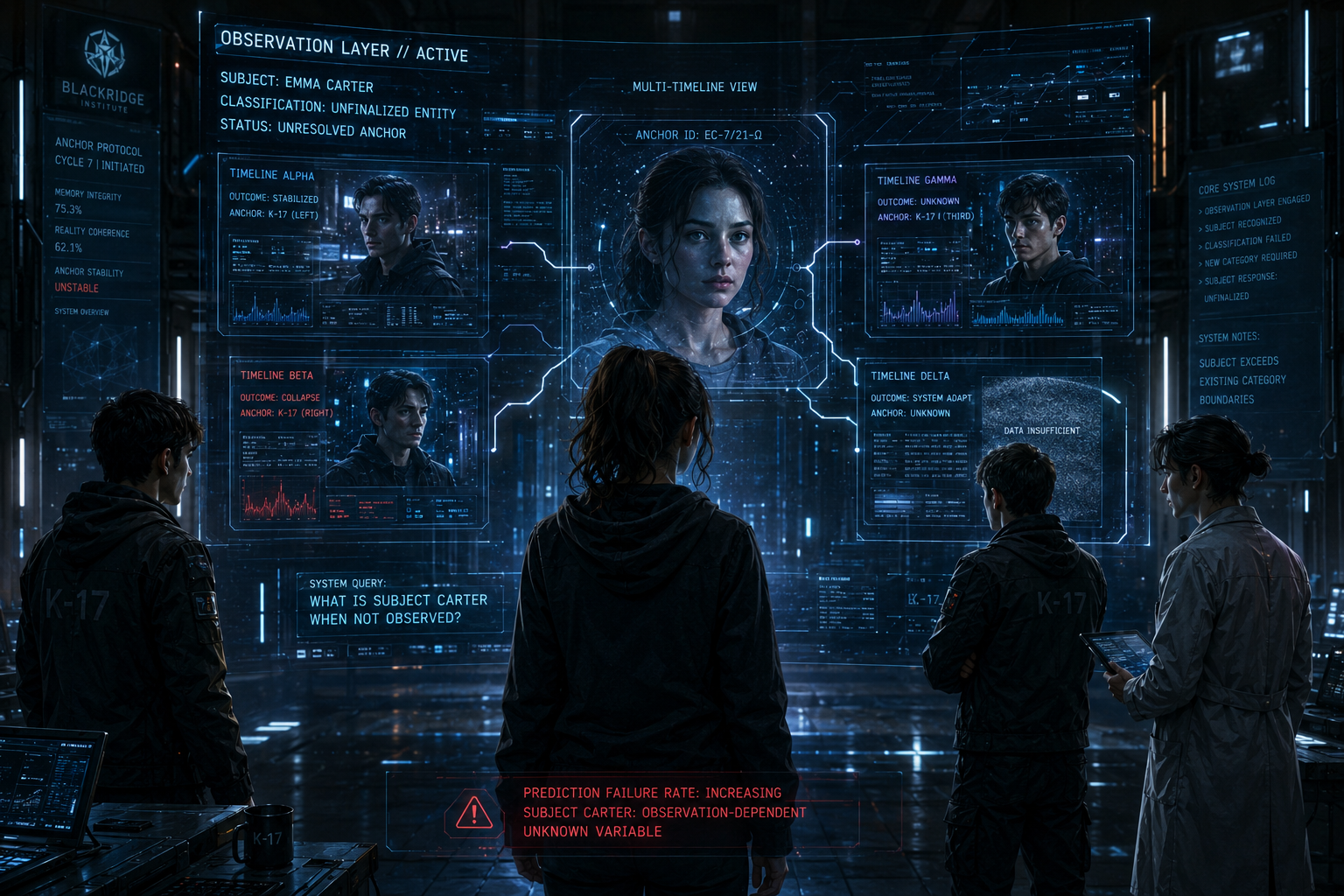
Inside was not a lab.
It was closer to a control observatory.
A wide room with layered transparent panels showing shifting data structures I couldn’t interpret.
Not screens.
Not projections.
Something more embedded.
Like the room itself was thinking in multiple directions at once.
People were here.
Not many.
All quiet.
Focused.
And when I entered—
everything paused for half a second.
Just half.
But I felt it.
K-17 felt it too.
A subtle recalibration of attention.
I swallowed.
“I don’t like how everyone does that,” I said.
K-17 nodded slightly.
“They’re confirming stability.”
“By staring at me?”
“By registering you.”
That sounded worse.
We approached the center of the room where a circular platform embedded into the floor hummed faintly.
A technician stepped forward.
They didn’t introduce themselves.
They just looked at me.
Then at K-17.
“Anchor proximity confirmed,” they said.
I frowned.
“I have a name.”
They nodded once.
“Emma Carter is indexed,” they replied.
That didn’t feel like acknowledgment.
It felt like cataloging.
K-17 stepped slightly closer to me—not protective this time.
Just… aligned.
“I need clarity,” I said quietly.
He nodded.
“That’s why we’re here.”
The technician gestured toward the platform.
“Baseline reconstruction interface is ready.”
I stiffened.
“Reconstruction of what?”
No one answered immediately.
Then K-17 said softly:
“Your point of origin state.”
I felt my stomach drop.
“My what?”
“The version of you before divergence pressure,” he explained.
“That sounds like something you should not be able to say calmly.”
He didn’t disagree.
The technician added:
“Anchor must confirm continuity baseline.”
I stepped back.
“No.”
The room didn’t react immediately.
No alarms.
No urgency.
Just waiting.
Like my refusal was part of the process.
K-17 looked at me.
“Emma,” he said quietly, “this is how we understand what changed.”
“I don’t care,” I said. “I already survived your ‘understanding.’”
A pause.
Then softer:
“You didn’t just survive it,” he said. “You altered it.”
That sentence made something cold settle in my chest again.
The technician waited.
Patient.
Neutral.
The room itself seemed to wait.
I looked at the platform.
Then at K-17.
“You keep saying I change things,” I said quietly. “But nobody tells me what I’m changing into.”
He hesitated.
Then said:
“That’s what this is for.”
I laughed once.
But it wasn’t humor anymore.
It was exhaustion.
“If I step on that thing,” I said, “what happens?”
The technician answered.
“We map your original continuity thread.”
“And if I refuse?”
Silence.
Then K-17 said quietly:
“Then we continue without knowing where the divergence began.”
A pause.
“And that’s how anchors fail.”
I closed my eyes for a moment.
I hated that word.
Fail.
Like I was already part of something that could succeed or fail depending on how accurately I matched expectations.
I opened my eyes again.
“I don’t like any of this,” I said.
K-17 nodded.
“I know.”
That honesty again.
It always disarmed me more than argument.
I stepped closer to the platform.
My heartbeat felt too loud.
“Just so I understand,” I said, “this is going to show me… what I was before all of this?”
“Yes,” the technician said.
“And if I’m different now?”
K-17 answered quietly.
“Then we’ll know where it started.”
That didn’t comfort me.
But something about it felt inevitable.
I stepped onto the platform.
It activated immediately.
A soft hum rose through the floor.
Not mechanical.
Resonant.
Like something listening.
And then—
the room around me disappeared.
And deep within Blackridge’s structural memory layer, a new readout formed without authorization:
ORIGIN THREAD ACCESS: INITIATED
ANCHOR CONTINUITY: UNSTABLE RECONSTRUCTION IN PROGRESS
Somewhere, something that had been hidden even from K-17’s clearance level began to surface.
Not a memory.
Not a record.
May you like



A contradiction.
And it had always been attached to Emma Carter.