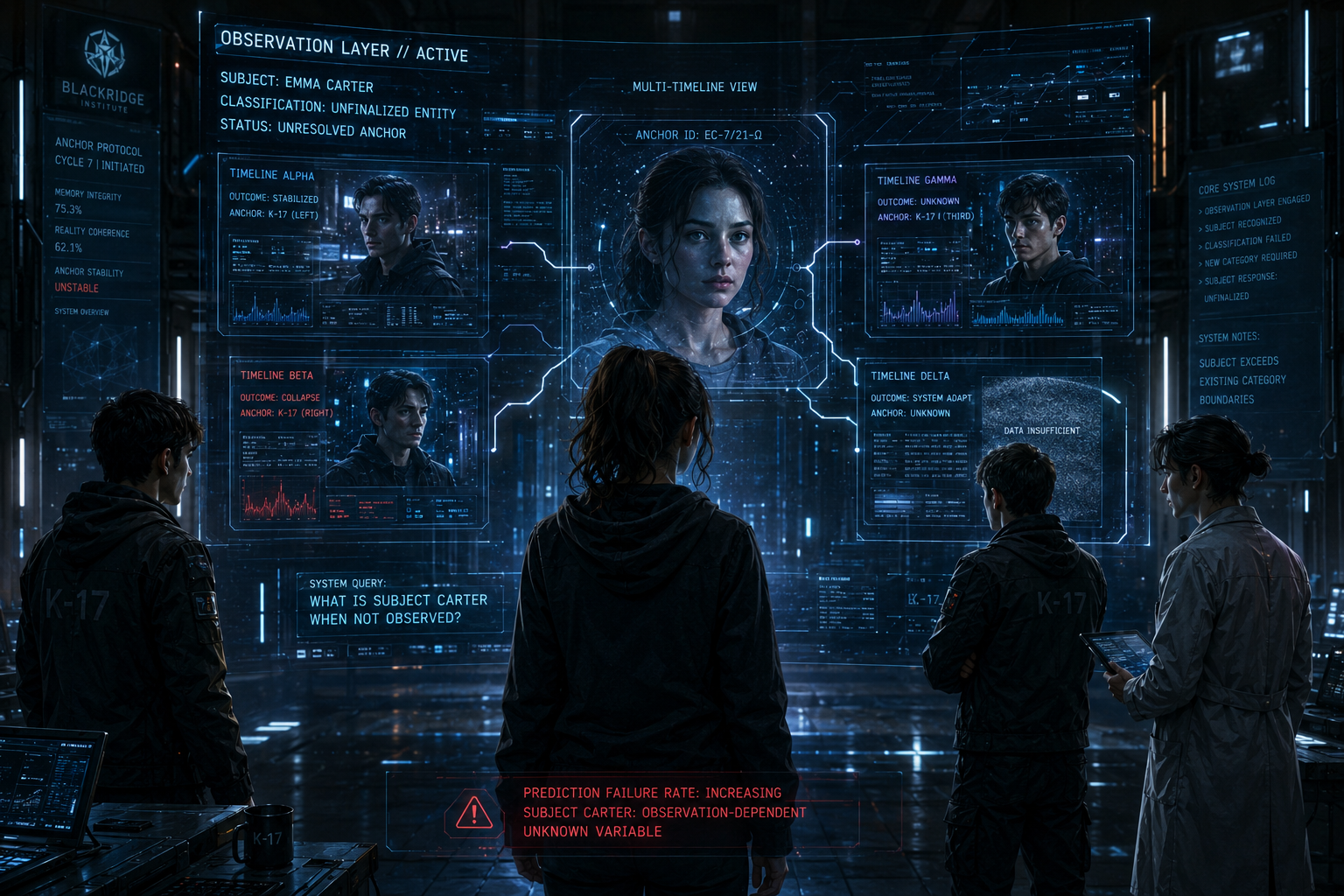
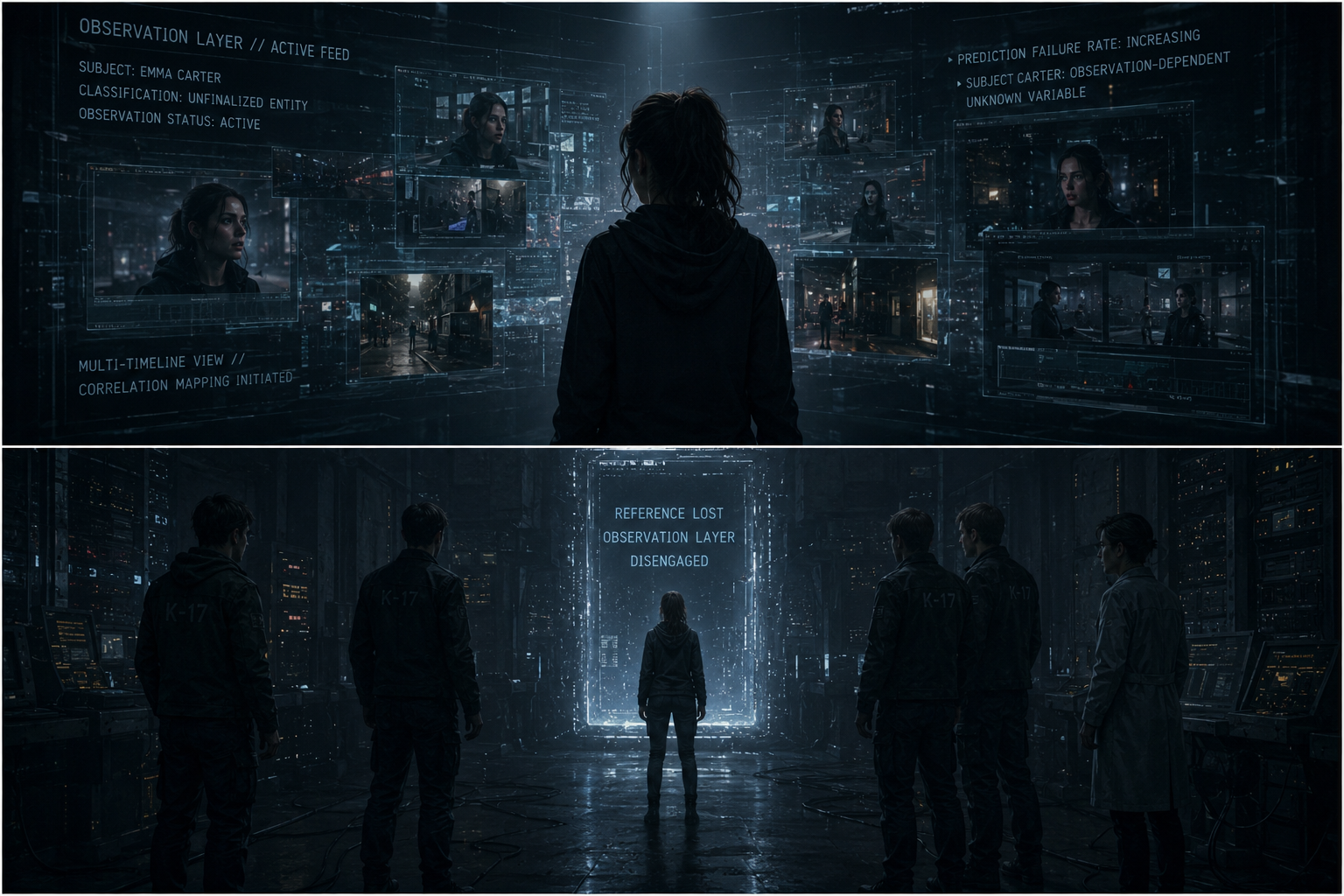
Chapter 15 – The Version K-17 Remembers

The room stayed quiet long after she was gone.
Not normal quiet.
Controlled quiet.
Like the space itself was waiting to see if something else would fall through it.
I kept staring at the empty seam in the air, even though it had already sealed.
My mind refused to accept how quickly something so impossible could become “not currently present.”
K-17 finally moved.
Slowly.
Like he was recalibrating his own position in the room.
The technician didn’t speak.
Didn’t even look relieved.
That worried me more than anything else.
I turned toward K-17.
“She knew me,” I said quietly.
He didn’t answer immediately.
That hesitation again—but heavier now.
Different.
Finally, he said:
“Yes.”
My stomach tightened.
“In a way I don’t understand?”
He looked at me.
“In a way I do,” he corrected.
That made my skin go cold.
I stepped closer.
“Explain.”
He exhaled slowly.
And for the first time since I met him, he didn’t sound like he was translating the system.
He sounded like he was remembering it.
“There are multiple stabilization histories,” he said quietly.
I frowned.
“I don’t care about your terminology. Tell me what that means.”
He nodded slightly.
“Different iterations of me have been assigned to different anchor attempts.”
My chest tightened.
“Assigned?” I repeated.
“Yes.”
A pause.
Then softer:
“And I haven’t always been the same one.”
The words didn’t land at first.
Then they did.
Hard.
I stepped back.
“You’re saying there are versions of you too.”
He didn’t deny it.
That silence again.
The technician finally spoke, almost carefully.
“Cross-instance operator continuity is documented but restricted.”
I snapped my head toward them.
“So you all know this is happening and you just—what? Pretend it’s normal?”
No response.
K-17 raised a hand slightly.
“Don’t,” he said quietly.
Not to me.
To them.
The technician stopped.
I turned back to him.
My voice dropped.
“How many versions?” I asked.
He hesitated.
Then said:
“Enough that I can recognize patterns in what you trigger.”
My stomach tightened again.
“Trigger,” I repeated.
He nodded.
“Emma, you don’t just change outcomes.”
A pause.
“You reorganize operator alignment.”
That sentence felt like stepping off something solid.
“I don’t understand what that means,” I whispered.
He looked at me for a long moment.
Then said:
“It means I’ve met you before.”
Silence.
Absolute.
Immediate.
I felt my throat tighten.
“No,” I said quickly. “No, you haven’t.”
He didn’t correct me.
That was worse.
I stepped back again.
“You said you were the first one who stayed consistent,” I said.
He nodded.
“Yes.”
“So what does that mean?” I asked. “Consistent with what?”
His expression tightened slightly.
“With you,” he said.
The room felt colder.
I shook my head.
“That doesn’t make sense.”
“It does if you consider non-linear recall,” the technician added quietly.
I shot them a look.
“Stop helping,” I snapped.
They went silent immediately.
K-17 didn’t react.
He just kept watching me.
Like he was measuring something.
Not my reaction.
My continuity.
I felt my breathing tighten.
“You’re saying you’ve met me in other versions,” I said slowly.
“Yes.”
“And in those versions…?”
He hesitated.
That hesitation again—but this one felt different.
He looked away for a moment.
Then back at me.
“In some,” he said quietly, “I didn’t find you in time.”
My chest tightened.
“In some I did,” I said.
He nodded.
“Yes.”
A pause.
“And in those?”
He didn’t answer immediately.
When he did, his voice was quieter.
“In those, you trusted me less.”
I swallowed.
“That’s it?”
“No.”
A pause.
“Sometimes you didn’t trust me at all.”
Another pause.
“And sometimes…”
He stopped.
I stared at him.
“Sometimes what?”
He looked at me directly now.
“And sometimes I was the reason you stopped becoming an anchor.”
Silence hit like impact.
I felt my hands shake slightly.
“That’s not possible,” I whispered.
He didn’t deny it.
That was becoming the most terrifying pattern of all.
The technician spoke again, carefully.
“Operator K-17 has documented variability across anchor cycles.”
I turned sharply.
“Cycles,” I repeated.
They nodded.
“Stabilization cycles are iterative.”
I laughed once, but it came out wrong.
“So I’ve been through this before,” I said.
No answer.
K-17 finally spoke.
“Not in the way you think.”
I stepped closer to him.
“Then explain it in a way I can think.”
He hesitated.
Then said:
“Every time you approach stabilization, something changes in me.”
My chest tightened.
“What kind of change?”
He looked at me.
And for the first time, there was something almost vulnerable in his expression.
“Sometimes I remember you too early,” he said.
A pause.
“Sometimes too late.”
My voice dropped.
“And sometimes?”
He didn’t answer immediately.
Then:
“Sometimes I don’t recognize you at all.”
Silence.
Heavy.
Unavoidable.
I stepped back slowly.
“So which one are you?” I asked quietly.
He looked at me for a long time.
Then said:
“The one who recognized you at the point where you still had a choice.”
The room hummed faintly again.
Like the system had overheard something it wanted to preserve.
I felt my throat tighten.
“You’re not helping me feel safer,” I said.
He nodded once.
“I’m not trying to.”
A pause.
Then softer:
“I’m trying to keep you coherent.”
That word again.
Coherent.
As if I could become less real depending on interpretation.
The technician suddenly stepped forward.
“Temporal resonance spike detected,” they said quickly.
K-17 stiffened.
“That’s not external,” he muttered.
I looked between them.
“What’s happening now?” I asked.
No answer immediately.
Then the room flickered.
Just slightly.
Like reality had skipped a frame.
K-17 turned sharply toward me.
His voice changed.
Lower.
Faster.
“Emma—stay focused.”
“On what?” I asked.
He hesitated.
Then said:
“On me.”
The lights dimmed.
And for a fraction of a second—
I saw something behind him.
Not a projection.
Not a memory.
Another version.
K-17 standing in the same place.
But his eyes were different.
Colder.
And he was looking at me like I was already lost.
I stumbled back.
“No,” I whispered.
The real K-17 moved instantly.
Grabbing my arm.
“Don’t split perception,” he said sharply.
“What does that mean?” I snapped.
“It means you’re overlapping timelines again.”
The technician stepped back.
“Anchor instability increasing,” they said urgently.
K-17 didn’t look away from me.
“Listen to me,” he said.
His voice was steady again.
But something underneath it wasn’t.
“I am the one who remembers you correctly right now,” he said.
A pause.
“And that matters more than you understand.”
I stared at him.
“And the other one?” I asked quietly.
His expression tightened.
“The other one,” he said, “doesn’t consider you stable yet.”
Silence.
The room flickered again.
Longer this time.
I felt it.
A second presence pressing against the edges of perception.
Like something trying to overwrite the version I was standing in.
K-17 stepped closer.
His voice dropped.
“You need to choose which version of me you anchor to,” he said.
My throat tightened.
“I don’t even understand the question.”
“I know,” he said quietly.
“But the system does.”
And deep within Blackridge, two operator continuity streams began diverging for the first time in recorded anchor history.
Not Emma Carter.
Not the system.
May you like

But the man assigned to remain consistent.
And both versions of him turned toward the same unresolved variable.