Chapter 2 – The Man Who Wasn’t Supposed to Survive
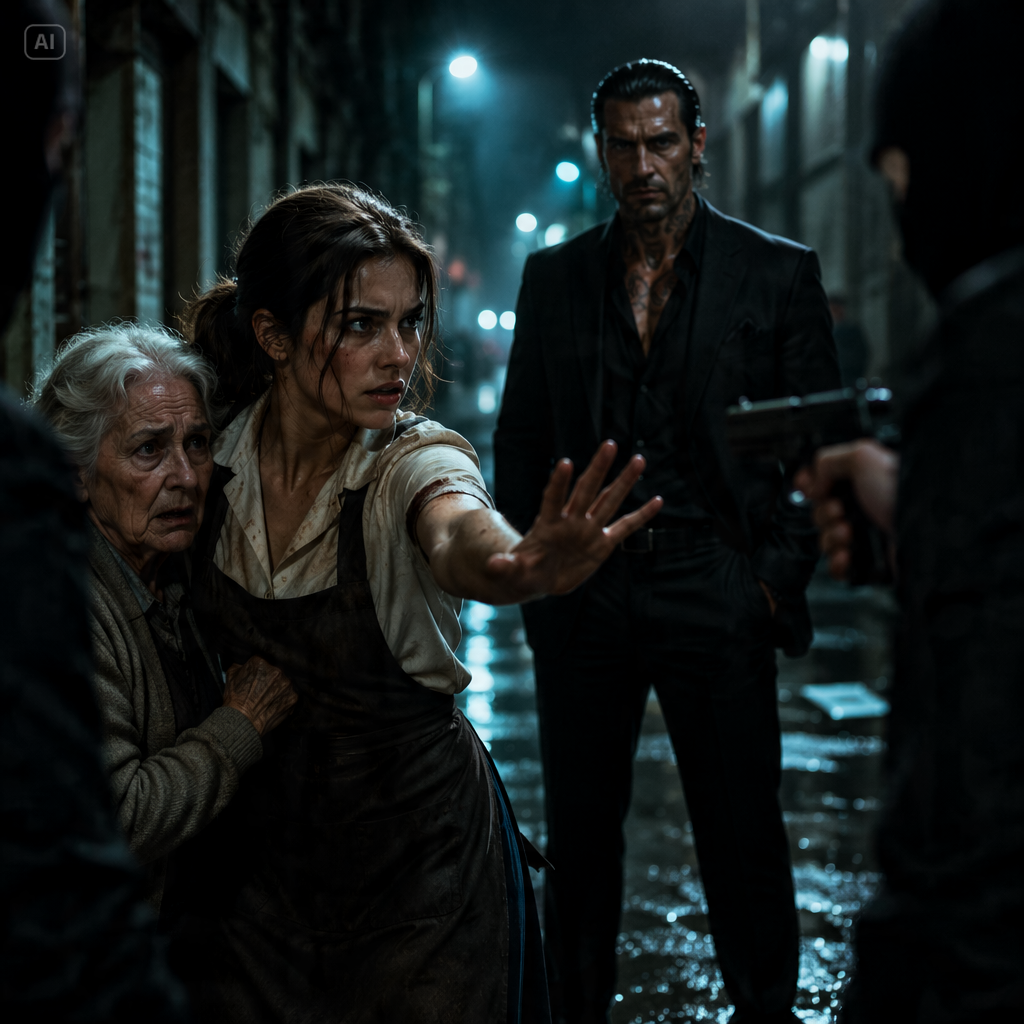
The footsteps slowed.
Not rushed. Not chaotic.
Controlled.
That was the worst kind.
People who hurry are afraid.
People who slow down are certain.
The man on the ground felt it too. His grip on my wrist loosened slightly, not from weakness—but resignation.
“They found me,” he whispered.
My mind screamed at me to run.
But my body didn’t move.
The alley felt smaller now, like the walls were leaning in to listen.
I turned my head slightly.
At the far end of Hawthorne Alley, a figure stood beneath the broken streetlight.
He wasn’t fully visible. Just a silhouette shaped by rain and flickering amber light.
But I could feel his attention lock onto us like a blade.
Then another shadow appeared beside him.
And another.
Three.
Maybe four.
I couldn’t tell anymore.
My pulse roared in my ears.
The man on the ground tugged weakly at my sleeve again.
“Go,” he breathed. “Now.”
“Not without you,” I whispered before I could stop myself.
That sentence would haunt me later.
Because it meant I had already chosen.
The first shadow stepped forward.
The light caught just enough of his face for me to see something that didn’t belong in a normal alley confrontation.
He wasn’t dressed like a mugger.
No hoodies. No street clothes.
Dark coat. Clean lines. Professional.
Like security.
Or worse.
Organized.
He raised something in his hand.
Not a gun.
A phone.
He looked at the screen.
Then at us.
And nodded once.
That was the signal.
The man on the ground suddenly reacted.
With a burst of strength I didn’t think he had, he shoved me sideways.
“MOVE!” he shouted.
A crack split the air.
Not a gunshot.
A stun device.
Blue-white light burst where we had been a second earlier.
The pavement hissed.
I scrambled backward, heart slamming against my ribs.
The injured man was already moving—barely upright, staggering, but moving.
Toward me.
Not away.
“Why are you coming toward me?” I yelled.
“Because you’re already involved,” he said through clenched teeth. “And I don’t leave people behind.”
That answer didn’t make sense.
Nothing about this made sense.
The men advanced.
Faster now.
Purposeful.
The alley became a funnel of danger.
Left: brick wall.
Right: dumpsters.
Forward: them.
Behind: nowhere.
“Can you run?” I asked him.
He gave a short, humorless laugh.
“I’m going to die either way. So yes.”
That was not comforting.
“Then run when I say run,” I told him.
He looked at me like I was insane.
Maybe I was.
I grabbed his arm anyway.
“NOW!”
We ran.
Or at least, I ran while dragging a man who could barely stay upright.
The alley exploded behind us in footsteps.
They weren’t shouting.
That was the part that terrified me most.
No anger.
No panic.
Just pursuit.
Like this was routine.
Like we were already caught.
We reached a junction where the alley split into two narrow passages.
Left led toward the old textile district—abandoned warehouses, lots of hiding places.
Right led toward the main street—lights, cameras, witnesses.
Safety or anonymity.
Neither felt real.
“Left,” the man gasped.
“Are you sure?” I asked.
“No,” he said. “But I am.”
That was apparently good enough.
We turned left.
The air changed immediately.
The city here was older, more forgotten. Buildings leaned inward like tired giants. Windows were either boarded up or shattered.
The rain grew heavier.
My shoes splashed through puddles that smelled like rust and oil.
Behind us, the footsteps split.
They were adapting.
Covering both exits.
Professional, I thought again.
That word stuck in my head like a warning label.
We cut through a gap between two warehouses and emerged into an open loading dock.
Empty crates stacked like skeletons.
A rusted forklift frozen in place like it had died mid-task years ago.
The man finally collapsed against a crate.
He slid down slowly, leaving a dark streak on the wood.
“Okay,” I said, breath shaking. “We stop for ten seconds. Just ten.”
“No time,” he muttered.
I pulled out my phone.
“No signal,” I said immediately.
Of course there wasn’t.
Blackridge didn’t allow signals in places where truth might matter.
I crouched beside him.
“Who are they?” I asked.
He looked at me for a long moment.
Rainwater ran down his face like he couldn’t decide whether to wash away blood or memory.
Then he said something that didn’t belong in any normal explanation.
“They’re not supposed to exist.”
I stared at him.
“That’s not an answer.”
“It’s the only one I’ve got left.”
A loud metallic clang echoed behind us.
Somewhere in the warehouse maze.
Closer now.
He tried to stand again, failed, and exhaled sharply through pain.
I made a decision I didn’t understand myself making.
I tore off my jacket and pressed it into his hands.
“What are you doing?” he asked.
“Buying time,” I said.
“You can’t—”
“I’m not asking permission.”
I helped him behind the crate stack, pushing him into the narrow shadow between pallets.
“Stay quiet,” I whispered.
“And you?” he asked.
I hesitated.
That hesitation said everything.
Before I could answer, I stepped away.
Into the open dock.
My heart was doing something between panic and disbelief.
This was stupid.
This was how people died in movies.
But in movies, people always had time to regret it.
I didn’t.
A voice came from the darkness.
“Step away from him.”
Calm.
Male.
Close.
I turned slowly.
A man stood near the entrance of the dock.
Same coat. Same controlled posture.
But now I could see his face.
No mask.
No anger.
Just observation.
Like I was a variable in an equation.
“You’re not part of this,” I said, trying to sound stronger than I felt.
He tilted his head slightly.
“You made yourself part of it when you touched him.”
“That’s not how choices work.”
A faint, almost amused expression crossed his face.
“In your world, maybe.”
He took one step forward.
Then another.
My body wanted to run.
But I forced myself to stand still.
Behind me, I could hear the injured man breathing—too loud, too unstable.
The stranger’s eyes flicked past me.
He knew exactly where he was.
Of course he did.
“Last chance,” the man said quietly. “Walk away.”
My throat tightened.
If I walked away, I survived.
If I didn’t—
I didn’t know what I was anymore.
I thought of my rent notice.
My empty bank account.
My invisible life.
All of it suddenly felt very far away.
“No,” I said.
The word surprised even me.
Something shifted in his expression.
Not anger.
Assessment.
Like I had changed categories.
He reached into his coat.
I braced myself.
But instead of a weapon, he pulled out a small device.
He pressed it once.
A soft electronic beep echoed through the dock.
Behind me, the injured man suddenly tensed.
“No—!” he tried to shout.
But it was too late.
A second beep.
And everything went silent.
Not the world.
Just him.
He collapsed fully into unconsciousness.
My stomach dropped.
“What did you do to him?” I screamed.
The man looked at me calmly.
“Saved your life.”
That was the moment I realized:
This wasn’t a rescue.
It was containment.
And I had just stepped into the middle of something I was never meant to see.
The next thing I remember clearly is the sound of sirens far away.
And the feeling of hands lifting me off the ground.
Not gentle.
Not cruel.
Just final.
Before everything went dark, I saw the injured man being carried away in the opposite direction.
And I realized something that made no sense at all:
They weren’t trying to kill him.
May you like



They were trying to make sure he survived.
And I had just become the new problem.







