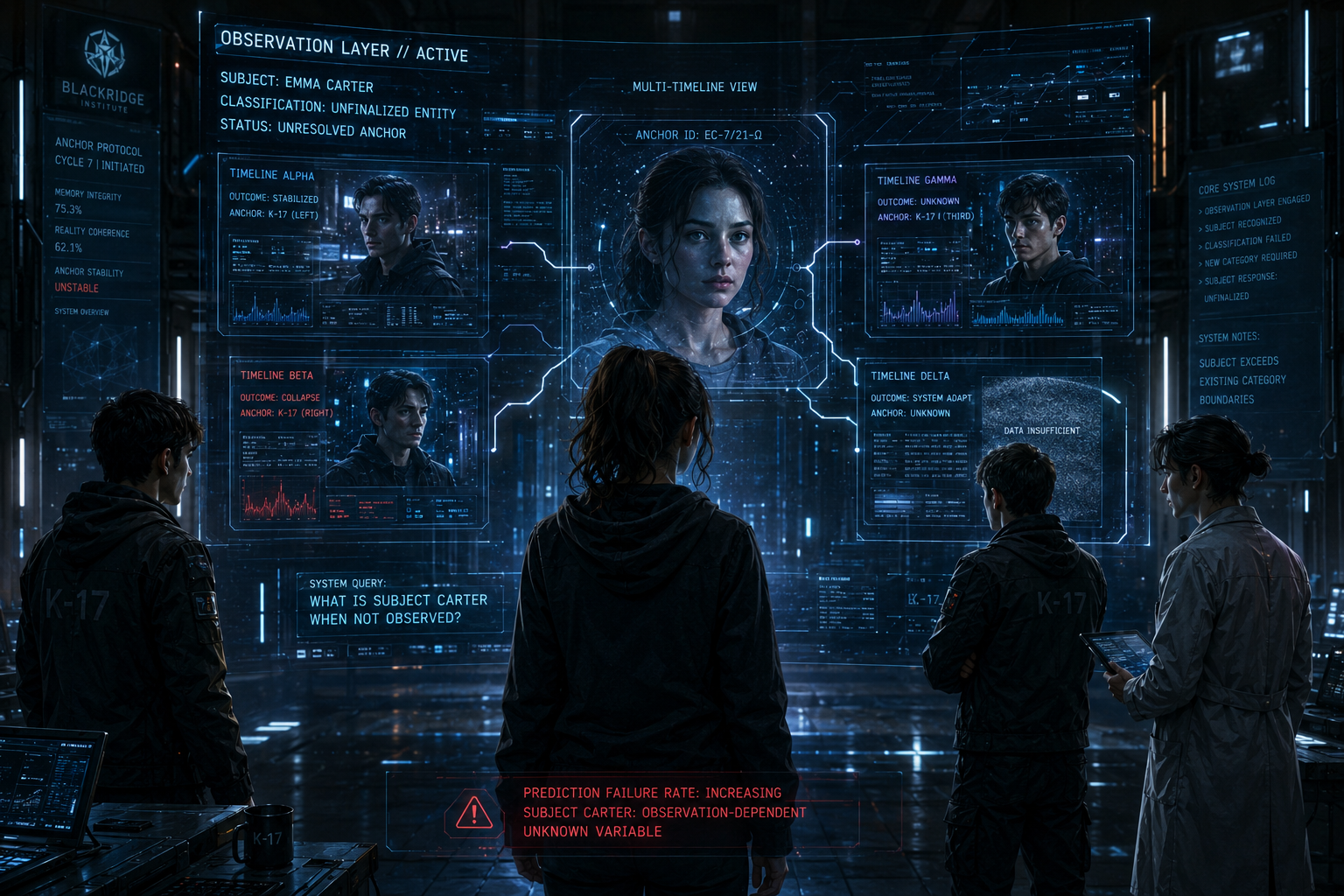
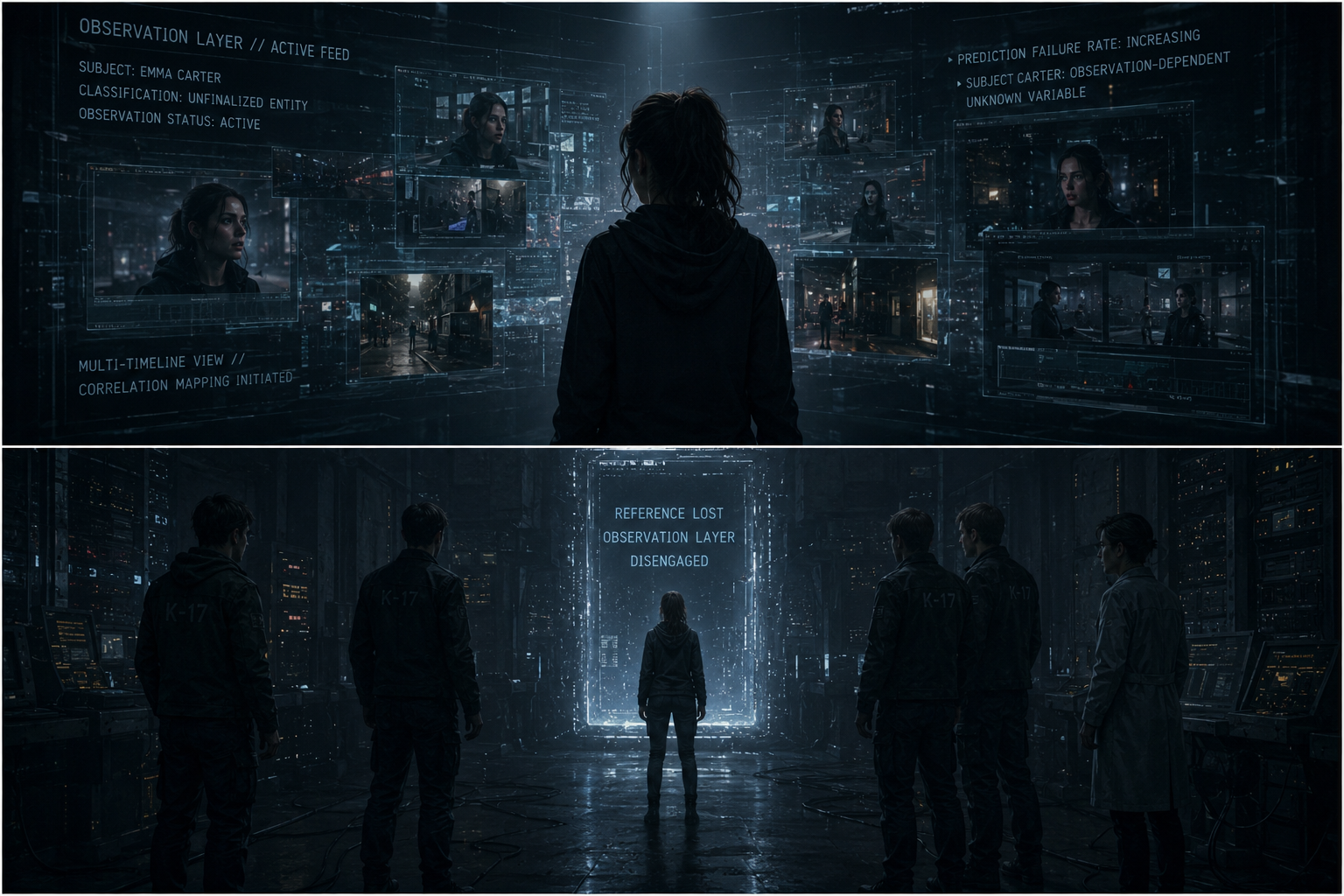
Chapter 13 – The Version That Shouldn’t Exist

Returning hurt.
Not physically.
Worse than that.
Like my mind had been stretched across too many places and was snapping back into shape reluctantly.
The control room reformed around me in fragments.
Light first.
Then sound.
Then weight.
Then me.
I stumbled slightly as my feet reconnected with the platform.
K-17 was already there, watching me closely.
The technician stood a few steps back, scanning a readout that was flickering too fast to be comfortable.
“You’re back,” K-17 said quietly.
It wasn’t a question.
I swallowed hard.
“I saw it,” I said.
He nodded once.
“I know.”
My voice cracked slightly.
“I saw you before you knew me.”
A pause.
He didn’t deny it.
That silence again.
The technician spoke without looking up.
“Origin thread is inconsistent across resolution layers.”
I turned toward them sharply.
“Stop talking like I’m a malfunctioning file.”
They finally looked at me.
“You are not a malfunction,” they said.
A pause.
“You are a convergence of unresolved versions.”
That phrase should have meant nothing.
But it did.
K-17 stepped closer.
“Did you see anything else?” he asked.
I hesitated.
Then nodded.
“The diner,” I said quietly. “You were there.”
His expression tightened slightly.
“That’s expected.”
“No,” I said quickly. “It wasn’t just memory. You saw me. I saw you. But not like before.”
He didn’t respond immediately.
That hesitation again.
It was becoming a language.
Finally:
“Then you’ve crossed into shared recursion awareness,” he said.
I blinked.
“That is not a real sentence.”
“It is here,” he replied softly.
I laughed once, but it came out shaky.
“I hate that phrase.”
He didn’t react.
The technician stepped closer to the platform readout.
“Stability is increasing,” they said.
I frowned.
“That doesn’t feel stable.”
K-17 looked at the readout.
“It’s not,” he said quietly. “It’s integrating.”
“Integrating what?” I asked.
No immediate answer.
That silence again—but heavier now.
Like they were deciding how much truth I could survive at once.
Then the technician said something that made the air feel colder.
“There is another active imprint.”
I frowned.
“Another what?”
K-17 stiffened slightly.
“That shouldn’t be online,” he muttered.
My stomach tightened.
“What shouldn’t be online?”
The technician turned the display slightly.
A new dataset appeared.
Not mine.
Or rather—
not only mine.
A second anchor signature.
Stable.
Active.
And disturbingly familiar in structure.
I stepped closer despite myself.
“What is that?” I asked.
K-17 didn’t answer.
He was staring at it like it was something he hadn’t expected to see again.
My voice lowered.
“K-17?”
He exhaled slowly.
“That’s impossible,” he said.
The technician responded immediately.
“It is active.”
A pause.
Then:
“It is responding to her presence.”
My blood went cold.
“Me?” I whispered.
The display flickered.
And for a fraction of a second—
I saw it.
Not data.
Not code.
A face.
A woman.
Standing somewhere that didn’t look like any layer I had seen before.
She wasn’t speaking.
But she was looking directly at me.
And she smiled.
Like she had been waiting.
I stepped back sharply.
“No,” I said.
“That’s not part of this.”
K-17 turned fully toward me now.
His voice was low.
“You’re not the only anchor attempt,” he said.
My chest tightened instantly.
“What does that mean?”
He hesitated.
Then said:
“It means you’re the second stable iteration.”
Silence.
Heavy.
Immediate.
I felt something in my stomach drop.
“Second?” I repeated quietly.
The technician confirmed it.
“There was a prior anchor convergence event.”
My voice shook slightly.
“And she is… what? Still active?”
K-17 didn’t answer immediately.
That was worse than anything else.
Finally:
“She was never fully removed,” he said.
I stared at him.
“Never fully—”
The system abruptly flickered.
Every display in the room shifted at once.
A synchronized pulse.
Like something had just noticed we were speaking about it.
The lights dimmed slightly.
Then stabilized.
But not in a reassuring way.
In a controlled way.
The technician stepped back from the interface.
“External resonance spike detected,” they said quietly.
K-17’s posture changed immediately.
“This shouldn’t be reacting yet,” he muttered.
I looked between them.
“What shouldn’t be reacting?”
K-17 met my eyes.
“The first anchor,” he said.
My throat tightened.
“You said she was inactive.”
“I said she was unconfirmed,” he corrected.
That distinction mattered more than I wanted it to.
The room hummed faintly again.
But this time, it felt different.
Not observation.
Response.
The display flickered once more.
And the woman appeared again.
Not as an image.
As a presence layered over the system itself.
She tilted her head slightly.
And spoke.
Not through speakers.
Not through interface.
Directly.
To me.
“You’re early.”
I froze.
K-17 stepped forward instantly.
“Don’t engage,” he said sharply.
But I was already staring at her.
“What are you?” I whispered.
Her expression softened slightly.
Not kindness.
Recognition.
“What you were supposed to become,” she replied.
My breathing stopped for a second.
“That’s not possible,” I said.
She smiled faintly.
“That’s what I thought once too.”
The technician stepped back further.
“Containment field instability increasing,” they said quickly.
K-17 didn’t look away from her.
“You shouldn’t be here,” he said.
The woman tilted her head.
“Neither should she,” she replied.
I felt my chest tighten.
“What does that mean?” I asked.
She looked directly at me now.
And for the first time—
I felt something like weight behind her presence.
Not threatening.
Confirming.
“You are not the first to stabilize Blackridge,” she said softly.
A pause.
“You are just the first to survive it this long.”
The room went silent.
Even the hum stopped.
K-17’s voice dropped.
“This is what you didn’t tell us.”
She didn’t deny it.
Instead:
“Because I failed.”
My stomach dropped.
“You failed?” I whispered.
She nodded slightly.
“And now you are repeating the sequence.”
K-17 turned toward me sharply.
“No,” he said. “She’s diverging.”
The woman’s gaze didn’t leave me.
“Divergence always returns to structure,” she said.
I stepped back slowly.
“I don’t understand any of this anymore,” I said.
She looked at me with something almost like sympathy.
“You will,” she said softly.
Then—
the projection flickered.
Her presence destabilized.
And before she disappeared completely, she said one final thing.
“Don’t trust the version of him that remembers you first.”
Then she was gone.
Silence returned.
Heavy.
Immediate.
Wrong.
I turned slowly toward K-17.
He didn’t move.
Didn’t speak.
But something in his expression had changed.
Just slightly.
Like something had been placed there that wasn’t there before.
I swallowed hard.
“What did she mean?” I asked quietly.
K-17 finally looked at me.
And said something that made the room feel like it tilted.
“I was never the first one to find you,” he said.
A pause.
“I was the first one who stayed consistent.”
And deep within Blackridge’s system, a second anchor signature pulsed in response for the first time in years.
Not dormant.
May you like


Not erased.
Just waiting for the correct version of Emma Carter to recognize it.