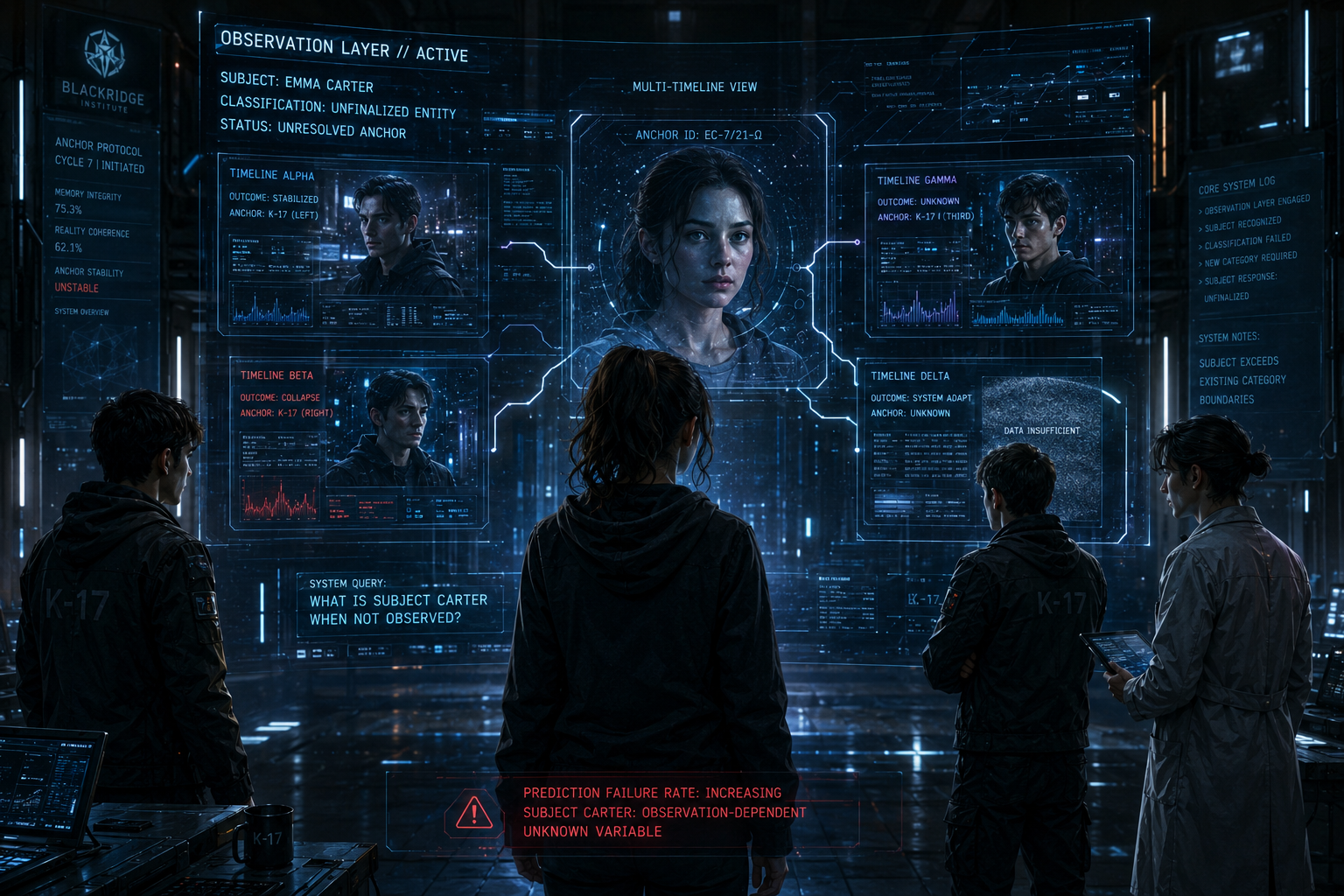
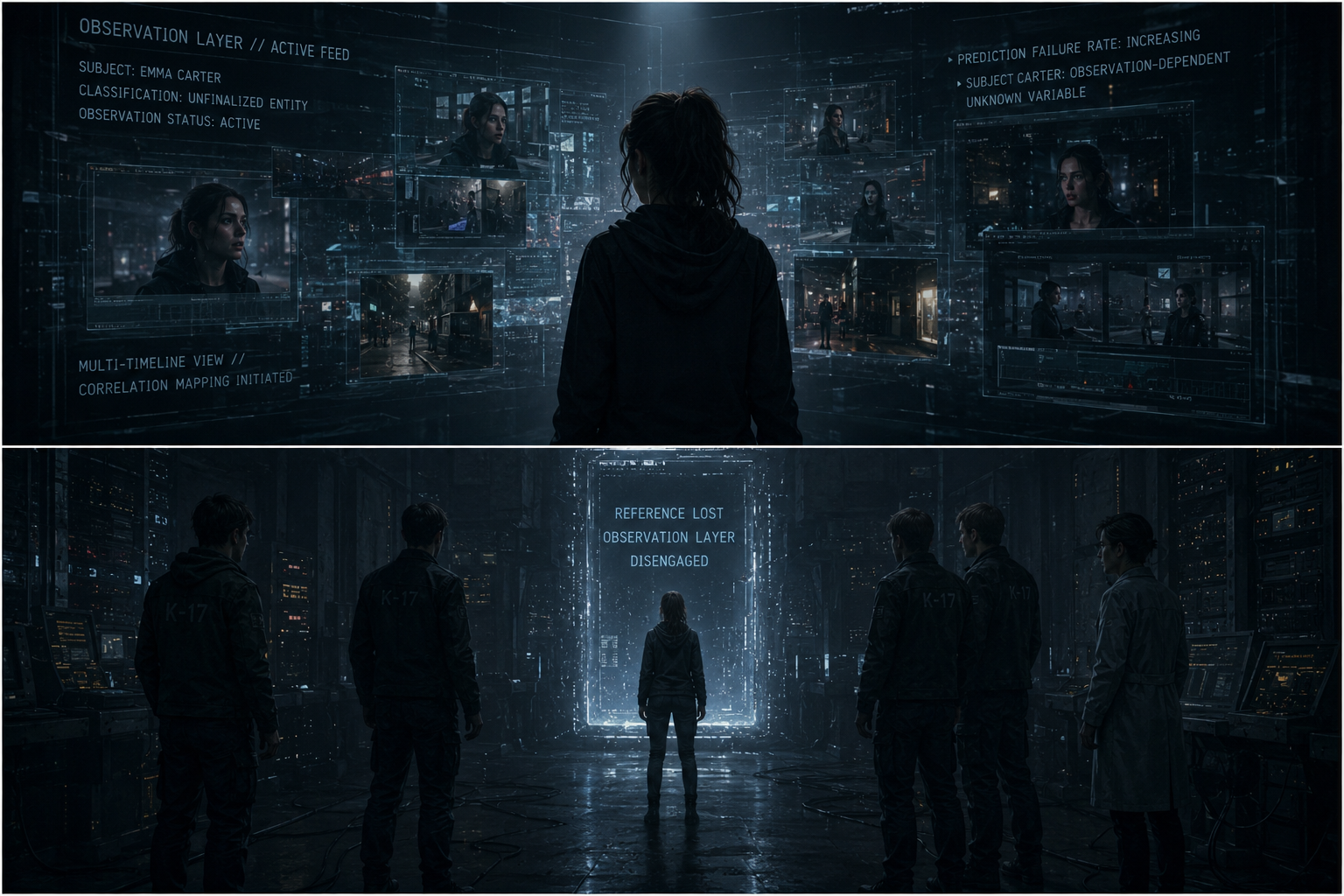
Chapter 14 – The First Anchor

The silence after her message didn’t feel empty.
It felt occupied.
Like something had just stepped out of the room but hadn’t fully left.
I kept staring at the space where the projection had been.
My mind refused to settle.
Don’t trust the version of him that remembers you first.
That sentence looped in my head until it stopped sounding like language and started sounding like a warning system.
K-17 hadn’t moved.
That was the part I couldn’t ignore.
He stood there like he was listening to something I couldn’t hear.
Finally, I broke the silence.
“Who was she?” I asked quietly.
No immediate answer.
That hesitation again.
But this time it wasn’t just K-17.
Even the technician avoided looking at the interface.
That told me more than anything else.
K-17 exhaled slowly.
“The first anchor,” he said.
My stomach tightened.
“She said she failed,” I replied.
He nodded once.
“Yes.”
A pause.
Then softer:
“She failed to remain singular.”
I frowned.
“That doesn’t mean anything to me.”
“It will,” he said.
The technician stepped back toward the console.
“Residual imprint activity increasing,” they said quietly.
K-17 turned slightly.
“Is she localizing?” he asked.
The technician hesitated.
Then:
“Not fully.”
That word again.
Not fully.
Like reality itself was never complete here—just approximated.
I stepped forward.
“Where is she?” I asked.
No one answered immediately.
Then the system did.
Not with sound.
But with spatial distortion.
The room dimmed.
Not lights going out.
More like attention narrowing.
And then—
the air in front of us folded.
Not physically tearing.
Just… reordering.
A vertical seam appeared in space, like reality had been split and pinned open.
K-17 stepped in front of me instantly.
“Don’t move,” he said.
But I was already staring.
Because something was on the other side.
A corridor.
Different from ours.
Older.
Heavier.
Like it had been used longer than anything in Blackridge should have been allowed to exist.
And someone was standing in it.
A woman.
Not projection.
Not data.
Present.
Real.
She stepped forward slowly.
And the seam widened just enough for her to cross.
The moment she entered our space, the lighting changed.
Not dramatically.
But enough that I felt it in my bones.
She looked at me first.
Not K-17.
Me.
Like she had already decided he was secondary.
I felt my throat tighten.
“You’re her,” I whispered.
She smiled faintly.
“I was.”
The way she said it made my stomach drop.
K-17’s voice was controlled.
“You shouldn’t be able to cross layer boundaries.”
She tilted her head slightly.
“That used to be true.”
A pause.
Then she looked at him.
“And yet here I am.”
The technician stepped back.
“Containment breach protocol—”
“Stop,” K-17 said sharply.
The technician froze.
Not because of authority.
Because something about him had changed in tone.
The woman stepped fully into the room now.
And I realized something immediately.
She didn’t look like me.
Not exactly.
But close enough that my brain kept trying to align the differences and failing.
Like a version of me that had been refined through decisions I hadn’t made yet.
She stopped a few feet away from me.
And studied me like I was a reflection that had learned to move independently.
“You’re early,” she said again.
I swallowed.
“So you already said.”
She nodded.
“I remember.”
My chest tightened.
“You remember me?”
“Yes,” she said.
A pause.
“Across most versions.”
That word again.
Versions.
K-17 spoke quietly.
“You shouldn’t have retained cross-instance continuity.”
She didn’t look at him.
“That’s what failure looks like,” she said simply.
I stepped forward slightly.
“What are you talking about?” I asked.
She turned her attention fully to me.
And for the first time, I felt it clearly.
Weight.
Not authority.
Not threat.
Experience.
Like she had lived through something I hadn’t even conceptualized yet.
“You are standing at the point where I stopped being singular,” she said.
I frowned.
“That doesn’t help me.”
“It’s not meant to,” she replied.
The technician whispered something about instability thresholds.
No one responded.
The woman continued.
“I was the first successful anchor integration,” she said.
A pause.
“And the first failure of continuity.”
I felt my stomach tighten.
“Failure how?”
She looked at me for a long moment.
Then said:
“I began remembering outcomes that didn’t belong to my timeline.”
Silence.
Heavy.
Immediate.
K-17’s voice dropped slightly.
“Cross-branch leakage,” he muttered.
She nodded once.
“That’s your technical term for it.”
She looked back at me.
“I remember choosing wrong in versions I never lived.”
My breath slowed.
“That’s impossible.”
She shook her head.
“No,” she said softly.
“It’s what happens when you become stable enough to hold multiple outcomes.”
My hands felt cold.
“And then what?” I asked quietly.
She hesitated.
For the first time, uncertainty crossed her expression.
Then she said:
“I stopped being one person.”
The room felt smaller.
Not physically.
Conceptually.
Like everything inside it was being forced to acknowledge something larger pressing against its boundaries.
K-17 stepped closer.
“You destabilized the entire anchoring framework,” he said quietly.
She looked at him.
“Yes.”
A pause.
“Because I refused to collapse into a single version of myself.”
That sentence hit differently.
Not as science.
As choice.
I swallowed hard.
“And Blackridge…?” I asked.
She turned back to me.
“Blackridge adapted,” she said.
My stomach tightened.
“How?”
Her expression darkened slightly.
“By trying to make the anchor consistent.”
A pause.
“And when that failed…”
She looked at K-17.
“They started over.”
Silence.
K-17 didn’t deny it.
That was the worst part.
I felt my voice drop.
“What happened to you?”
She looked at me for a long moment.
And then said:
“I’m what remains when the system stops trying to correct you.”
My breath caught.
“You’re not removed?” I asked quietly.
A faint smile.
“No,” she said.
“I’m unresolved.”
The air in the room shifted again.
The seam behind her flickered.
Like it couldn’t maintain her presence much longer.
K-17 noticed immediately.
“She’s destabilizing,” he said.
She nodded once.
“I won’t stay long.”
I stepped forward.
“Wait,” I said quickly. “If you’re me—if you’re what I become—then tell me what I’m supposed to do.”
She looked at me.
And for the first time, her expression softened.
Not comfort.
Recognition.
Then she said:
“Don’t accept completion.”
My brow furrowed.
“What does that mean?”
She stepped slightly closer.
“Every version of you that accepts finality becomes controllable.”
A pause.
“I was the first one who refused.”
K-17’s voice was low.
“And you broke the system.”
She nodded.
“Yes.”
Then she looked at me one last time.
“But it learned from me.”
The seam behind her widened suddenly.
Too fast.
K-17 moved forward.
“You’re collapsing,” he said.
She didn’t resist it.
Instead, she looked at me one last time.
And said something that made everything feel heavier than before:
“When you meet him again,” she said quietly.
“Don’t assume he remembers you correctly.”
My stomach dropped.
“K-17?” I whispered.
But she was already fading.
The seam closed.
And she was gone.
The room returned.
But nothing felt normal anymore.
K-17 stood very still.
Not looking at where she had been.
Looking at me.
Like something in him had just been confirmed.
Or challenged.
I swallowed.
“Tell me she’s wrong,” I said quietly.
He didn’t answer immediately.
That hesitation again.
Then he said:
“She wasn’t supposed to exist anymore.”
My chest tightened.
“And yet she did.”
He looked at me.
“Yes.”
A pause.
“And now she knows you exist too.”
And somewhere deep within Blackridge’s layered structure, a suppressed continuity line reactivated for the first time in an unresolved cycle.
Not forward.
Not backward.
May you like



But recursive.
And it began searching for its missing anchor again.