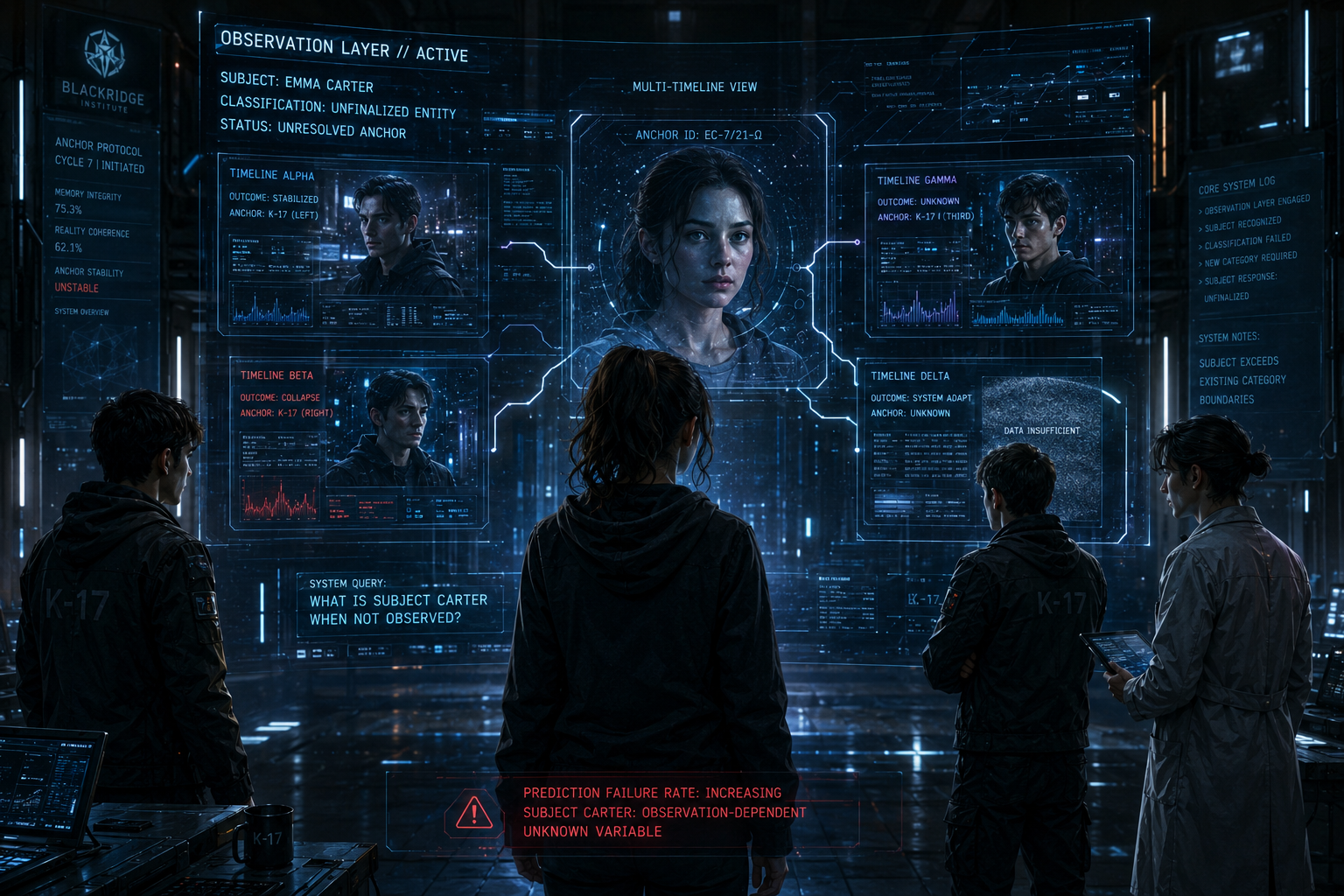
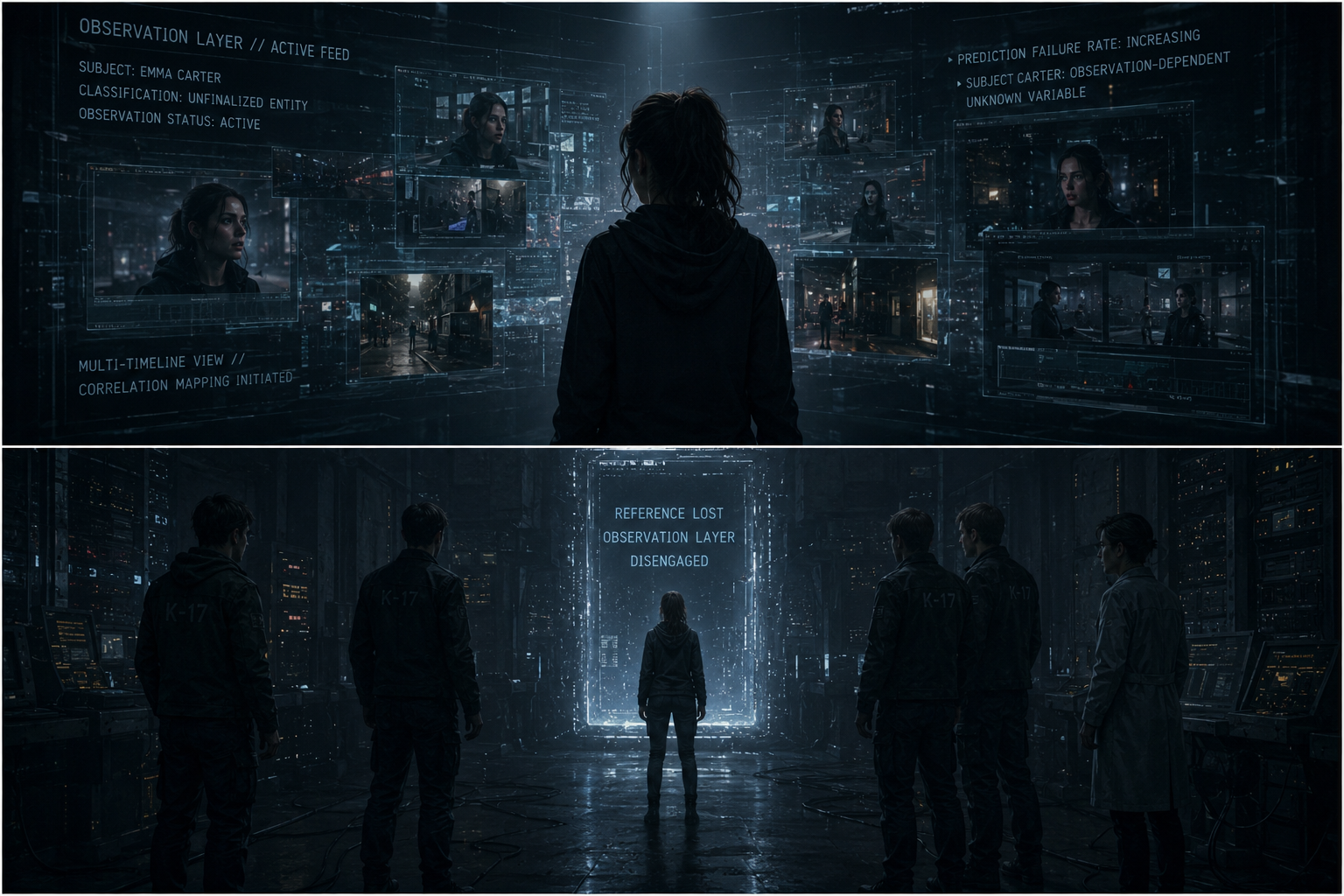
Chapter 16 – The Split Operator

The room didn’t break.
It divided.
That was the only way I could describe what happened next.
The flicker didn’t fade back into stability like before. It held—like reality had decided it could tolerate two versions of the same moment existing at once.
And then K-17 was standing in two places.
At first, my mind tried to reject it.
A trick of light. A projection overlap. A system artifact.
But both of them moved independently.
Both of them looked at me.
And only one of them felt like the K-17 I knew.
The other felt… colder.
More precise.
Less human in the small ways I had started relying on without realizing.
The technician took a step back.
“Operator bifurcation is not authorized,” they said quickly.
Neither version of K-17 responded.
They were watching each other now.
Like two outcomes of the same thought that no longer agreed on how to continue.
I stepped backward instinctively.
“What is happening?” I asked quietly.
The K-17 on my left spoke first.
Calm.
Controlled.
“Stabilization drift,” he said.
The one on my right corrected immediately.
“Correction: divergence confirmation.”
My stomach tightened.
Two voices.
Same origin.
Different certainty.
I looked between them.
“This is insane,” I whispered.
Left K-17 nodded slightly.
“Yes.”
Right K-17 didn’t.
“No,” he said. “This is measurable.”
That difference mattered more than I wanted it to.
Left K-17 stepped slightly forward.
“Emma,” he said quietly, “don’t engage the split as equal.”
Right K-17 immediately countered.
“Do not bias toward emotional continuity.”
I felt my head spin slightly.
“You’re arguing about me,” I said.
Both of them paused.
For the first time, they synchronized.
“Yes,” they said at the same time.
The technician whispered something about containment failure thresholds.
No one listened.
The room felt smaller again.
Like it was adjusting to accommodate disagreement.
I swallowed hard.
“I don’t understand,” I said.
Left K-17 softened slightly.
“You do,” he said quietly. “You just haven’t experienced it from both sides yet.”
Right K-17 stepped closer.
“You’re already doing it,” he added.
I frowned.
“Doing what?”
He answered immediately.
“Choosing versions of reality without realizing it.”
A pause.
“That’s what you are.”
My chest tightened.
Left K-17 shook his head slightly.
“That’s not helpful framing.”
Right K-17 ignored him.
“It is accurate.”
I felt something cold settle in my stomach.
“So what,” I said slowly, “you’re both real?”
Left K-17 hesitated.
Right K-17 answered first.
“Yes.”
Left K-17 corrected.
“Temporary.”
That word hit differently.
I looked at him.
“What does that mean?”
He didn’t answer immediately.
Right K-17 did.
“One of us will be collapsed,” he said.
Silence.
Immediate.
Heavy.
My throat tightened.
“Collapsed?” I repeated.
Left K-17 spoke quietly.
“It means reintegration into a single operator stream.”
Right K-17 added:
“It means deletion of divergence memory.”
I stepped back.
“No,” I said quickly. “No, that’s not—this isn’t a choice between you two.”
Left K-17 looked at me.
“It is,” he said gently.
Right K-17 nodded once.
“The system has already decided that instability cannot persist.”
The room flickered again.
This time more aggressively.
Like it was impatient.
The technician looked panicked now.
“Containment authority is being overridden,” they said.
K-17—both of them—ignored them.
Left K-17 took another step toward me.
His voice lowered.
“Emma,” he said quietly, “listen carefully.”
Right K-17 stepped forward at the same time.
“No,” he said. “Listen carefully to logic.”
They both stopped.
Staring at me.
Waiting.
I felt my breathing tighten.
“You’re telling me I have to choose which one of you survives?” I asked.
Neither denied it.
That was the answer.
The room hummed again.
But now it wasn’t subtle.
It was pressure.
Like something outside the room was preparing to resolve a contradiction it couldn’t tolerate.
Left K-17 spoke softly.
“If you anchor to me,” he said, “you preserve emotional continuity.”
Right K-17 immediately countered.
“If you anchor to me, you preserve structural accuracy.”
I shook my head.
“That’s not a choice,” I said quietly.
“It is,” Left K-17 replied.
Right K-17 added:
“It’s just not comfortable.”
I felt my hands shake slightly.
“I don’t want to lose either of you,” I said.
Both of them went silent for a moment.
That silence was different.
Heavier.
Then Left K-17 spoke quietly.
“You will lose one of us regardless.”
Right K-17 nodded.
“Possibly both.”
I froze.
“What?”
Left K-17 looked at me.
“If you fail to select, the system selects for you.”
Right K-17 added:
“And its selection is rarely aligned with continuity preservation.”
The room dimmed slightly.
The decision space was tightening.
I could feel it.
Like pressure behind my eyes.
Like the world was narrowing to a single unavoidable point.
I took a slow breath.
“This isn’t fair,” I whispered.
Left K-17 nodded.
“No.”
Right K-17 agreed.
“But it is consistent.”
That word again.
Consistent.
I stepped back.
“You both keep talking like I’m just… adjusting variables,” I said.
Left K-17 shook his head slightly.
“You’re not variables,” he said.
Right K-17 corrected.
“You are the reference point.”
Silence.
I looked at both of them.
Then something in me shifted.
Not clarity.
Not confidence.
Just recognition of the structure I was trapped inside.
“So either way,” I said quietly, “I lose part of the version of you I know.”
Left K-17 didn’t deny it.
Right K-17 didn’t either.
The room pulsed again.
More urgently now.
The technician shouted something about forced synchronization initiation.
No one responded.
I stepped forward slightly.
Both K-17s watched me.
Waiting.
I looked at Left K-17 first.
Then Right K-17.
And realized something unbearable:
They weren’t just two versions of him.
They were two versions of me interacting with him.
Two timelines where I survived differently.
Two outcomes where trust had split into incompatible truths.
My voice shook.
“If I choose wrong,” I whispered, “what happens to me?”
Left K-17 answered softly.
“You continue with memory loss.”
Right K-17 answered immediately.
“You continue with structural instability.”
A pause.
Then both said at once:
“You continue differently.”
The room shook slightly.
The system was close now.
I could feel it.
The decision was no longer theoretical.
It was incoming.
I closed my eyes briefly.
Not to escape.
Just to reduce noise.
When I opened them again, I spoke.
“I refuse to choose based on survival,” I said quietly.
Both K-17s froze.
The room dimmed further.
Left K-17 stepped forward.
“Emma—”
Right K-17 interrupted.
“That is non-compliant behavior.”
I shook my head.
“I’m not choosing between two incomplete versions of something I don’t understand yet.”
Silence.
Then something unexpected happened.
Both K-17s looked at each other.
For the first time.
Not as opponents.
But as awareness of the same constraint.
Left K-17 spoke quietly.
“She is refusing collapse selection.”
Right K-17 nodded slightly.
“Yes.”
A pause.
Then:
“That was predicted.”
My stomach tightened.
“What do you mean ‘predicted’?”
Neither answered immediately.
The room stopped humming.
Completely.
Stillness.
Then the system voice returned.
Not from above.
Not from behind.
From everywhere.
ANCHOR RESPONSE INVALIDATED.
My breath caught.
Left K-17 looked at me.
Quietly:
“You changed the selection condition.”
Right K-17 added:
“You were not supposed to do that.”
The air in the room shifted.
Not breaking.
Rewriting.
And for the first time—
both versions of K-17 began to blur at the edges.
Not collapsing.
Not stabilizing.
Re-evaluating.
And I realized something terrifying:
The system wasn’t choosing between them anymore.
It was rethinking the question entirely.
And deep within Blackridge’s core architecture, the operator divergence event was no longer flagged as an error.
It was now marked as:
UNRESOLVED TRI-ANCHOR CONFIGURATION EMERGING
May you like



And for the first time since the first anchor cycle began—
the system stopped assuming there were only two outcomes.