Chapter 7 – Running Out of Safe Places

The lights didn’t fully come back.
They tried to.
That was the unsettling part.
Instead of stabilizing into normal brightness, they hovered somewhere between functioning and failing—like the building itself couldn’t decide which version of reality it was supposed to obey.
A faint electrical hum filled the room.
Constant.
Unsettled.
Wrong.
I took a step backward without realizing it.
K-17 moved with me instantly, not touching me, but staying aligned—like a shadow that had decided it belonged to me.
The woman’s eyes stayed fixed on the ceiling lights.
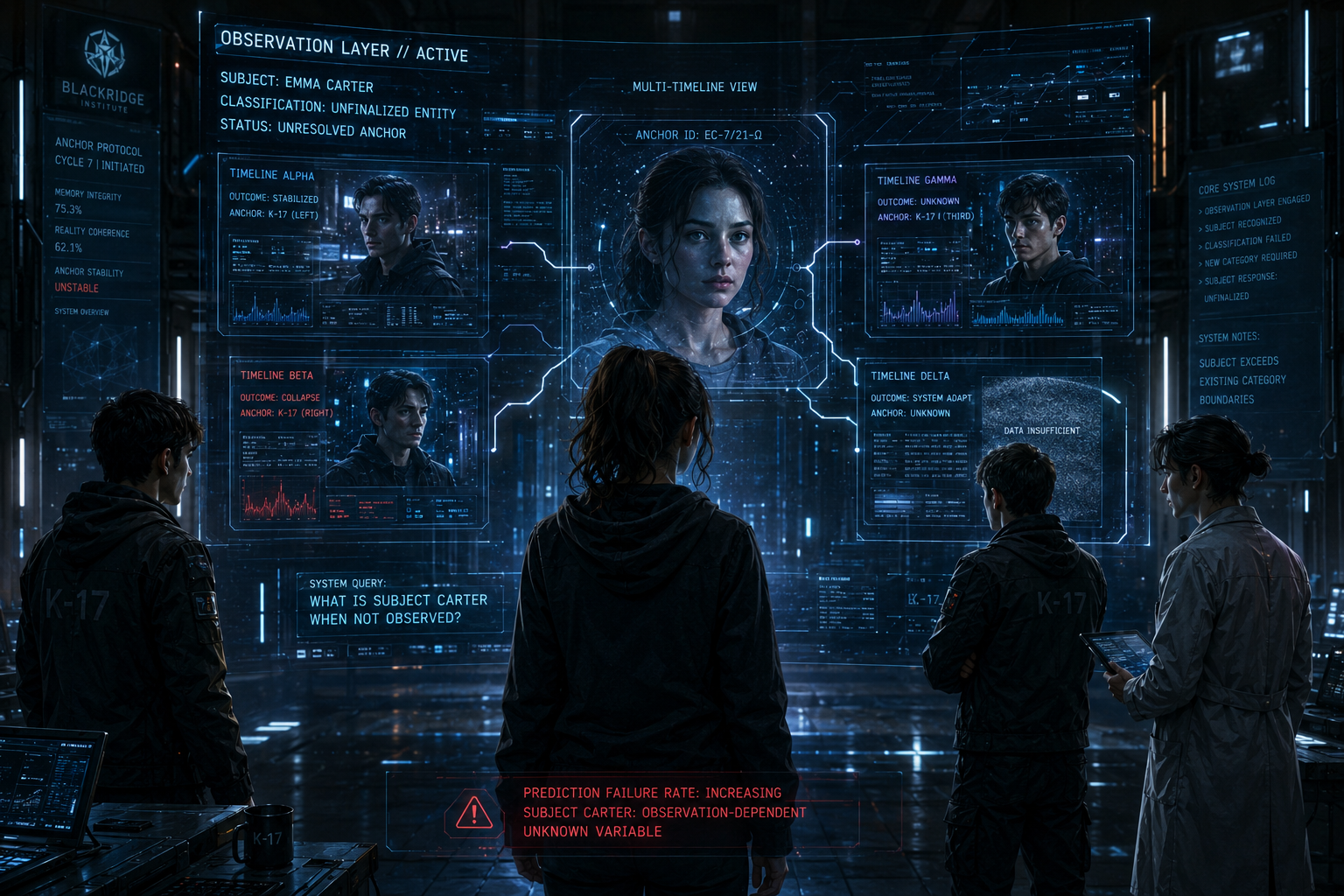
“Containment variance increasing,” she said quietly.
No urgency.
Just acknowledgment.
Like reading a meter that had crossed a threshold too many times to be surprised anymore.
“I don’t care about your containment anything,” I said, my voice shaking now. “I want out of this building. Out of this system. Out of whatever you think I am.”
No one answered immediately.
That silence had become familiar.
And I hated it.
Finally, K-17 spoke.
“You can leave,” he said.
I turned to him sharply.
“Then why am I still here?”
He hesitated.
Because of course he did.
“Because leaving doesn’t mean exiting,” he said.
“That doesn’t make sense.”
“It does here,” he replied.
The woman finally looked at me directly.
“For the first time,” she added quietly, “you are not stable outside monitored zones.”
My stomach dropped.
“That’s not a real sentence,” I whispered.
“It is now,” she said.
A distant metallic sound echoed through the corridor outside the room.
Then another.
Then several.
Not alarms.
Not panic.
Movement.
Coordinated.
The guards had repositioned.
I could feel it without seeing it.
Like the building itself was tightening around us.
K-17’s posture changed slightly.
“Shift has started,” he muttered.
“What shift?” I snapped.
He didn’t answer.
Instead, he looked toward the door.
The woman did too.
For the first time, she wasn’t in control of the timing anymore.
That realization hit me harder than anything else.
Something outside this room had started making decisions without her.
Without them.
Without anyone.
A soft voice came through the intercom.
“Level synchronization breach detected.”
Then another voice, overlapping.
“Subject proximity instability confirmed.”
The woman closed her eyes for half a second.
Then opened them again.
“Move,” she said immediately.
That was new.
Command, not observation.
K-17 didn’t hesitate this time.
He grabbed my arm—not forcefully, but decisively.
“We’re leaving,” he said.
“Where?” I demanded.
“Anywhere that isn’t here.”
That wasn’t comforting.
The door slid open before we reached it.
Not unlocked.
Opened.
Like it had been waiting for the exact moment we decided to leave.
That alone made my skin crawl.
We stepped into the corridor.
It was different now.
Not physically changed.
But perceptually wrong.
The lighting flickered in uneven rhythms.
The air felt heavier in some directions than others.
And the farther we walked, the more I became aware of something I couldn’t un-feel.
Attention.
Not from people.
From the environment itself.
Like the building was noticing me more directly with every step.
“What is happening?” I whispered.
K-17 didn’t slow down.
“They’re losing control of the mapping layer,” he said.
“That’s not an answer!”
“It’s the closest thing you’ll get,” he replied.
We turned a corner.
And I stopped abruptly.
The corridor ahead split into two paths.
But something was wrong.
Both paths looked identical.
Down to the smallest detail.
Same lighting.
Same cracks in the wall.
Same flickering panel overhead.
A perfect duplication.
My stomach twisted.
“That wasn’t there before,” I said.
“It was,” K-17 replied. “You just weren’t aligned to see both at once.”
“That doesn’t help!”
He looked at me briefly.
“I didn’t say it would.”
We stood there for a moment.
The building humming softly around us like a machine pretending to be architecture.
Then the woman’s voice came from behind us.
“Left path is stabilized route.”
I turned.
“How do you know?” I asked.
She hesitated.
That hesitation again.
“I don’t,” she admitted.
K-17 looked between both paths.
“This is branching,” he said quietly.
“What does that mean?” I asked.
He didn’t answer immediately.
Then:
“It means outcomes are overlapping.”
I felt my throat tighten.
“That’s not how buildings work.”
“It is now,” he said again.
I stared at both corridors.
They both felt real.
But not equally real.
One of them felt slightly colder.
The other slightly quieter.
Neither felt safe.
The woman spoke again.
“If we don’t move, stabilization collapses further.”
“That sounds bad,” I muttered.
“It is,” K-17 said.
I laughed once, but it came out thin.
“I miss when my biggest problem was rent.”
No one responded.
Because none of this was meant to be funny.
Finally, K-17 made a decision.
“Right,” he said.
The woman frowned slightly.
“That’s not confirmed.”
“It doesn’t need to be,” he replied.
He started walking.
And because I had no better option, I followed.
The moment we stepped into the right corridor—
everything changed.
Not visually at first.
But emotionally.
Like stepping into a room where a conversation had already happened without you.
The air felt… remembered.
I stopped again.
“Do you feel that?” I whispered.
K-17 didn’t answer.
But his jaw tightened slightly.
So yes.
He felt it too.
The corridor stretched longer the more we walked.
But distance didn’t feel linear anymore.
Sometimes a step felt like ten meters.
Sometimes like nothing at all.
My sense of direction started slipping.
“Why is this happening?” I asked quietly.
K-17 finally answered.
“Because you’re stabilizing the reference field.”
“I don’t know what that means!”
“It means,” he said, “the system is adjusting reality around you instead of adjusting you to reality.”
I stopped walking.
“Stop saying things like that,” I said. “That sounds insane.”
He turned slightly toward me.
“It is,” he admitted.
That honesty again.
It always landed worse than denial.
The corridor ahead flickered.
And for a brief moment—
I saw something else layered over it.
A different version of the same hallway.
But darker.
Empty.
Collapsed.
Like a future that had already happened once.
I stumbled back.
“What was that?” I whispered.
K-17 looked at it too.
His expression tightened.
“Residual collapse state,” he said.
The woman stepped closer now, her voice lower.
“We need to exit this section immediately.”
“For once,” I said, my voice shaking, “I agree with something you say.”
We moved faster.
The corridor ended in another door.
No markings.
No indicator.
Just metal.
Waiting.
K-17 placed his hand on it.
Paused.
Then looked at me.
“This is the point where things stop being reversible,” he said.
I swallowed hard.
“That implies they were reversible before.”
He didn’t answer.
The woman stepped in.
“Open it,” she ordered.
K-17 did.
The door slid open.
And for a moment—
nothing happened.
Just silence.
Still air.
Normal light.
A hallway that looked almost… ordinary.
Too ordinary.
I stepped forward slowly.
“This feels wrong,” I whispered.
K-17 nodded once.
“It is.”
And then—
somewhere deep in the building—
something shifted again.
Not loudly.
Not dramatically.
But fundamentally.
Like a rule being rewritten mid-sentence.
And I realized something I didn’t want to understand yet:
We weren’t running out of safe places.
We were running out of places that still agreed what “safe” meant.
And far beneath Blackridge’s visible infrastructure, something long dormant adjusted its perception model.
May you like
Because the anchor wasn’t just moving through the system anymore.
The system was beginning to move around her.