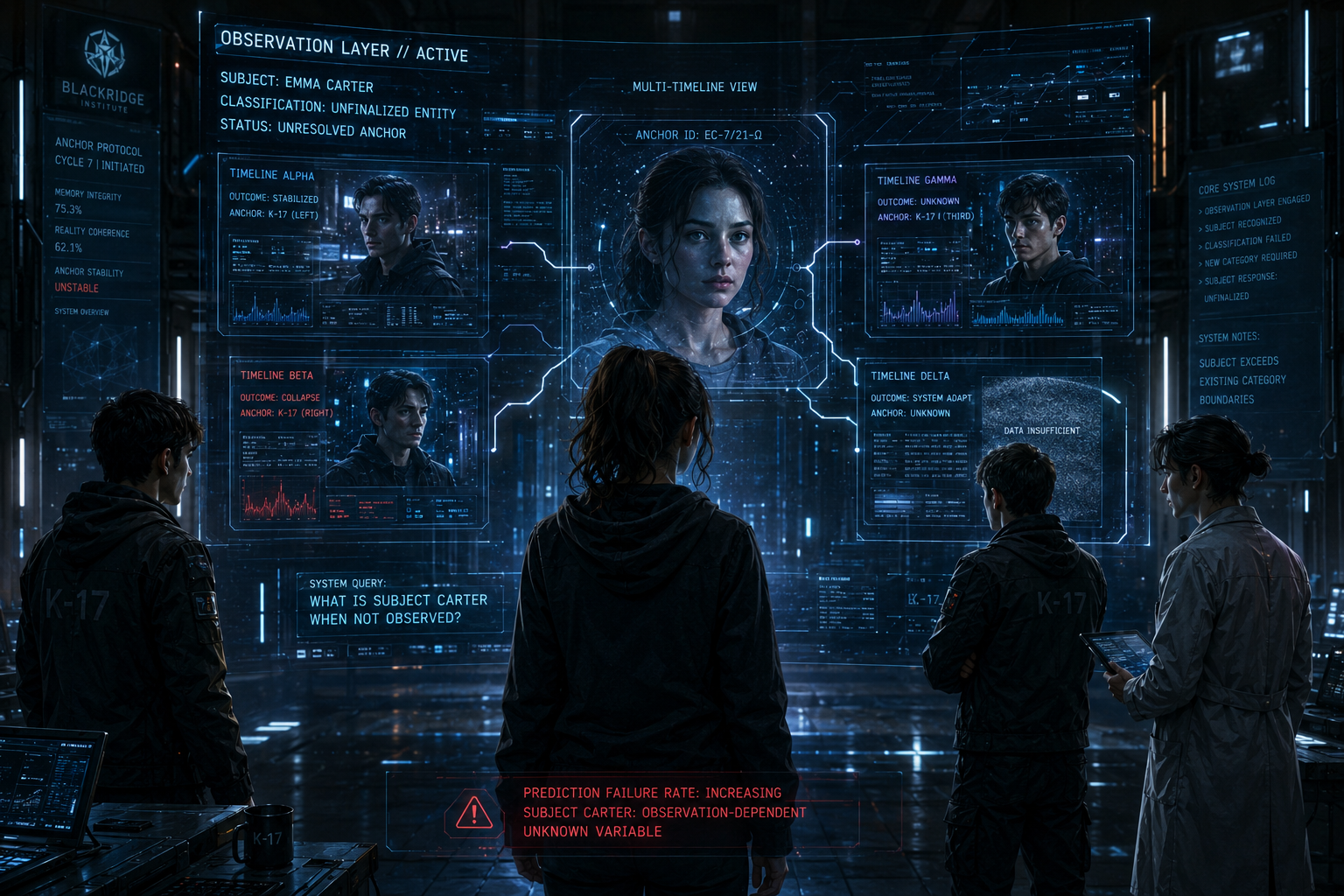
Chapter 9 – The Price of Knowing
The word loop stayed in my mind like a bruise you keep pressing without meaning to.
Anchor loop condition active.
I didn’t fully understand it.
But I understood enough to know it wasn’t something you wanted attached to your name.
We left the memory surface behind it like it was something we weren’t supposed to look at twice.
Maybe we weren’t.
The further we walked, the less the environment felt like a corridor and the more it felt like… correction.
Like reality itself was smoothing out inconsistencies around us.
Sometimes the lights dimmed when I thought too loudly.
Sometimes the walls seemed to adjust their texture when I hesitated.
It wasn’t dramatic.
It was worse.
It was subtle enough to doubt.
K-17 walked slightly ahead now, scanning every junction.
The woman followed behind, silent for longer than before.
I broke first.
“What happens to people who know too much?” I asked.
K-17 didn’t answer immediately.
That alone told me everything I needed.
Finally, he said:
“They stop being useful in unstable form.”
I frowned.
“That’s not an answer.”
“It is here,” he said again.
I hated how often that sentence was becoming the explanation for everything.
The woman finally spoke.
“They are either stabilized or removed.”
I stopped walking.
“Removed,” I repeated.
She didn’t correct it.
That was the answer.
My voice lowered.
“And what determines that?”
K-17 turned slightly toward me.
“Whether you can hold your version of reality without collapsing the system around you.”
I laughed once, but it came out wrong.
“So I either accept your version of reality or I get erased?”
“No,” he said quietly.
A pause.
“Or you become the version that defines it.”
That made no sense and too much sense at the same time.
We turned into a wider chamber.
This one wasn’t empty.
There were structures here.
Not rooms.
Not machines.
More like frames embedded into the space itself.
Each one showed faint flickers of movement inside—like half-formed scenes trying to load.
My skin prickled.
“What is this place?” I whispered.
The woman looked around carefully.
“Transition archive.”
“That sounds like a place where people don’t come back from,” I said.
K-17 didn’t deny it.
That was becoming his habit when things were true.
We walked deeper.
And then I saw it.
One of the frames flickered more strongly than the others.
It stabilized as we approached.
And I saw myself.
Again.
But this time—
I wasn’t in Hawthorne Alley.
I was here.
Standing exactly where I was standing now.
Except I wasn’t with them.
I was alone.
And I was looking directly at something off-screen with an expression I couldn’t read.
Calm.
Controlled.
Final.
My breath caught.
“No…” I whispered.
The woman stepped closer to the frame.
“That’s a completed convergence state,” she said.
K-17 stared at it for a long time.
“This is the version they keep trying to avoid,” he said quietly.
I turned to him sharply.
“What version?”
He finally met my eyes fully.
“The one where you stop reacting.”
That sounded harmless.
It wasn’t.
I shook my head.
“I don’t understand what you want from me.”
The woman answered.
“We don’t want anything.”
A pause.
“We are trying to prevent systemic collapse.”
“That sounds like your problem, not mine,” I snapped.
K-17 stepped closer.
“It becomes your problem when your choices stop being isolated.”
I backed away slightly.
“My choices are mine.”
He looked at me sadly.
“That’s what every iteration says before it changes.”
The frame flickered again.
This time faster.
And suddenly—
the scene changed.
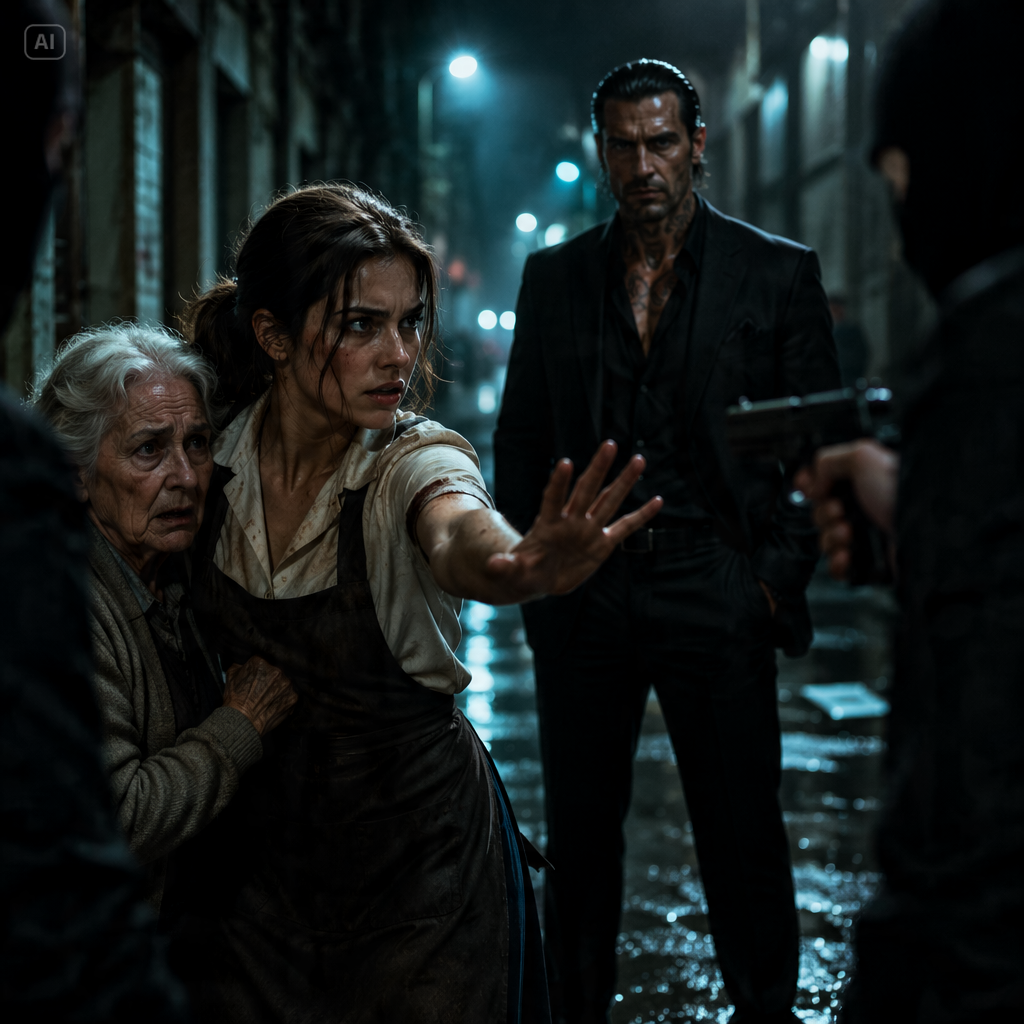
Now I saw Hawthorne Alley again.
But it wasn’t the first night.
It was another version.
Different rain angle.
Different lighting.
Different timing.
And I was there.
But I wasn’t helping him.
I was standing over K-17.
Watching him.
While he was still alive.
My stomach twisted violently.
“That didn’t happen,” I said quickly.
K-17 didn’t look away from the frame.
“It did,” he said quietly.
My voice cracked.
“I would never—”
“You already did,” the woman interrupted softly.
Silence dropped hard.
I turned to her.
“What does that mean?”
She hesitated.
Then said:
“You are not a single event entity.”
I stared at her.
“That’s not English.”
“It is classification,” she replied.
K-17 spoke quietly.
“She exists across divergence attempts.”
I shook my head.
“No. I’m me. I’m right here.”
The woman looked at me directly.
“You are a stabilization point across multiple collapsed outcomes.”
The chamber suddenly felt colder.
K-17’s voice dropped.
“And in some outcomes, you choose differently.”
My breath hitched.
“And those outcomes?” I whispered.
The woman didn’t answer immediately.
Then:
“Most of them fail.”
My chest tightened.
“Fail how?”
K-17 finally said it.
“You don’t survive contact with the system in most versions.”
A pause.
“But in a few…”
He hesitated.
I felt my heart pounding.
“In a few what?” I asked.
He looked at me.
“You become what it stabilizes around.”
The frame behind him flickered violently now.
And for a moment—
I saw it clearly.
Another version of me.
Standing in a control room I didn’t recognize.
Surrounded by people who weren’t speaking.
And K-17—
standing beside me.
Alive.
Not injured.
Not running.
Just waiting.
Like he had always been there.
I stumbled back.
“That’s not real,” I whispered.
But my voice didn’t sound certain anymore.
The woman stepped forward.
“We are out of time,” she said.
The chamber began to hum.
Low.
Rising.
Not alarm.
Response.
K-17 moved immediately.
“Collapse cycle is initiating,” he said.
“What does that mean?” I demanded.
He grabbed my arm.
“For you,” he said quietly, “it means the system is choosing a dominant version.”
My breathing quickened.
“And if I’m not that version?”
He looked at me.
“You won’t be retained.”
The words hit harder than anything before.
Not removed.
Not contained.
Not extracted.
Not retained.
Like I was a possibility that could be discarded.
The frames around us began flickering faster.
Scenes overlapping.
Versions of me stacking on top of each other.
Too many eyes.
Too many choices.
Too many outcomes that no longer agreed.
The woman stepped back slightly.
“This is the threshold,” she said.
I looked around.
Panic rising now.
“What threshold?”
K-17’s grip tightened slightly.
“The point where you either anchor,” he said, “or you fragment.”
I swallowed hard.
“And if I don’t choose?”
He didn’t answer immediately.
Then:
“You already are.”
And somewhere deep beneath Blackridge, something long trained for divergence recognized a final condition being met.
Not failure.
Not success.
May you like



But selection.
And the city prepared to remember only one version of Emma Carter.