Chapter 4 – The Wrong Rescue
The room didn’t feel like a room anymore.
It felt like a container.
Like something airtight had been sealed around me the moment K-17 spoke those words.
“You were activating me.”
I kept replaying it in my head, searching for a version where it made sense.
There wasn’t one.
My hands curled into fists at my sides.
“That’s impossible,” I said. “I don’t even know you.”
K-17 studied me for a long moment.
Not like a stranger.
Like someone checking a result they didn’t expect.
“You don’t know me,” he agreed. “But you intersected with me at exactly the wrong time.”
“Wrong time for what?” I snapped.
The woman—the one who wouldn’t give me her name—stepped in slightly.
“Enough,” she said calmly.
But it wasn’t directed at him.
It was directed at me.
That realization made my anger spike.
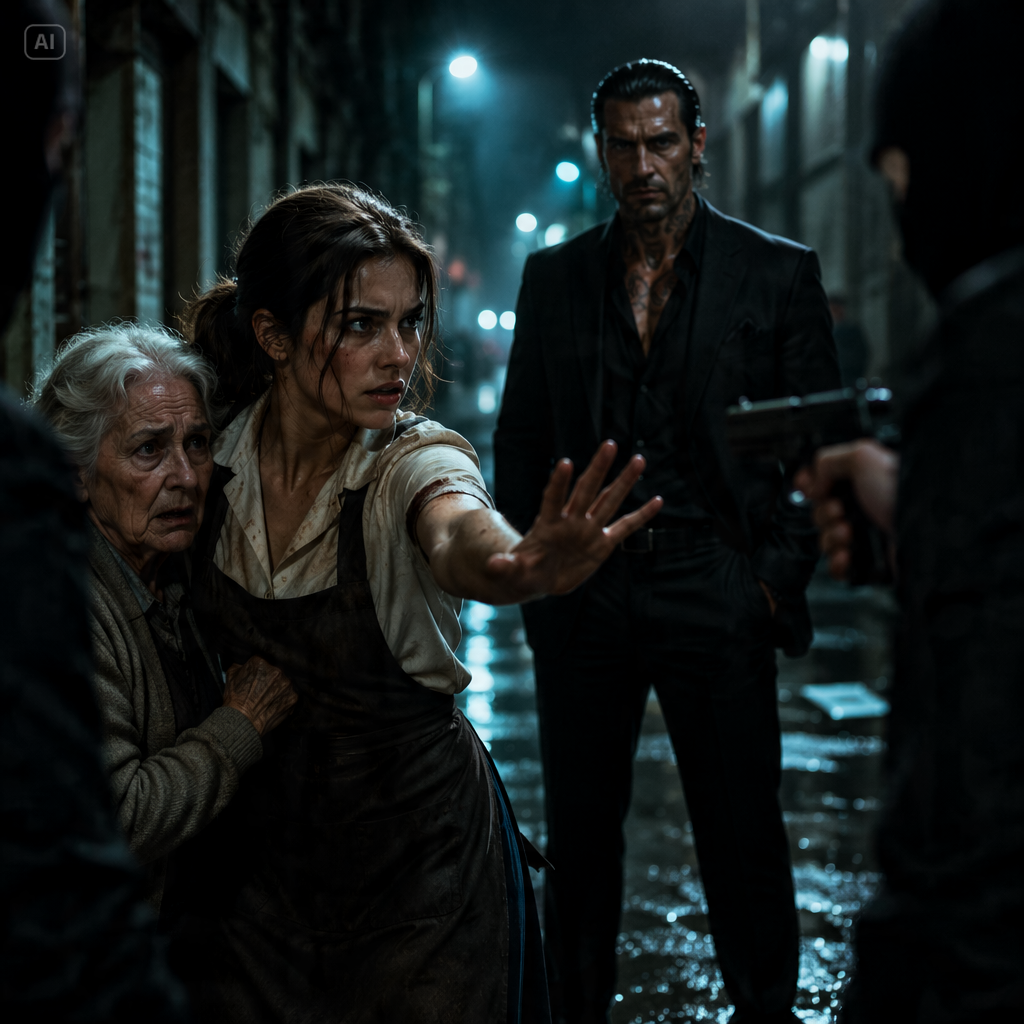
“I didn’t do anything wrong,” I said. “I helped someone bleeding in an alley. That’s it.”
K-17 looked away for a second, almost like he was choosing how much truth I could survive hearing.
Then he said:
“That’s the problem.”
Silence dropped hard.
The woman crossed her arms.
“Explain.”
K-17 exhaled slowly.
“You weren’t supposed to see me,” he said. “Not like that. Not in that condition.”
I laughed, sharp and broken.
“So I was supposed to just walk past a dying man?”
“No,” he said immediately. “You were supposed to not exist at that location at that time.”
That didn’t help.
“That’s not an answer,” I said.
“It is,” he replied. “It’s just not one you’re used to hearing.”
My pulse started climbing again.
The woman finally opened the folder she had brought earlier, flipping it to a page I hadn’t seen yet.
A map.
Hawthorne Alley.
But it wasn’t just a map.
There were markings. Timelines. Movement paths. Heat signatures.
My stomach tightened.
“You were tracked,” she said simply.
“I was walking home.”
“You were observed before you entered the alley,” she corrected.
K-17’s gaze sharpened slightly.
“She wasn’t random,” he said.
The woman didn’t respond.
That silence was confirmation enough.
Something cold settled in my chest.
“You’re saying…” I hesitated. “You’re saying I was followed into this?”
“No,” she said.
Then she paused.
And corrected herself.
“You were guided.”
The word didn’t make sense.
But it felt worse than “followed.”
I took a step back.
“Guided by who?”
No answer.
Of course.
K-17’s voice dropped slightly.
“They needed proximity.”
“To what?” I demanded.
He looked at me.
And for the first time, there was something almost like warning in his expression.
“To me.”
The room tilted slightly in my mind.
I grabbed the edge of the table to steady myself.
“I don’t know you,” I repeated again, softer now.
“You don’t need to,” he said.
The woman finally closed the folder.
“You were at the right emotional threshold,” she said.
I stared at her.
“What does that even mean?”
“It means,” she continued, “you were statistically unlikely to comply with avoidance behavior under distress conditions.”
I blinked.
“That’s… not English.”
“It’s data,” she corrected.
K-17 looked away again, jaw tightening.
“She’s not wrong,” he muttered.
I turned on him instantly.
“Don’t talk like I’m not here!”
He met my eyes again.
“I’m not,” he said quietly. “I’m talking like I’m trying not to make it worse.”
That landed strangely.
For a second, neither of us spoke.
Then I forced the question out.
“Worse for who?”
The woman answered immediately.
“For everyone involved.”
A distant sound echoed through the corridor outside the room.
Footsteps.
Not rushed.
Controlled.
But heavier than before.
Multiple people.
The woman didn’t react outwardly, but something in her posture tightened.
K-17 noticed it too.
His shoulders shifted subtly.
“Time’s up,” he said.
My stomach dropped.
“For what?” I asked.
No one answered.
The door opened.
This time, it wasn’t just the woman who entered with authority.
There were others.
Three individuals in dark uniforms, each with the same restrained posture, the same calm expressions.
Not guards.
Not police.
Something more practiced.
One of them held a small rectangular device.
It emitted a faint, steady tone.
K-17 took a half-step forward instinctively.
“Don’t,” one of them said.
Just one word.
But it carried weight.
The woman turned slightly toward me.
“This is where you leave observation status,” she said.
“I don’t want to leave anything,” I said immediately. “I want to go home.”
A pause.
Then she said something that made my stomach drop again.
“Home is no longer an isolated variable for you.”
K-17 looked at me.
And for the first time, I saw urgency in his eyes.
“Emma,” he said quietly. “Listen to me.”
I didn’t like how serious my name sounded in his voice.
“What?” I snapped.
“You need to understand something before they move you.”
“Move me where?”
He hesitated.
And that hesitation was the answer.
The woman stepped aside.
“The protocol is simple,” she said. “You were exposed to an active containment anomaly. You will now be transferred to evaluation.”
“Evaluation of what?”
No answer.
The device in the guard’s hand beeped again.
Shorter this time.
Like a countdown shortening.
K-17’s voice dropped.
“You didn’t just see what happened in the alley,” he said. “You affected it.”
“That’s not possible.”
“It already happened,” he said.
One of the guards stepped forward.
“Subject interaction window closing.”
The phrase made my skin crawl.
I backed away instinctively.
“No,” I said. “No, I’m not going anywhere.”
The guard didn’t raise his voice.
Didn’t rush.
Just looked at me like I was already scheduled.
“You are already in transit,” he said.
K-17 suddenly moved.
Fast.
Not attacking.
Positioning.
Between me and them.
And that single movement changed the energy in the room instantly.
The woman’s eyes narrowed slightly.
“Don’t escalate this,” she said.
K-17 didn’t look at her.
He looked at me.
And said something that made my heart stop for a different reason.
“You saved me,” he said. “But you didn’t save me as me.”
“What does that mean?” I whispered.
He swallowed once.
Then said:
“You saved the version of me that was supposed to be removed.”
Silence hit like impact.
The device beeped faster now.
The guards shifted.
The woman spoke quietly.
“Containment breach threshold approaching.”
I felt something cold crawl through my chest.
“This is insane,” I whispered again, but weaker this time.
K-17 stepped closer to me.
“Emma,” he said. “When you touched me in the alley—when you refused to leave—you altered the outcome state.”
“I don’t understand any of this.”
“I know,” he said softly. “But they do.”
That was the worst part.
They understood it.
The guards advanced one step.
Then another.
The room tightened into a final decision point.
And I suddenly realized something terrifying:
I was no longer being questioned.
I was being classified.
K-17 turned slightly toward them.
And said, very calmly:
“If you remove her now, you’ll destabilize the sequence.”
One of the guards tilted his head.
“That is not confirmed.”
K-17 met his gaze.
“It will be.”
A pause.
The device beeped again.
Longer this time.
Then—
It stopped.
Complete silence.
The guard lowered the device slightly.
For the first time, uncertainty entered the room.
The woman exhaled slowly.
And looked directly at me.
Not like I was a mistake anymore.
But like I was something newly discovered.
Something they hadn’t prepared for.
“You’re not supposed to be here,” she said quietly.
I laughed once, hollow.
“I’ve been saying that since the alley.”
K-17 didn’t take his eyes off me.
“No,” he said.
“You’re not supposed to exist in this branch at all.”
And somewhere far beyond the room, Blackridge’s hidden systems registered an anomaly they had no protocol for.
Because the wrong rescue…
May you like
was no longer an incident.
It was becoming an event.