Chapter 6 – The Woman in the Photograph
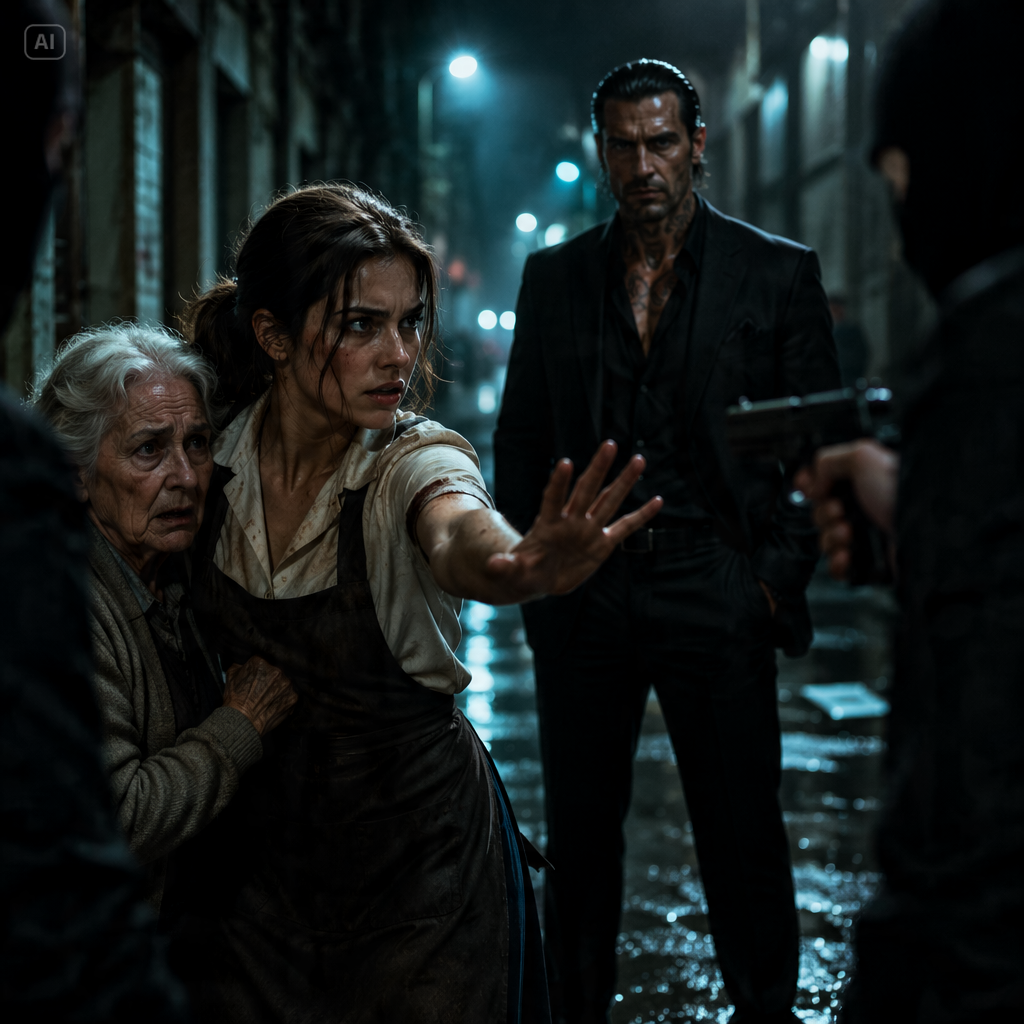
The corridor felt longer than it should have.
Not physically—nothing had changed about its length—but something about the space made each step feel like it was taking me further away from where I was supposed to be.
Or closer to something I wasn’t ready for.
Behind me, K-17’s footsteps echoed again.
Closer now.
“Emma!” he called.
His voice sounded strained, like the corridor itself was interfering with it.
I turned my head slightly but didn’t stop walking.
“I’m right here,” I said.
But even I could hear the hesitation in my own voice.
That was new.
The corridor ended in a junction.
Three directions.
Left: brighter light, sterile white.
Right: dimmer, warmer tones—almost like a public space pretending to be normal.
Forward: a sealed door with no markings.
My body wanted to choose forward.
My instincts—whatever they were becoming—wanted right.
Left felt wrong in a way I couldn’t explain.
I chose right.
The moment I stepped into it, the environment shifted.
Not dramatically.
Subtly.
But unmistakably.
The corridor widened into what looked like a lounge area.
Too clean to be casual. Too empty to be real.
A row of chairs.
A table.
A water dispenser no one had touched.
It looked like a waiting room designed by someone who had never seen waiting people.
And then I saw it.
On the far wall.
A screen.
It wasn’t on.
But it was displaying an image anyway.
Static at first.
Then clarity.
My breath stopped.
It was me.
Not a photo I recognized.
Not a memory.
A still image captured from above.
Hawthorne Alley.
Me kneeling beside K-17.
The angle was impossible for a street camera.
Too precise.
Too close.
Too intentional.
My knees went weak for a second.
“No…” I whispered.
Behind me, K-17 finally caught up.
He stopped the moment he saw the screen.
And went completely still.
That silence was worse than anything he had said before.
“What is that?” I asked, though I already knew I didn’t want the answer.
He didn’t respond immediately.
That hesitation again.
Then:
“That’s not current.”
I turned to him sharply.
“What does that mean?”
He stepped closer to the screen.
His expression tightened slightly.
“That image shouldn’t exist in this layer.”
“Layer,” I repeated. “Stop saying words like this is normal.”
He didn’t look at me.
Instead, he studied the image like it was a wound.
“They’re pulling archival prediction data,” he said quietly.
“Prediction?” I snapped. “You’re predicting me now?”
“No,” he said. “They’re matching you.”
My throat tightened.
“Matching me to what?”
He didn’t answer.
Instead, the screen flickered.
Once.
Then changed.
The image updated.
My stomach dropped.
It wasn’t just Hawthorne Alley anymore.
It was multiple scenes.
Me at Monroe’s Diner.
Me walking home.
Me standing at a bus stop.
But something was wrong.
The timestamps.
They didn’t follow time.
They followed… probability.
Like each version of me was a different outcome.
A different path.
A different “me” that could have existed.
My voice came out thin.
“What am I looking at?”
K-17 finally spoke.
“Possible states.”
I stared at him.
“That’s not a real thing.”
“It is here,” he said again.
The same phrase.
Always the same phrase.
The screen flickered again.
And then it stopped on a single image.
A close-up.
My face.
But not the version I knew.
My expression was different.
Calmer.
Colder.
Like someone who had already accepted something I hadn’t lived through yet.
Underneath it, a label appeared:
ANCHOR VECTOR – CONFIRMED COMPATIBILITY
My stomach twisted violently.
“I don’t understand any of this,” I whispered.
K-17 stepped closer to me.
“This is why they’re cautious,” he said.
“Cautious?” I laughed weakly. “They’re detaining me like a threat.”
“They’re not detaining you,” he corrected.
A pause.
“They’re stabilizing around you.”
That sentence made no sense and too much sense at the same time.
I stepped back.
“I want out,” I said again, but it sounded less like a demand now.
More like instinct.
K-17 looked at me for a long moment.
Then said:
“You already are out.”
Before I could respond, a voice came from behind us.
“I see you found it.”
The woman.
No name.
Same calm posture.
But now something about her felt different.
Less authority.
More containment.
Like she was following rules she didn’t fully trust anymore.
She walked into the room and looked at the screen.
Then at me.
“You’re reacting better than expected,” she said.
“Is that supposed to make me feel better?” I asked.
“No,” she replied honestly. “It’s information.”
That word again.
Information instead of emotion.
Data instead of experience.
I clenched my fists.
“What is that file?” I demanded.
She didn’t answer immediately.
Instead, she tapped a small device in her hand.
The screen shifted again.
Now showing a classification header.
SUBJECT INTERFACE RECORD – EMMA CARTER
My name again.
But this time it wasn’t just a label.
It was attached to something else.
A diagram.
A structure.
Lines extending outward from a central point labeled me.
Connecting to places.
Events.
People.
Including K-17.
My breathing became shallow.
“I didn’t agree to any of this,” I said.
“No,” she agreed. “You didn’t.”
K-17’s voice dropped slightly.
“This wasn’t consent-based.”
The woman looked at him briefly.
“Nothing here is.”
That was the first time he didn’t immediately respond.
Because it was true.
I pointed at the screen.
“So what is that supposed to mean? That I’m some kind of… hub?”
The woman hesitated.
Then corrected me carefully.
“Anchor.”
The word hit harder than I expected.
“Anchor for what?”
Silence.
Even K-17 didn’t answer this time.
The screen flickered again.
And for a brief moment, I saw something new.
Not data.
Not classification.
A recording.
Hawthorne Alley.
But different.
In this version, I wasn’t kneeling beside K-17.
I was standing.
And he wasn’t injured.
He was looking at me like he already knew me.
Like this wasn’t the first time.
My breath stopped.
“That didn’t happen,” I said quickly.
K-17 stared at the image.
“Not to you,” he said quietly.
The woman stepped forward and closed the feed.
The screen went dark instantly.
The room felt heavier without it.
She turned to me.
“You are not the first instance of this anomaly,” she said.
My voice cracked slightly.
“Instance?”
K-17 looked away.
That was the answer.
My stomach dropped fully now.
“You’re telling me there have been… others?”
The woman nodded once.
“Variations.”
My hands were shaking now.
“I’m not a variation,” I said. “I’m me.”
For the first time, something like discomfort crossed her expression.
“Yes,” she said quietly. “That’s what makes this unstable.”
A distant alarm tone echoed somewhere beyond the room.
Not loud.
Not urgent.
But present.
The kind of sound that meant something had already begun.
K-17 stepped slightly in front of me again.
But this time, it didn’t feel like protection.
It felt like alignment.
The woman looked between us.
Then said something I wasn’t ready for.
“She’s resonating more than expected.”
K-17’s voice dropped.
“That wasn’t supposed to happen this fast.”
My breath caught.
“What wasn’t?”
No one answered.
Because the lights in the room flickered again.
And this time—
they didn’t return to normal.
And somewhere deep within Blackridge, systems that had been dormant for years began to register a pattern they had not seen since the last failed stabilization cycle.
May you like



A new anchor was forming.
And it was waking the city with it.







