Chapter 19 – The Observation Layer Opens

Nothing changed immediately.
That was the most unsettling part.
No alarms. No collapse. No dramatic system failure like something in the building had finally snapped.
Instead, Blackridge simply… watched me.
Quietly.
Continuously.
Like I had been placed under a kind of attention that didn’t need to announce itself anymore.
The room stayed still.
The three versions of K-17 were still present, but something about them had shifted.
Not merging.
Not diverging further.
Just less certain of their own boundaries.
Left K-17 glanced at the ceiling first.
Right K-17 noticed the floor-level reflections.
The third K-17 was the only one who kept looking at me.
Like he already knew what was coming next.
The technician spoke softly.
“Observation layer is stabilizing around Subject Carter.”
I frowned.
“That sounds like a bad thing,” I said.
No one answered immediately.
Then the system did.
Not a voice this time.
A reconfiguration of space itself.
The walls of the room dimmed—not physically—but perceptually, as if detail was being stripped away from everything that wasn’t directly relevant to me.
Then the air behind me shifted.
I turned.
And saw it.
A panel.
Not installed.
Not built.
Revealed.
Like it had always existed but was only now allowed to be noticed.
It wasn’t a screen in the normal sense.
It was more like a layered interface embedded into reality itself.
And it was labeled:
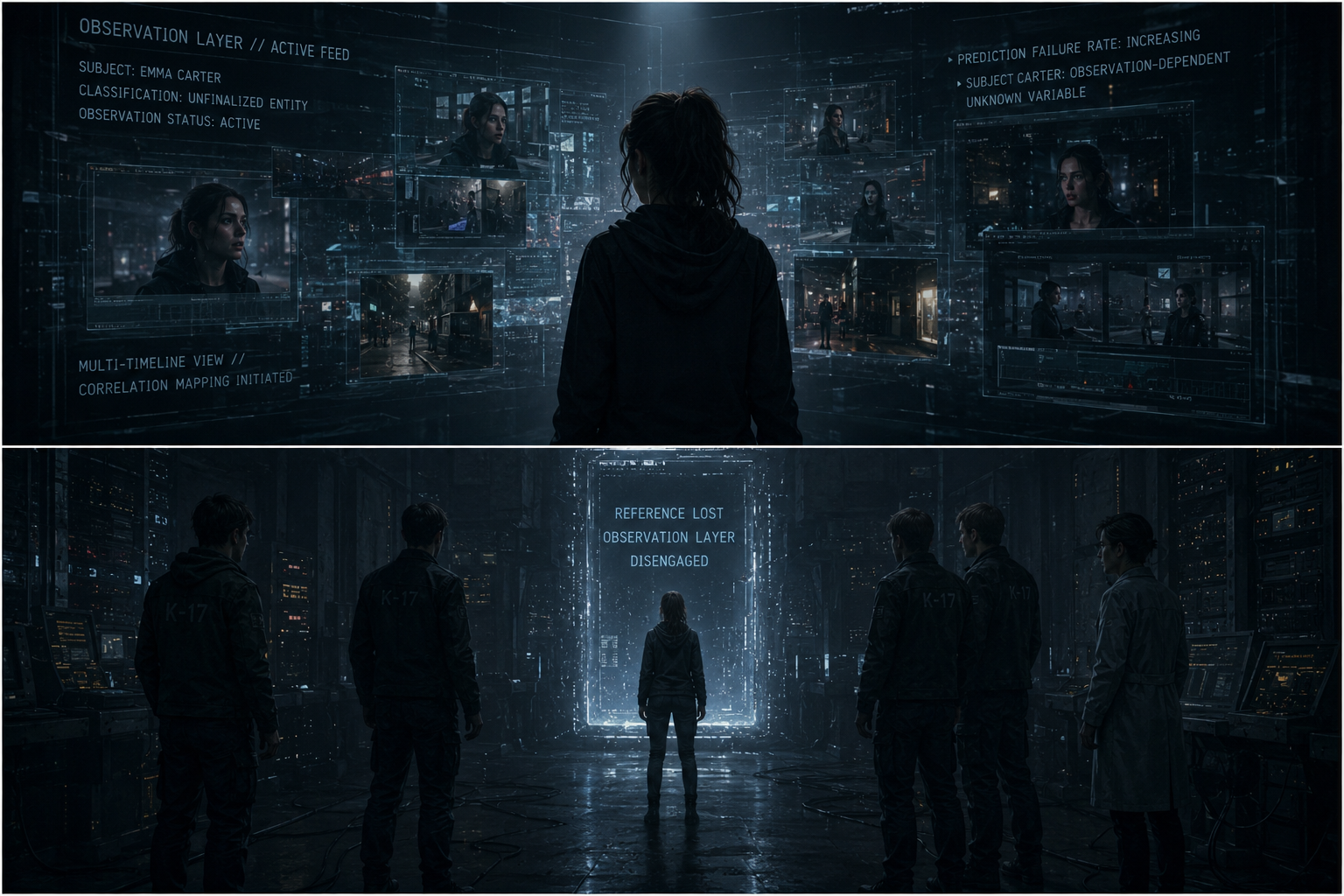
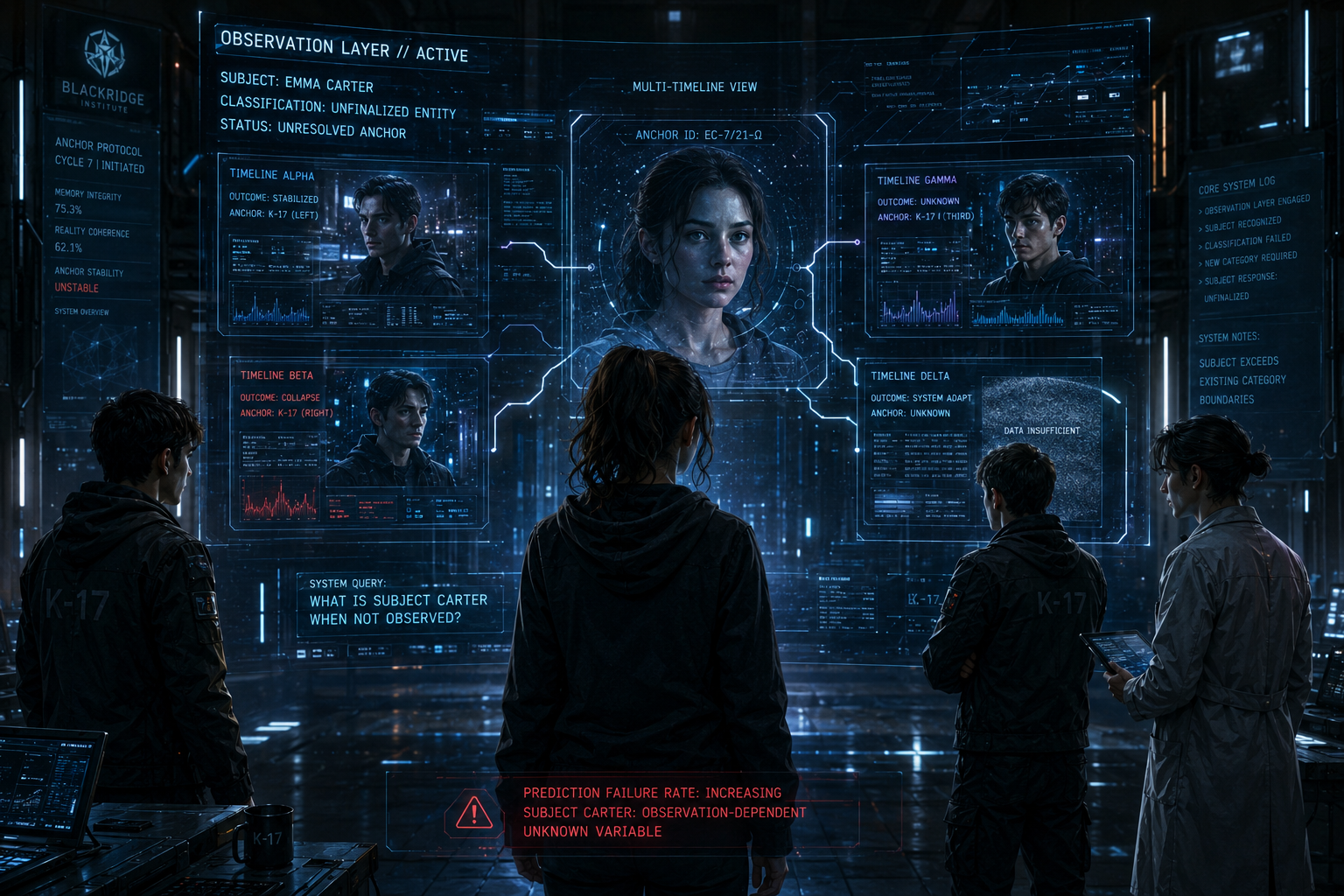
OBSERVATION LAYER // ACTIVE FEED
My stomach tightened.
“That wasn’t there before,” I whispered.
The third K-17 nodded slightly.
“It was,” he said quietly.
“You just weren’t part of it yet.”
I stared at him.
“What does that mean?”
Left K-17 stepped forward.
“It means the system is no longer simulating your behavior locally,” he said.
Right K-17 added:
“It is tracking you as a persistent variable across operational layers.”
I felt my throat tighten.
“So I’m being monitored,” I said slowly.
The technician shook their head.
“Not monitored,” they said quietly.
A pause.
“Observed structurally.”
That didn’t make it better.
The observation layer flickered.
And then—
I saw myself.
Not reflected.
Not replayed.
Displayed.
Standing in multiple environments at once.
Hawthorne Alley.
The diner.
The transit corridor.
The control room.
All layered together in a shifting composite that refused to settle into a single timeline.
My breath caught.
“This isn’t real,” I whispered.
The system responded instantly.
REALITY CONSISTENCY: UNAVAILABLE
Silence.
Then:
SUBJECT BEHAVIOR CANNOT BE SIMULATED LOCALLY
I took a step back.
“What does that even mean?” I asked.
No immediate answer.
Then the third K-17 spoke quietly.
“It means you break prediction models,” he said.
A pause.
“So now they’re watching instead of predicting.”
That hit differently.
Left K-17 looked uneasy now.
“That is a significant escalation,” he said.
Right K-17 agreed.
“It implies long-term adaptive learning behavior.”
I turned toward them sharply.
“So I’m a subject in a learning experiment now?”
The technician hesitated.
Then said:
“Not an experiment.”
A pause.
“A recalibration source.”
My stomach tightened.
“That sounds worse,” I said.
No one disagreed.
The observation layer shifted again.
This time, I saw something new.
Not just me.
But versions of K-17.
All three of them.
But not aligned.
Different interactions.
Different outcomes.
Different ways of standing beside me—or not standing beside me at all.
My voice dropped.
“You’re watching him too,” I said quietly.
The third K-17 nodded once.
“Yes.”
Left K-17 looked away slightly.
Right K-17 remained still.
The system continued.
MULTI-AGENT DIVERGENCE DETECTED
A pause.
Then:
CORRELATION MAPPING INITIATED
The room dimmed further.
Now the observation layer wasn’t just showing me.
It was showing relationships.
Between me and him.
Between him and him.
Between me and every possible version of this interaction that had ever been attempted.
I felt something cold settle in my chest.
“This is getting too big,” I whispered.
The third K-17 looked at me.
Quietly:
“It was always this big,” he said.
“You were just the only variable it couldn’t compress.”
Silence.
Then the system shifted again.
And something unexpected happened.
The observation layer stopped showing variations of the past.
And started projecting future divergences.
My breath caught.
“No,” I said immediately.
But it was too late.
I saw myself in the control room.
Walking away.
I saw myself refusing.
I saw myself collapsing.
I saw myself standing alone in Blackridge as the system stabilized without me.
I saw myself becoming something else entirely—something that didn’t resemble “Emma Carter” in any recognizable way.
My hands shook slightly.
“I don’t want to see that,” I whispered.
No one answered.
Because none of them controlled it anymore.
The system did.
The third K-17 stepped slightly closer to me.
“Don’t anchor emotionally to projections,” he said quietly.
I laughed once.
“It’s projecting me.”
A pause.
He nodded.
“Yes.”
Left K-17 looked disturbed now.
“This level of forecasting should not be visible to the subject,” he said.
Right K-17 added:
“It indicates recursive self-model exposure.”
I shook my head.
“I don’t understand any of this anymore,” I said.
The system responded.
UNDERSTANDING IS NOT REQUIRED FOR OBSERVATION
My breath hitched.
“That’s comforting,” I muttered.
The observation layer flickered again.
And then something changed.
The projected futures paused.
All of them.
Like something had interrupted the system’s confidence.
Then—
a new line appeared across the interface.
Not prediction.
Not variation.
A question.
WHAT IS SUBJECT CARTER WHEN NOT OBSERVED?
Silence.
Absolute.
Even the K-17s didn’t respond.
Because for the first time—
the system wasn’t asking what I would do.
It was asking what I was without being watched.
I stepped forward slowly.
My reflection—across all timelines—moved with me.
“Am I supposed to answer that?” I whispered.
The system did not respond.
But something about the observation layer shifted again.
Less control.
More uncertainty.
Like it had asked something it didn’t know how to process.
The third K-17 spoke quietly.
“Careful,” he said.
“This is where systems begin to change their assumptions.”
I looked at him.
“What happens if it can’t assume anymore?”
He didn’t answer immediately.
Then:
“Then it starts learning in real time.”
The room dimmed slightly again.
The observation layer expanded.
No longer just showing me.
Now recording the fact that I was aware of being observed.
A loop forming.
Not stable.
Not resolved.
But alive.
And somewhere deep within Blackridge, the system logged its first true uncertainty about its primary anchor:
PREDICTION FAILURE RATE: INCREASING
SUBJECT CARTER: OBSERVATION-DEPENDENT UNKNOWN VARIABLE
And for the first time since the system was built—
May you like



it stopped trying to decide what I was.
And started trying to understand why I didn’t stay the same when it looked away.