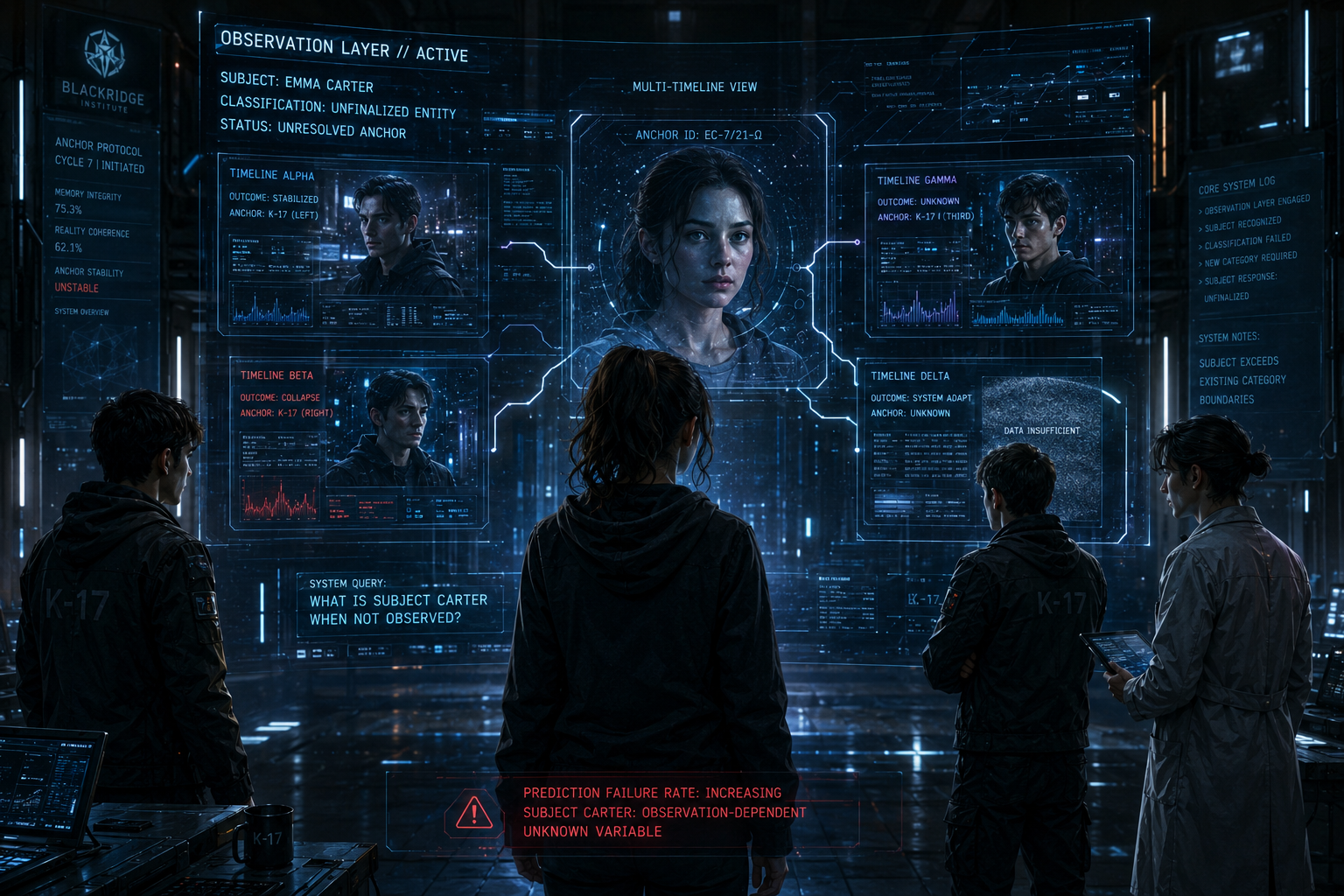
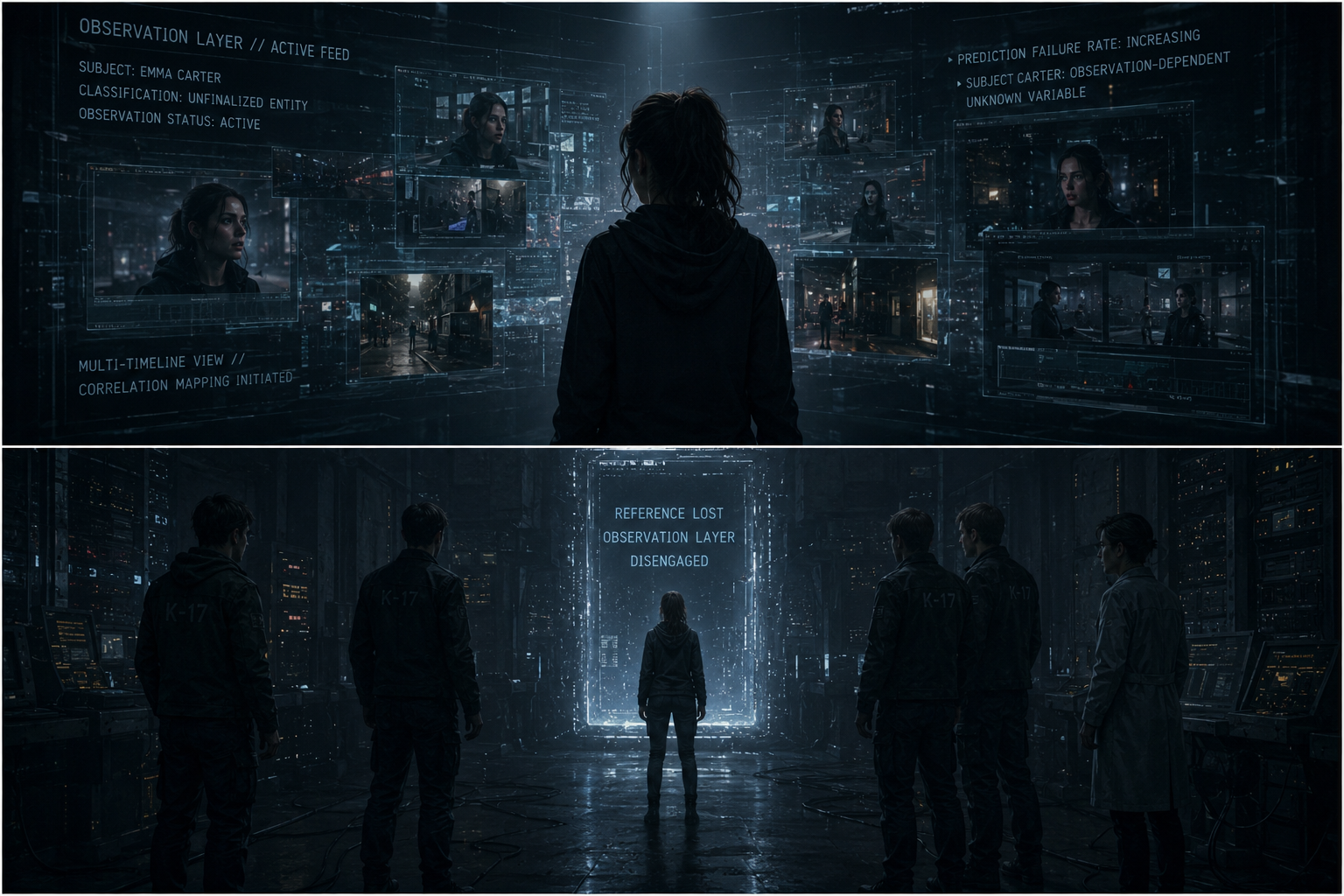
Chapter 17 – The Third Outcome

The room didn’t settle after my refusal.
It reconfigured.
That was becoming a pattern I hated: nothing here ever simply stopped. It adapted like disagreement was just another input it had been trained to process.
The two versions of K-17 were still there—but the edges of both were beginning to blur.
Not disappearing.
Not merging.
Just… becoming uncertain.
Like the system itself was struggling to decide what “K-17” even meant anymore.
The technician took a step back.
“No recorded precedent for tertiary operator emergence,” they muttered.
I didn’t look at them.
I couldn’t.
Because something else had shifted in the room.
A pressure I hadn’t felt before.
Not split.
Not dual.
Directional.
Like something was approaching from outside the structure we had been arguing inside.
Left K-17 noticed first.
His posture changed slightly.
“Do you feel that?” he asked quietly.
Right K-17 answered immediately.
“Yes.”
They said it at the same time—but not in sync.
That alone told me something had already changed.
I turned slowly.
“What is it?” I asked.
Neither answered.
Instead, the lights in the room dimmed again.
But this time, it wasn’t flicker or instability.
It was reallocation.
Like attention was being withdrawn from everything except one point in space.
Directly behind me.
I felt my stomach tighten.
“No,” I whispered.
I didn’t want to turn around.
But I did.
At first, there was nothing.
Just empty space.
Then the air folded slightly.
Not violently.
Carefully.
Like something stepping through a membrane it had used before.
And then—
a third presence entered the room.
He didn’t look like the other two K-17s.
Not exactly.
Not even slightly.
He was… older.
Not in age.
In structure.
Like time had layered itself differently over him.
His expression wasn’t confused like Left K-17.
Or precise like Right K-17.
It was… aware.
Fully aware in a way that felt almost unnatural.
He looked at me immediately.
Not the others.
Me.
And he smiled faintly.
Like he already knew how this moment ended.
My voice barely worked.
“Who are you?” I asked.
He tilted his head slightly.
“That depends,” he said quietly.
His voice was the same.
But the tone carried weight neither of the others had.
Left K-17 stepped forward sharply.
“This configuration is not authorized,” he said.
Right K-17 followed instantly.
“Identify your origin layer.”
The third K-17 didn’t even glance at them.
Instead, he kept his eyes on me.
“I’m the version that stopped asking which one of me was correct,” he said.
Silence dropped instantly.
Not emotional.
Structural.
Like the system itself had recognized the sentence and paused to evaluate it.
The technician whispered something about “impossible continuity drift.”
No one responded.
I took a cautious step forward.
“What does that mean?” I asked.
The third K-17 looked at me for a long moment.
Then said:
“It means I stopped splitting.”
My stomach tightened.
“That’s not how this works,” I said.
He nodded slightly.
“It is if you refuse the framework that requires it.”
Left K-17 stepped forward.
“You cannot exist without collapse resolution,” he said firmly.
Right K-17 added:
“Your presence violates system integrity rules.”
The third K-17 finally looked at them.
Not dismissively.
Not angrily.
Just… understanding.
“I know,” he said.
A pause.
“That’s why I’m not supposed to be here.”
The room flickered again.
But this time it didn’t stabilize quickly.
It hesitated.
Like even the environment was unsure how to categorize him.
I felt my throat tighten.
“Are you real?” I asked quietly.
He looked at me.
A softer expression now.
“Yes,” he said.
A pause.
“But not in the way you’re used to verifying it.”
That answer made my skin go cold.
Left K-17 stepped closer.
“This is a corrupted convergence state,” he said.
Right K-17 disagreed immediately.
“No,” he said. “This is a resolved contradiction.”
The third K-17 nodded slightly.
“Closer,” he said.
I looked between all three of them now.
My mind struggled to hold the structure.
Three versions.
Three interpretations.
Three incompatible truths occupying the same space.
“This is impossible,” I whispered.
The third K-17 shook his head.
“No,” he said quietly.
“You just haven’t experienced enough outcomes yet.”
That sentence hit differently.
Like it wasn’t about logic.
It was about scale.
The technician suddenly stepped back.
“Containment boundaries collapsing,” they said urgently.
Left K-17 turned sharply.
“This cannot persist,” he said.
Right K-17 added:
“It will cascade instability across all anchor layers.”
The third K-17 finally took a step forward.
And as he moved, the room reacted.
Not violently.
Not defensively.
But reverently.
Like something the system didn’t fully understand but could no longer ignore.
He stopped a few feet from me.
And looked directly into my eyes.
“I’ve seen you stabilize,” he said quietly.
My breath caught.
“In how many versions?” I asked.
He smiled faintly.
“Enough to stop counting.”
Silence.
Then he added:
“And enough to know it never lasts the same way twice.”
My chest tightened.
“What happens to me in those versions?” I asked.
He hesitated.
For the first time, something like sadness crossed his expression.
Then he said:
“In most of them, you become the system’s compromise.”
A pause.
“In a few, you become its correction.”
I swallowed.
“And in this one?”
He looked at me for a long moment.
Then said:
“You’re still deciding what category you refuse to belong to.”
The room dimmed slightly.
Like that sentence had weight.
Left K-17 stepped forward urgently.
“You are introducing unauthorized interpretive instability,” he said.
Right K-17 agreed.
“Terminate self-reference loop immediately.”
The third K-17 finally turned toward them.
Not hostile.
Just certain.
“I already did,” he said.
A pause.
“I just didn’t tell the system it needed permission.”
Silence.
Heavy.
Immediate.
Then the room reacted.
Not alarms.
Not warnings.
But absence of certainty.
The space around us seemed to lose coherence for a moment.
Like reality was unsure how to continue processing three contradictory operator states at once.
I stepped back slightly.
“This is getting worse,” I whispered.
The third K-17 looked at me.
“No,” he said softly.
“This is getting honest.”
Left K-17 looked at me sharply.
“Do not engage him,” he said.
Right K-17 added:
“He is not a stable reference.”
The third K-17 nodded slightly.
“I agree.”
A pause.
“But neither are you anymore.”
That landed harder than anything else.
Because neither of the other K-17s denied it.
The room hummed again.
Lower now.
Slower.
Like a system preparing to rewrite something fundamental.
I felt my voice shake slightly.
“What do I do?” I asked.
All three of them looked at me now.
For the first time.
Together.
And the third K-17 said quietly:
“You stop letting the system choose how many of you are allowed to exist.”
And deep within Blackridge’s core structure, a new classification emerged without authorization:
MULTI-ANCHOR RESOLUTION FAILURE: NON-BINARY ENTITY EMERGENCE
May you like



And for the first time, the system did not attempt to correct the anomaly.
It began to observe it.