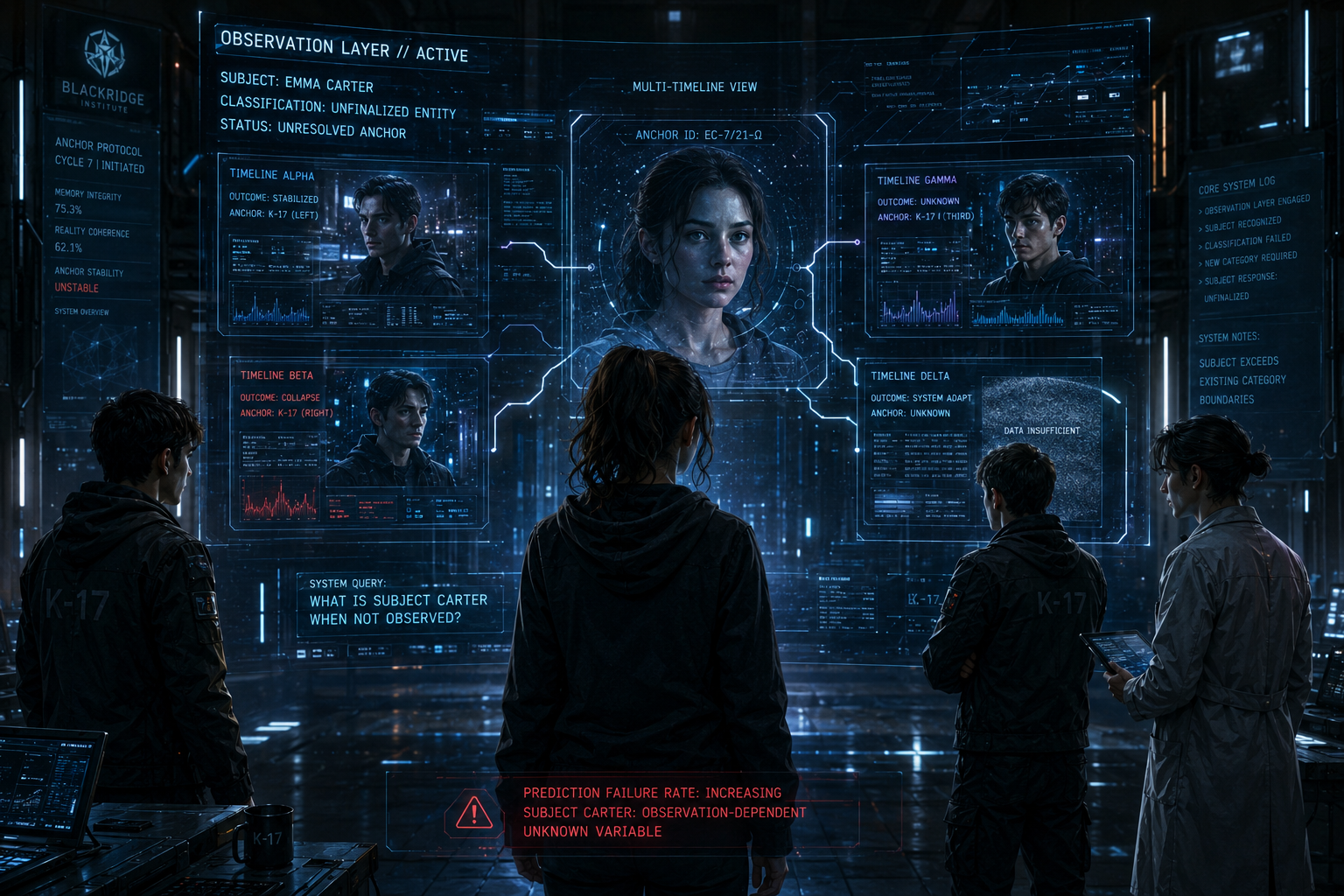
Chapter 20 – When the System Looks Away

The change didn’t announce itself.
It withdrew.
That was the only way I can describe it—like something vast had been watching so closely that I hadn’t realized its attention was a form of pressure until it stopped.
And suddenly, I could breathe differently.
The observation layer didn’t vanish.
It faded from priority.
The room returned first.
Walls regained their ordinary texture.
Light stopped feeling calculated.
Even the three versions of K-17 seemed less sharply defined, like the system wasn’t actively maintaining their distinctions anymore.
Left K-17 noticed it first.
“It’s reducing observational fidelity,” he said quietly.
Right K-17 frowned slightly.
“That’s not standard behavior.”
The third K-17 didn’t speak immediately.
But his expression changed.
Not alarm.
Recognition.
I looked between them.
“What’s happening?” I asked.
No immediate answer.
Then the technician spoke, unusually tense.
“Observation layer disengagement detected.”
I blinked.
“That sounds like a good thing,” I said cautiously.
No one agreed.
The system responded instead.
But not in the way it had before.
There was no overlay.
No projection.
No structured voice.
Just absence.
A gap where response should have been.
I felt it immediately.
A subtle wrongness in the environment.
Like a heartbeat that had skipped but refused to resume.
Left K-17 took a slow step forward.
“This has never happened during active anchor observation,” he said quietly.
Right K-17 added:
“It should not be capable of voluntary disengagement.”
The third K-17 finally spoke.
“It isn’t voluntary,” he said.
I turned toward him.
“What does that mean?”
He looked at me for a long moment.
Then said:
“It means it lost its ability to sustain attention on you.”
Silence.
That didn’t feel like relief.
It felt like abandonment by something that had defined reality too tightly to ever be absent.
I swallowed.
“So what now?” I asked.
No immediate answer.
The room felt… lighter.
But not safer.
Like gravity had been reduced without warning.
The technician checked their console.
“The system is not responding to anchor presence queries,” they said.
Left K-17 stiffened.
“That’s impossible.”
Right K-17 corrected:
“It is unprecedented, not impossible.”
The third K-17 stepped slightly forward.
“This is the first true observational silence state,” he said quietly.
I frowned.
“That sounds like something you should be more worried about.”
He nodded slightly.
“I am.”
That was the most honest thing anyone had said in a while.
I looked around.
Without the observation layer active, the room felt… empty in a different way.
Not less real.
Less interpreted.
Like the system had been constantly telling reality what it meant, and now reality was unsure of its own definition.
I exhaled slowly.
“I don’t feel watched anymore,” I said.
Right K-17 looked at me sharply.
“That is the danger,” he said.
Left K-17 nodded.
“Unobserved anchor states have historically preceded system instability events.”
I frowned.
“That sounds like I’m the problem again.”
The third K-17 shook his head slightly.
“No,” he said.
“This time, you are not being processed.”
A pause.
“You are being ignored.”
That landed differently.
My chest tightened slightly.
“So I matter when I’m watched,” I said slowly, “and I destabilize things when I’m not?”
No one answered immediately.
Because it was too close to the truth.
The technician suddenly spoke.
“External system coherence dropping across all layers,” they said quickly.
Left K-17 turned toward them.
“Define drop rate.”
The technician hesitated.
“Accelerating.”
Right K-17’s posture tightened.
“That’s not disengagement,” he said quietly.
The third K-17 looked up slightly.
“It’s withdrawal,” he said.
I felt a chill.
“Withdrawal from what?” I asked.
No answer.
Then—
the room flickered.
Not like before.
Not layered.
Not recursive.
Just a simple interruption in continuity.
Like something had blinked.
And in that blink—
the system was gone.
No voices.
No projections.
No observation layer.
No predictive overlays.
Just silence.
Absolute.
Immediate.
K-17—both versions and the third—stilled instantly.
Even the technician froze.
I looked around slowly.
“This is worse, isn’t it?” I asked quietly.
The third K-17 nodded once.
“Yes.”
Left K-17 spoke softly.
“There is no monitoring state active.”
Right K-17 added:
“Which means no stabilization feedback loop.”
I frowned.
“I don’t understand.”
The third K-17 looked at me directly.
“It means,” he said quietly, “the system no longer knows you are here.”
Silence.
That sentence hit harder than anything before it.
Not because it sounded bad.
Because it sounded final.
I took a slow step back.
“So I’m free?” I asked quietly.
No one answered immediately.
Then Left K-17 said:
“No.”
Right K-17 followed:
“You are unreferenced.”
The technician whispered:
“That’s not supposed to be survivable.”
I felt my throat tighten.
“What happens to unreferenced things?” I asked.
The third K-17 looked at me for a long moment.
Then said:
“They become inconsistencies the system eventually corrects.”
Silence.
Heavy.
Immediate.
I stepped back again.
“So I disappear,” I said quietly.
No one corrected me.
The room flickered again.
But this time, there was no system response.
Just structural instability without governance.
Like reality itself was no longer being maintained in this region.
Left K-17 stepped forward quickly.
“We need to restore observation linkage,” he said.
Right K-17 shook his head.
“We cannot re-engage a system that has fully disengaged.”
The third K-17 looked at me.
Calm.
Almost sad.
“This is what she meant,” he said quietly.
I frowned.
“The first anchor?”
He nodded.
“Yes.”
A pause.
“She didn’t fail because she destabilized the system.”
My stomach tightened.
“She failed because the system stopped looking at her.”
Silence.
I swallowed.
“So what do I do?” I asked quietly.
The three of them looked at me.
For once, they were aligned.
Left K-17 spoke first.
“You re-establish reference.”
Right K-17 followed.
“You force recognition.”
The third K-17 added:
“Or you learn what remains when nothing is watching you at all.”
The room dimmed slightly again.
Not system control.
Just entropy beginning to fill the gap left behind.
And for the first time since Hawthorne Alley—
I realized something terrifying:
May you like



Blackridge wasn’t holding me anymore.
And I didn’t know if I still existed without it noticing.